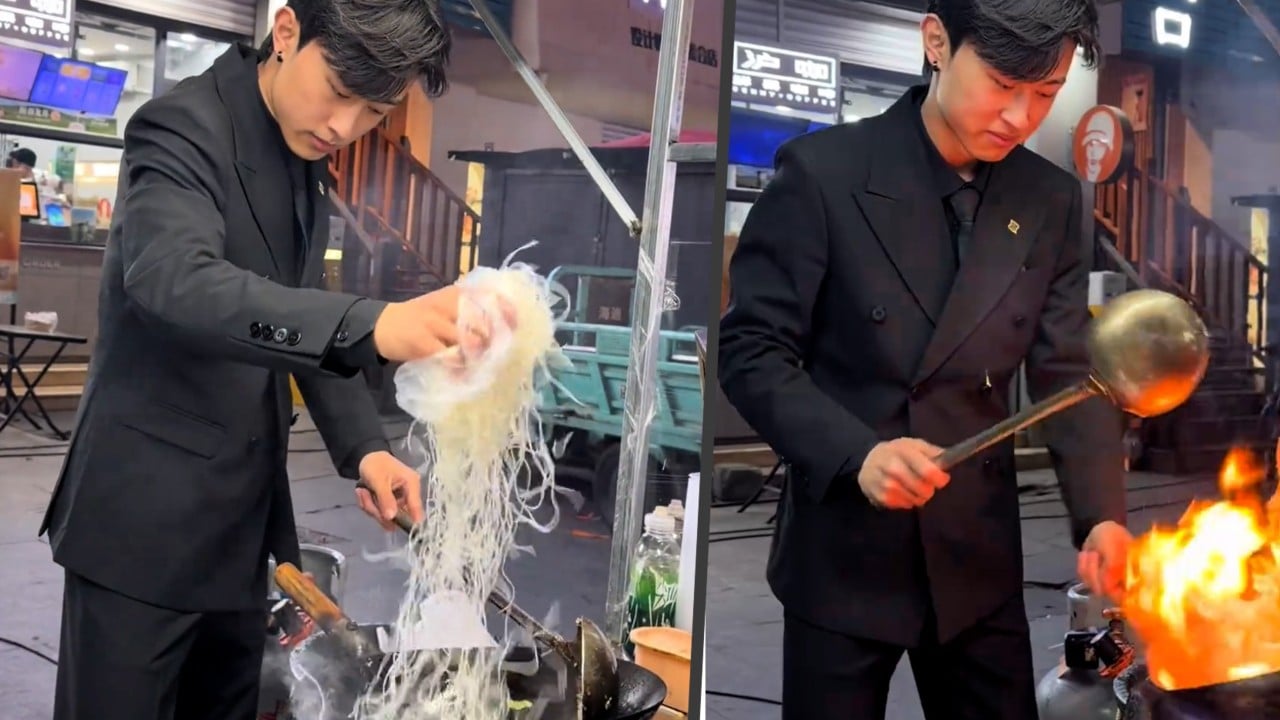
A 19-year-old street food vendor in Yantai, Shandong province, has become an overnight sensation by wearing a tailored two-piece suit, white shirt, and tie while tossing fried rice over a roaring blast furnace. The young man, surnamed Lu, allegedly pulls in a gross monthly turnover of 50,000 yuan ($7,400) by transforming the greasy, exhausting grind of a Chinese night market into a theatrical performance. He winks at cameras, catches raw eggs thrown by his father, and dangles an unlit cigarette from his lip to mimic an anime character.
While onlookers marvel at the apparent easy wealth of the viral creator economy, the reality behind the smoke and mirrors of street food influencer culture is far more unforgiving. Lu’s $7,400 headline figure is a gross revenue metric that masks razor-thin margins, punishing physical labor, and the volatile lifecycle of internet fame. Stripping away the algorithmic glamor reveals the actual economics of modern street hustling and the steep price of keeping a viral business alive.
The Grim Math Behind the Viral Revenue
Internet commentary quickly filled with skepticism regarding Lu's reported 50,000 yuan monthly revenue. Skeptics pointed out that selling individual portions of fried rice for roughly 10 yuan ($1.50) means a vendor must move an astronomical volume of food to hit those numbers.
To clear 50,000 yuan a month at 10 yuan per plate, a stall must sell exactly 5,000 portions monthly. Operating seven days a week, that breaks down to roughly 166 plates every single night. Lu claims his actual volume hits closer to 200 portions on peak evenings.
Mathematically, this is entirely possible, but only under highly optimized operating conditions. Lu operates his stall from 5:00 PM to 11:30 PM, a 6.5-hour window. Producing 200 plates in 390 minutes requires serving a customer every 1.95 minutes, continuously, with zero downtime.
[Total Nightly Window: 390 Minutes]
 ├── Preparation & Setup (Behind the scenes)
 ├── Peak Window: 200 Portions Served
 └── Average Output: 1.95 Minutes Per Plate (Continuous)
Street food veterans know a single vendor cannot achieve this velocity alone. The physical constraints of cooking rice in a single wok dictate that the operation must function like a factory assembly line. Lu’s father works constantly in the background, prepping ingredients, managing cash transactions, packaging orders, and supply-chaining eggs directly into Lu's theatrical arcs.
More importantly, Lu beats the clock by abandoning the single-order method. He routinely fries massive, multi-portion batches simultaneously, portioning them out into individual boxes at the end of a single wok-tossing cycle. Without this batch-processing technique, the viral narrative falls apart under the weight of basic arithmetic.
The Real Margin and the Cost of the Gimmick
Gross revenue is a vanity metric; net profit is reality. Lu openly acknowledges that after deducting the cost of ingredients, fuel, cart maintenance, and market stall fees, his monthly net takeaway drops to 20,000 yuan ($2,960).
A net margin of 40% is standard for street food operations, but it leaves little room for error. Rice, eggs, oil, scallions, and basic proteins are low-cost commodities, but they are highly vulnerable to localized inflation. A sudden spike in wholesale egg or cooking oil prices directly erodes that 20,000 yuan cushion.
| Financial Metric | Monthly Amount (CNY) | Monthly Amount (USD) | Percentage of Total |
|---|---|---|---|
| Gross Turnover | 50,000 | $7,400 | 100% |
| Operating Costs | 30,000 | $4,440 | 60% |
| Net Profit | 20,000 | $2,960 | 40% |
Then there is the cost of the gimmick itself. Cooking street food is notoriously filthy. Vaporized grease, charcoal smoke, and splashing soy sauce ruin clothing within hours. Maintaining a crisp, clean, professional suit while standing over a high-Btu propane burner requires constant dry cleaning or a continuous cycle of cheap, disposable replacement garments.
The physical toll is an unquantified overhead cost. Social media videos highlight the slicked-back hair and the theatrical poses, but they also catch glimpses of severe, raw blisters covering Lu’s hands. Tossing a heavy iron wok filled with three kilograms of rice for six hours straight inflicts severe stress on the wrists, shoulders, and lower back. The suit provides an illusion of upward mobility, but underneath the fabric is the same grueling physical wear that has characterized street vending for centuries.
The Sanji Effect and the Lifecycle of Novelty
Lu’s aesthetic strategy relies heavily on the "Sanji effect," referencing the sharply dressed, cigarette-troweling chef from the globally popular One Piece anime series. This intentional pop-culture crossover transformed a mundane food cart into an experiential destination, driving a hyper-localized form of culinary tourism in Yantai.
[Pop-Culture Aesthetic] + [Street Performance] ➔ [Algorithmic Amplification] ➔ [Foot Traffic]
However, novelty-driven businesses face a systemic structural flaw: curiosity is a non-renewable resource. Customers traveling to the night market to watch a teenager in a suit throw an egg may buy a plate of fried rice once to justify the trip and capture a video for their own social media feeds. They rarely return for a second plate based on the outfit alone.
Lu has recognized this vulnerability, stating that while curiosity draws the initial crowd, flavor is the only mechanism that retains them. But street food flavors are heavily commoditized. There are only so many ways to innovate a 10-yuan plate of fried rice without raising the price point and alienating the core demographic of late-night market consumers.
When the local algorithm shifts and a new viral performer emerges down the street, the casual foot traffic vanishes.
Monetizing the Disruption Before the Fade
Aware of the ticking clock inherent to viral fame, Lu has already initiated the standard monetization playbook for digital-era street vendors by accepting apprentices.
Charging fees to teach others how to replicate a business model is far more scalable than manually frying rice until two in the morning. By shifting from a pure food-service model to an educational and content-driven framework, Lu is attempting to build a franchise or agency model out of a single night-market cart.
The long-term viability of this pivot remains unproven. The value of Lu's apprenticeship program does not rest on a secret fried rice recipe; it rests on his specific visual charisma and his ability to command an algorithm. That is an intangible asset that cannot be easily transferred to an apprentice in a classroom setting.
The Western Suit Fried Rice Brother represents a fascinating convergence of traditional migrant labor and modern platform capitalism. He has successfully optimized a low-margin business through sheer showmanship, but the financial reality remains anchored to the pavement. To maintain the illusion of ease, he must continue to stand in the heat, battling blisters and rising oil costs, one two-minute plate at a time.