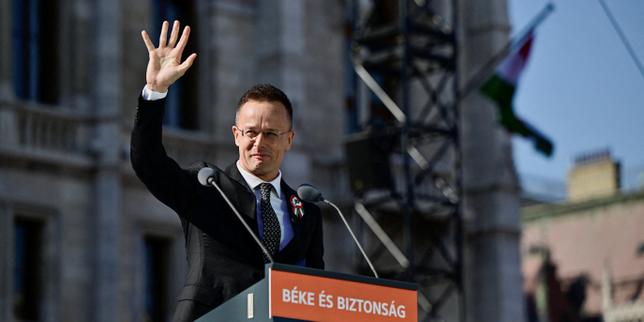
The persistent, high-level diplomatic choreography between Hungarian Foreign Minister Péter Szijjártó and his Russian counterpart, Sergey Lavrov, has moved past the point of simple bilateral cooperation. It is now a structural threat to European Union unity. While the rest of the bloc has spent years tightening sanctions and severing energy ties to isolate the Kremlin, Hungary has doubled down on a "pragmatic" relationship that looks increasingly like a strategic alliance. This is not just about cheap gas or historical stubbornness. It is a calculated challenge to the post-war security architecture of Europe.
Brussels is no longer just annoyed; it is paralyzed. Every handshake in Moscow or St. Petersburg serves as a visual reminder that the EU’s "common" foreign policy is anything but common. Prime Minister Viktor Orbán’s government argues that Hungary is a sovereign nation acting in its own energy and economic interests. However, the frequency of these meetings—occurring at a pace unmatched by any other NATO or EU member—suggests a deeper coordination that effectively provides Russia with a permanent lobbyist inside the Berlaymont.
Energy Dependence as a Political Shield
The bedrock of the Budapest-Moscow relationship is energy. Hungary remains one of the few EU nations still heavily reliant on Russian pipeline gas and oil, having secured exemptions from various sanction packages. This reliance is often framed by the Hungarian government as an inescapable geographical reality. But geography is only half the story. The other half is a deliberate choice to deepen that dependence through the Paks II nuclear power plant project, which is financed and built by Russia’s Rosatom.
By tying its long-term energy future to Russian state corporations, Hungary has created a situation where its national security is inextricably linked to the stability of the Kremlin. This gives Moscow immense leverage. When Szijjártó meets Lavrov, he isn't just discussing transit fees. He is signaling to the world that Russia still has a seat at the European table. This relationship functions as a pressure valve for Vladimir Putin, proving that the Western wall of isolation has a significant, persistent crack.
The Strategy of the Lone Dissenter
Hungary has mastered the art of the tactical veto. By threatening to block aid packages to Ukraine or additional sanctions against Russian entities, Budapest forces the other 26 member states into a cycle of constant concessions. This "blackmail diplomacy" as some critics call it, is highly effective. It allows Orbán to extract financial benefits from Brussels—such as the release of frozen cohesion funds—while simultaneously maintaining his "peace mission" persona for a domestic audience.
The internal logic of the Hungarian administration is that the West is in decline and the future belongs to a multipolar world where ties to the East are essential. This worldview directly contradicts the fundamental principles of the European Union, which views the Russian invasion of Ukraine as an existential threat to the continent. The result is a profound ideological schism. Hungary is not just a member with a different opinion; it is a member operating from a different geopolitical playbook.
Security Implications for the Schengen Area
The friction reached a new peak recently with Hungary’s decision to ease visa requirements for Russian and Belarusian citizens through the "National Card" scheme. From a security standpoint, this is a nightmare for European intelligence agencies. The Schengen Area relies on the principle of mutual trust; if one gateway is left ajar, the entire house is vulnerable.
By allowing easier access for Russian "specialists," Hungary is effectively bypassing the collective efforts of the EU to limit the movement of Russian intelligence assets. This isn't a hypothetical risk. European security services have already documented a surge in Russian-led sabotage and espionage activities across the continent. When Budapest opens the door wider, it does so knowing full well that its neighbors will have to bear the cost of increased surveillance and border checks.
The Limits of European Patience
How long can the EU tolerate a member state that actively undermines its core security interests? The tools available to Brussels are limited. Article 7, the so-called "nuclear option" that could strip a member of its voting rights, requires a level of consensus that is difficult to achieve. Even without Poland’s previous unwavering support, Hungary has found new allies in Slovakia under Robert Fico, creating a small but potent bloc of skeptics within the Council.
The frustration in Brussels is palpable. Diplomatic sources often describe meetings where Szijjártó is met with "stony silence" or "open hostility" from his peers. Yet, silence does not stop the flow of Russian gas, nor does it prevent the next high-profile meeting in Moscow. The EU is finding that its legal framework was designed for a club of like-minded democracies, not for a member state that views the bloc's primary adversary as a strategic partner.
Financial Leverage and the Rule of Law
The primary tool left for the EU is the wallet. The "rule of law" mechanism, which links EU funding to democratic standards, has been used to freeze billions of euros destined for Hungary. While this has caused economic pain in Budapest, it hasn't fundamentally altered the government’s foreign policy. If anything, it has pushed Hungary closer to non-Western lenders, including China, further diversifying its "Eastern Opening" strategy.
This financial tug-of-war has created a stalemate. Hungary needs the EU's market and its development funds, but it refuses to adopt the EU's geopolitical stance. This tension is unsustainable in the long run. If the EU cannot enforce a minimum level of solidarity on matters of war and peace, the very concept of a "Union" begins to dissolve.
The Role of Domestic Narratives
To understand why this strategy works for Orbán, one must look at the Hungarian domestic media landscape. The government controls a vast network of media outlets that frame every meeting with Lavrov as a victory for "Hungarian interests" and "peace." In this narrative, the EU and NATO are "pro-war," while Hungary is the only country brave enough to talk to all sides. It is a powerful message that resonates with a population wary of being dragged into a larger conflict.
This messaging creates a feedback loop. The more Brussels criticizes Hungary, the more the Hungarian government can play the victim of "liberal imperialism." This strengthens Orbán’s domestic position, which in turn gives him the political capital to continue his outreach to Moscow. It is a self-perpetuating cycle that leaves European diplomats with very few good options.
A Precedent for Future Fragmentation
The danger of the Hungarian model is that it provides a blueprint for other member states. If a country can stay in the EU, receive its benefits, and still maintain a "special relationship" with a hostile power, others may be tempted to follow. We are seeing early signs of this in the Balkans and parts of Central Europe, where populism and Russian influence often go hand-in-hand.
The Moscow-Budapest axis is not a temporary glitch in European diplomacy. It is a fundamental challenge to the idea that Europe can act as a single, coherent geopolitical actor. As long as Hungary can play both sides, the EU’s ability to project power and maintain a unified front against aggression will be compromised. The "scandal" in Brussels is not just about a few meetings; it is about the realization that the internal cohesion of the European project is being dismantled from within, one handshake at a time.
The most pressing question remains unanswered: at what point does a member state’s "sovereign right" to conduct foreign policy become a breach of its treaty obligations to "refrain from any action which is contrary to the interests of the Union?" If the EU cannot define that line, it has already lost the argument.
Watch the next European Council summit. Pay attention not to the official communiqués, but to the timing of the next flight from Budapest to Moscow. That is where the real policy is being made.