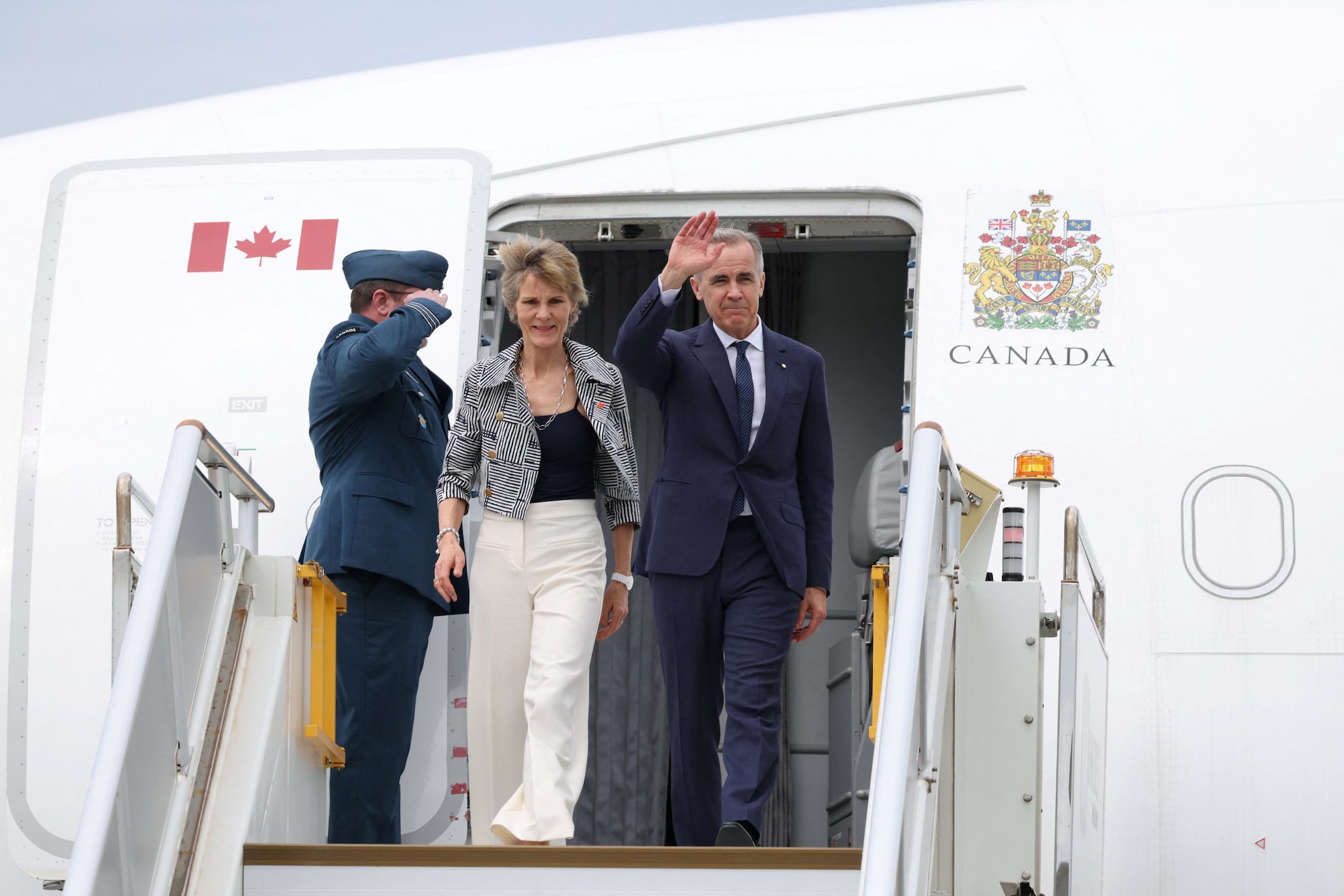
The arrival of Mark Carney in Australia signals a tactical shift in the global capital allocation strategy of "middle powers"—nations that lack the sheer demographic or military scale of superpowers but possess the financial liquidity and institutional stability to dictate the terms of the energy transition. This meeting is not a diplomatic formality; it is a structural alignment of two of the world's most significant sovereign balance sheets. Canada and Australia together represent a unique concentration of natural resource wealth, sophisticated pension capital, and strategic geography. Their coordination acts as a hedge against the bipolarity of the US-China trade war, creating a third pole of economic gravity defined by decarbonization and resource security.
The Trilateral Constraint Model
To understand the stakes of this meeting, one must look at the constraints currently bottlenecking middle power growth. These nations operate within a trilateral pressure system:
- Capital Flight vs. Capital Retention: High interest rate environments in the United States exert a "vacuum effect" on global liquidity. Middle powers must offer higher risk-adjusted returns or superior regulatory certainty to keep domestic capital from migrating to Wall Street.
- Resource Nationalism: As the world transitions from a fuel-intensive to a mineral-intensive energy system, Canada and Australia face the "Dutch Disease" trap. They must export raw materials (lithium, copper, uranium) without hollowing out their domestic industrial bases.
- Security of Supply Chains: Dependence on Chinese processing for critical minerals creates a systemic vulnerability. The Carney-led discussions focus on "friend-shoring"—the creation of a closed-loop supply chain between democratic partners that bypasses non-market economies.
The Institutional Investor as a Sovereign Instrument
Mark Carney’s presence is significant due to his dual role as a United Nations Special Envoy and a senior executive at Brookfield Asset Management. He represents the blurring of the line between state policy and private equity. In Canada, the "Maple Model" of pension fund management—where large institutions like CPPIB and CDPQ invest directly in global infrastructure—provides a blueprint for Australian superannuation funds.
The strategic objective is the synchronization of these "patient capital" pools. By aligning regulatory frameworks for green finance and carbon accounting, Canada and Australia can lower the cost of capital for massive infrastructure projects. This creates a competitive advantage over the United States, where fragmented regulation often delays project deployment.
The Critical Mineral Value Chain Cost Function
The primary economic friction point identified in these high-level meetings is the "Processing Gap." While Australia and Canada excel at extraction (the upstream), the value-added processing (the midstream) is currently dominated by China. The cost function of domestic processing is influenced by:
- Energy Input Costs: The high electricity requirements for refining minerals like lithium.
- Labor Arbitrage: The wage gap between Western mining jurisdictions and developing world processing hubs.
- Environmental Compliance Permitting: The "Time-to-Market" penalty imposed by rigorous ESG standards.
The Carney-led strategy proposes using state-backed financial guarantees to offset these costs, effectively subsidizing the midstream to ensure long-term national security. This is an application of the "Infant Industry" argument, updated for the 2020s.
The Geopolitical Risk Premium
Investment in middle powers is often stifled by a failure to quantify "Geopolitical Risk Premiums." In the current volatility, Australia and Canada serve as "Volatility Sinks." When the US-China relationship degrades, capital flows to jurisdictions with the highest "Rule of Law" scores. Carney’s mission involves formalizing this relationship into a "Middle Power Bloc" that can negotiate as a single entity with the G7.
This bloc seeks to standardize the definition of "green assets." If Canada and Australia can establish a shared taxonomy for what constitutes a sustainable investment, they can capture the lion's share of global ESG-mandated capital before the United States or the European Union finalize their own, potentially more restrictive, criteria.
The Hydrogen-Ammonia Export Bridge
A specific technical focus of the Australia-Canada dialogue is the scalability of the hydrogen economy. Australia possesses the landmass and solar irradiance for massive green hydrogen production, while Canada offers expertise in carbon capture and storage (CCS) and nuclear-generated "pink" hydrogen.
The bottleneck here is transport. The conversion of hydrogen to ammonia for maritime shipping is the current lead candidate for a global export standard. The strategic discussions involve setting up "Green Shipping Corridors" between Vancouver, Brisbane, and Japanese ports. This is not just environmental policy; it is the construction of a new energy trade architecture that replaces the petrodollar-based oil routes with a technology-based commodity market.
Structural Vulnerabilities in the Middle Power Strategy
No strategy is without failure points. The primary risks to this Australia-Canada alignment include:
- Political Incoherence: Both nations face domestic tension between their climate goals and their massive fossil fuel sectors. A change in government in either nation could lead to a "Policy Whiplash" that invalidates long-term investment signals.
- Infrastructure Lead Times: The lag between a Carney-led "meeting of minds" and the commissioning of a new refinery can be 10 to 15 years. Markets may not have the patience for this timeline.
- The US Inflation Reduction Act (IRA): The massive subsidies provided by the US government to domestic clean energy act as a giant magnet, pulling talent and capital away from middle powers. Canada and Australia cannot out-spend the US Treasury; they must out-innovate them via regulatory agility.
The Strategic Play: Operationalizing the Middle Power Bloc
The final move for these nations is the creation of a "Resource-Backed Sovereign Wealth Coordination Council." This would allow Australian Superannuation funds and Canadian Pension funds to co-invest in critical infrastructure under a unified risk-assessment framework.
By standardizing project risk, they can effectively create a "Middle Power Bond" or a similar synthetic asset class that offers the stability of a sovereign bond with the upside of a private equity infrastructure play. The immediate priority for stakeholders is the harmonization of "Free Trade" definitions to ensure that Australian-processed minerals and Canadian-built batteries qualify for US tax credits under the IRA, effectively forcing the US to subsidize the very middle-power independence it fears.