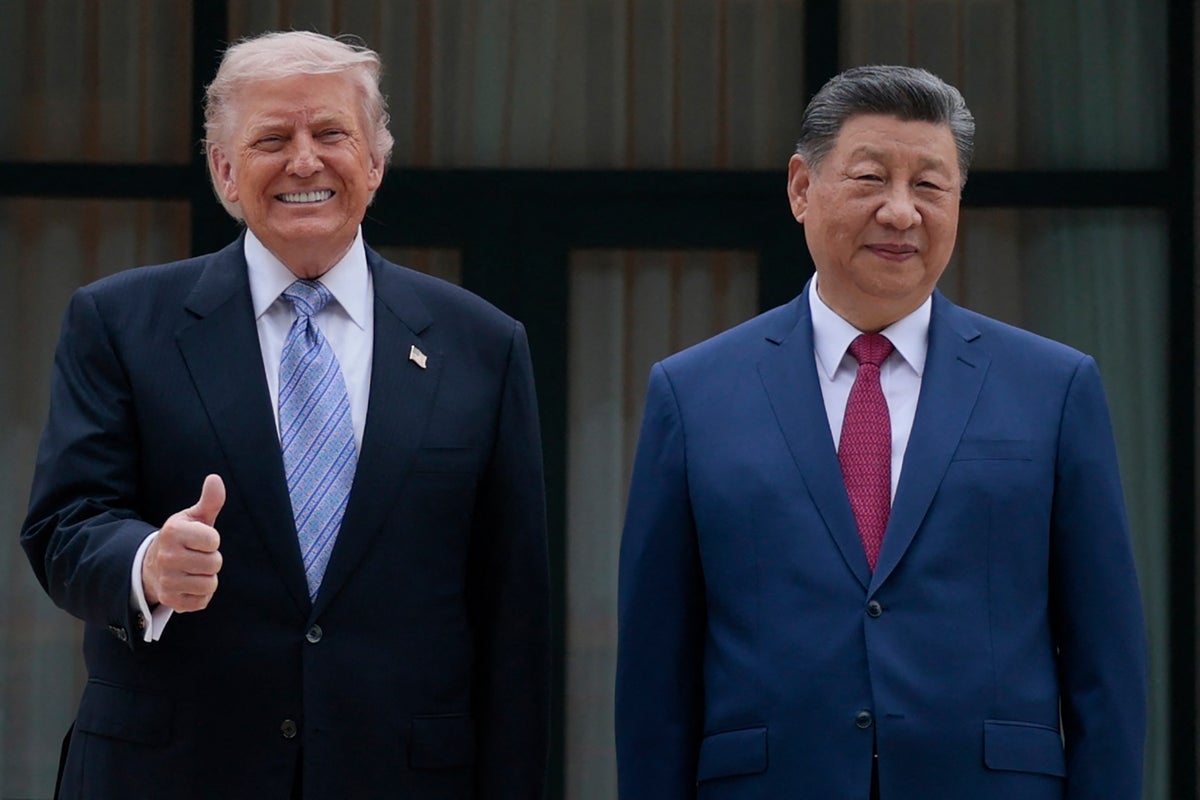
The perceived resolution of trade frictions between the United States and China often rests on high-visibility purchasing agreements that mask deeper structural imbalances in the bilateral relationship. When executive leadership claims "problems are settled," they are frequently referring to the immediate reduction of a trade deficit through commodity acquisition rather than the realignment of the underlying economic friction points: intellectual property (IP) transfer, market access asymmetry, and state-directed industrial policy. True strategic stability requires moving beyond the "shopping list" diplomacy of multi-billion dollar deals to address the systemic divergence between a liberal market economy and a state-led capitalist model.
The Dual-Track Friction Model
To analyze the state of US-China relations during high-level summits, one must separate the diplomatic theater from the technical economic reality. The friction exists on two distinct tracks:
- The Transactional Track: This involves the immediate exchange of capital for goods. During state visits, the announcement of massive orders for aircraft, agricultural products (soybeans), and energy (LNG) serves as a political signaling mechanism. These deals are designed to provide immediate, quantifiable evidence of "progress" to domestic constituencies.
- The Structural Track: This involves the regulatory environment, the legal protection of proprietary technology, and the role of State-Owned Enterprises (SOEs). While the transactional track can be "settled" with a pen stroke, the structural track is resistant to short-term diplomacy because it involves the core of China’s development strategy.
The failure to distinguish between these tracks leads to a "signal-to-noise" problem. Observers mistake a surge in Boeing orders for a shift in Chinese industrial policy. In reality, the transactional track often functions as a pressure-release valve, allowing the structural track to remain unchanged while depleting the political will for more painful, systemic reforms.
The Mechanism of Coerced Technology Transfer
One of the primary "problems" frequently cited in bilateral talks is the price of entry for US firms into the Chinese market. This mechanism operates through Joint Venture (JV) requirements. In specific sectors—automotive, telecommunications, and aviation—foreign firms are often legally or practically required to partner with local entities.
This creates a Technology Depreciation Trap:
- Initial Entry: The US firm provides high-value IP to gain access to the Chinese consumer base.
- Absorption Phase: The local partner absorbs the operational and technical expertise via proximity and shared workforce.
- Displacement Phase: The local partner, often supported by state subsidies, develops a "good enough" domestic alternative that eventually displaces the original US firm from the market.
Unless a diplomatic breakthrough addresses the removal of JV requirements and the enforcement of non-discriminatory licensing, "settling" the problem remains a temporary truce. The cost of doing business is effectively the surrender of future global competitiveness for current quarterly revenue.
Quantifying the Reciprocity Gap
The concept of reciprocity is the bedrock of international trade, yet in US-China relations, it remains a theoretical ideal rather than a functional reality. The gap is best measured through Market Access Parity.
While the US market remains largely open to Chinese investment and products under a standard regulatory framework (with increasing scrutiny from CFIUS on national security grounds), the Chinese market utilizes a "Negative List" approach. This list dictates where foreign capital is prohibited or restricted. A "masterclass" in strategy would focus on the delta between these two lists. If the US allows Chinese firms to compete in 95% of its industrial sectors, but China only allows US firms into 60% without significant hurdles, a structural deficit exists regardless of how many tons of soybeans are sold.
The Role of State-Owned Enterprises (SOEs)
SOEs act as an extension of the state’s industrial policy, benefiting from:
- Preferential Financing: Access to low-interest loans from state banks that do not follow commercial risk-assessment models.
- Regulatory Shielding: Domestic standards that are often tailored to the specific technical capabilities of national champions.
- Land Subsidies: Provision of industrial land at near-zero cost.
These factors create a distorted cost function. When a US president discusses "settling problems," the conversation must shift from the final price of the product to the inputs of production. A trade deal that ignores the cost-of-capital advantage held by SOEs is merely treating the symptoms of a systemic imbalance.
The Geopolitical Risk Premium
Strategic planners must account for the reality that economic deals are frequently leveraged as geopolitical tools. In the context of a Xi-Trump summit, the "settling" of trade issues is often a quid-pro-quo for cooperation on security fronts, such as the denuclearization of the Korean Peninsula or maritime claims in the South China Sea.
This creates a Volatility Tax on businesses operating in these regions. Companies cannot rely on long-term trade stability when trade policy is used as a bargaining chip for non-economic objectives. The sudden imposition or removal of tariffs based on the "mood" of a summit introduces a level of uncertainty that inhibits capital expenditure and long-term R&D investment.
The Illusion of Finality
The rhetoric of "problems settled" ignores the iterative nature of global economic competition. Trade relations between two superpowers are never "solved"; they are managed. The belief in a final resolution is a strategic fallacy.
The current landscape is defined by Strategic Decoupling, a process where both nations attempt to reduce their mutual dependencies in critical sectors like semiconductors, AI, and battery technology. This decoupling is driven by the realization that economic interdependence, once thought to be a guarantor of peace (the "Golden Arches Theory" updated for the 21st century), has instead become a source of vulnerability.
The "problems" mentioned in the article—trade deficits and market access—are actually outcomes of this deeper competition for technological hegemony. Addressing the trade deficit without addressing the race for 5G or quantum computing dominance is akin to rearranging deck chairs while the hull is being redesigned.
Operational Framework for Market Entry and Protection
For organizations navigating this environment, the strategy must shift from expansion-at-all-costs to a model of Compartmentalized Integration.
- IP Ringfencing: Separate R&D cycles for the Chinese market and the global market. Never introduce "Crown Jewel" IP into a jurisdiction where legal recourse for theft is subject to political whims.
- Supply Chain Diversification (China Plus One): Maintain a presence in China to serve the domestic market but establish redundant manufacturing hubs in Southeast Asia or Mexico to mitigate the risk of sudden tariff escalations.
- Local Stakeholder Alignment: Instead of relying solely on JV partners, engage with local municipal governments whose incentives (employment, tax revenue) may differ from the central government’s broader geopolitical goals.
The path forward is not found in the flamboyant signing of memorandums of understanding (MOUs). It is found in the granular, sector-by-sector negotiation of technical standards and the enforcement of intellectual property rights through neutral third-party arbitration.
The true test of any summit is not the total dollar value of the deals announced, but the establishment of a "snap-back" mechanism—a predefined set of consequences that trigger automatically if the structural reforms promised in the "transactional" phase fail to materialize. Without this, the cycle of grievance, negotiation, and temporary settlement will continue, with the underlying "problems" only growing in complexity and cost.
Strategic leadership must prepare for a "Long Peace" characterized by constant economic friction rather than a "Grand Bargain" that resolves all tension. The objective is to build an enterprise or a national policy that is resilient to the inevitable pivots of bilateral diplomacy, ensuring that the "settling" of today's problems does not create the catastrophes of tomorrow.