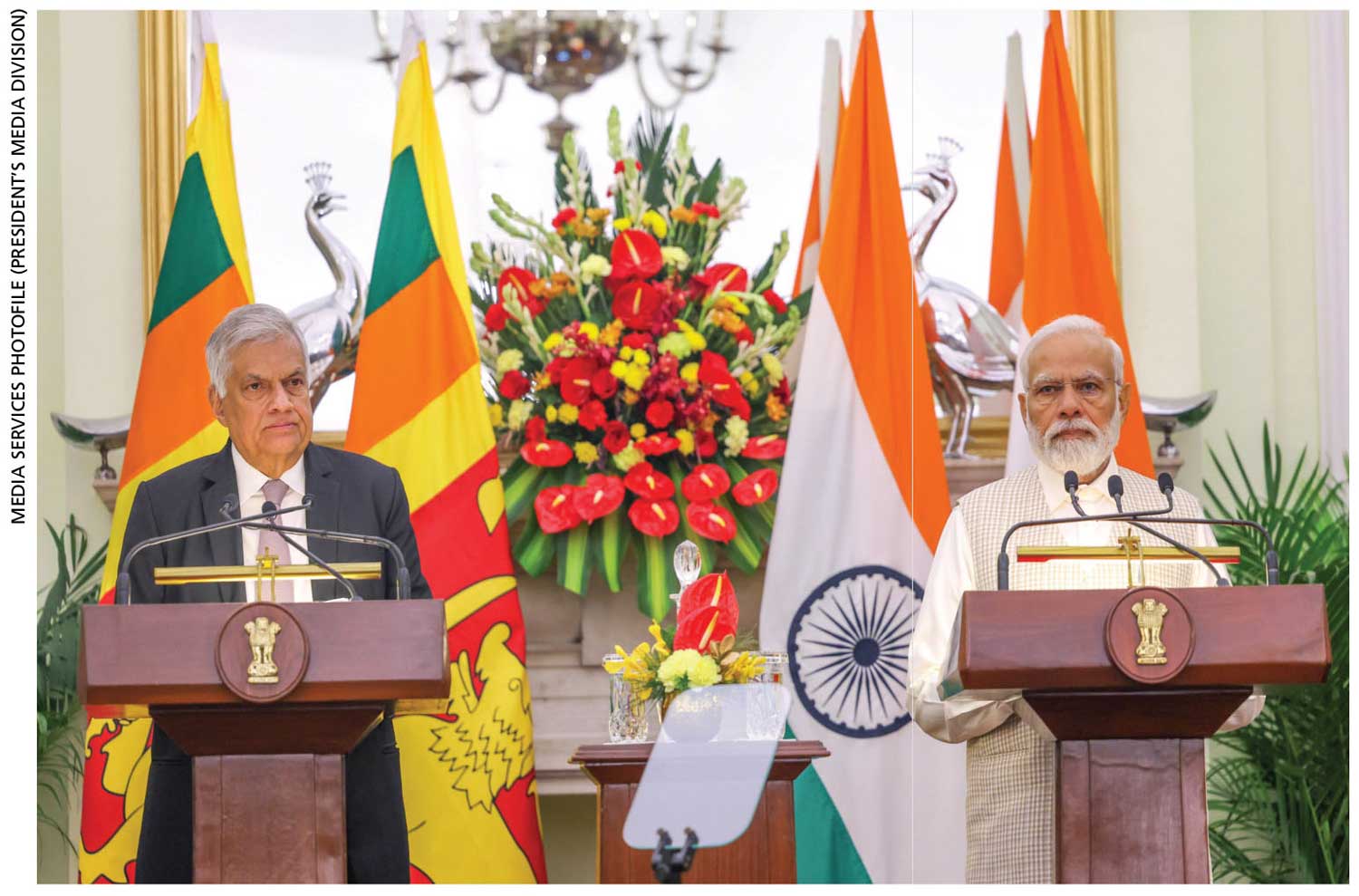
India’s engagement with Sri Lanka operates through a dual-track mechanism of economic stabilization and ethnic mediation. The recent visit of Vice President C.P. Radhakrishnan to Jaffna and the Eastern Province signals a recalibration of New Delhi’s approach, shifting from high-level debt restructuring to granular, community-level diplomacy. This maneuver addresses a critical geopolitical bottleneck: the necessity of securing the Tamil political base to ensure long-term stability for Indian infrastructure investments in the island's north and east.
The Geopolitical Cost Function of Sri Lankan Stability
India’s strategic interest in Sri Lanka is governed by the "security-economy nexus." New Delhi views the island not merely as a neighbor, but as a critical node in its maritime security architecture. The cost of instability in Sri Lanka is high for India, manifesting in refugee inflows, decreased maritime safety in the Palk Strait, and the potential for extra-regional powers to establish permanent naval footprints.
To mitigate these risks, India employs a three-pronged strategy:
- Direct Fiscal Support: The $4 billion aid package provided during Sri Lanka's 2022 economic collapse functioned as a liquidity bridge, preventing total state failure and ensuring the continuity of bilateral agreements.
- Infrastructure Integration: By funding the rehabilitation of the Kankesanthurai (KKS) Harbor and the Palaly Airport, India creates physical dependencies that link the Sri Lankan economy to the Indian supply chain.
- The 13th Amendment Leverage: India utilizes the constitutional framework of the 13th Amendment to the Sri Lankan Constitution—which provides for the devolution of power to provinces—as a tool to maintain political influence within the minority Tamil community.
Mapping the Tamil Political Landscape
The interaction between Vice President Radhakrishnan and Tamil leaders, including members of the Tamil National Alliance (TNA) and other splinter groups, highlights the fragmentation of Northern Sri Lankan politics. This fragmentation creates a challenge for New Delhi: there is no single interlocutor for the Tamil cause.
Indian diplomacy must navigate three distinct Tamil interest blocks:
- The Federalists: Groups demanding a merger of the North and East provinces and significant autonomy. They view Indian intervention as the only viable pressure point against the Colombo government.
- The Pragmatists: Local leaders focused on immediate developmental gains, such as housing units and connectivity projects. For this group, the Indian-funded 1,000 houses project and the Jaffna Cultural Centre are tangible proofs of efficacy.
- The Estate Tamils: Located primarily in the hill country, this group remains economically marginalized. India’s focus here is purely humanitarian and educational, aiming to prevent social unrest that could disrupt the tea export economy.
The Vice President's visit to the "1990 Suwa Seriya" ambulance service and educational facilities serves to reinforce the "soft power" component of this strategy. By branding aid as a "gift from the people of India," New Delhi bypasses the bureaucratic friction of the central government in Colombo, building direct rapport with the grassroots population.
The Energy and Connectivity Corridor
The strategic rationale for India’s presence in the North and East is increasingly tied to energy security. The proposed power grid interconnection and the development of the Trincomalee Oil Tank Farm are not isolated projects; they are components of a regional energy integration plan.
Trincomalee represents a geographic advantage that cannot be replicated. By securing development rights and establishing a presence through high-level visits, India ensures that the deep-water harbor remains under a collaborative framework rather than falling under the influence of competitors. The logic is simple: economic integration creates a "sunk cost" for the Sri Lankan state, making it prohibitively expensive to pivot away from Indian interests.
The "Development Assistance" model used by India differs significantly from traditional debt-based financing. Indian aid often takes the form of grants or concessional lines of credit targeted at social infrastructure. This creates a favorable public perception, which acts as a buffer against nationalistic rhetoric in Southern Sri Lanka that occasionally targets Indian "interference."
Addressing the Devolution Deficit
The primary friction point in Indo-Lanka relations remains the full implementation of the 13th Amendment. While India consistently advocates for provincial elections and the devolution of land and police powers, the Sri Lankan central government maintains a policy of strategic delay.
This creates a credibility gap for India among the Tamil population. If New Delhi provides massive economic bailouts without extracting concessions on Tamil rights, it risks losing its primary leverage within the island's internal politics. Radhakrishnan’s engagement with Tamil leaders is an attempt to signal that the "Tamil Question" remains a priority, even as economic ties with Colombo deepen.
The failure to hold Provincial Council elections since 2018 has led to a centralization of power. For India, this centralization is a risk; it simplifies the path for third-party actors to influence Sri Lankan policy through a single point of failure in Colombo. Distributed power through provincial councils, conversely, provides India with multiple points of entry into the Sri Lankan political system.
The Maritime Security Variable
The Palk Strait is a narrow corridor where domestic politics and international security collide. The recurring issue of Indian fishermen being detained by the Sri Lankan Navy is a symptom of a larger resource competition. India’s investment in the KKS harbor and the resumption of ferry services between Nagapattinam and Kankesanthurai are tactical moves to formalize maritime traffic.
By increasing legitimate commercial and passenger movement, India can better monitor the "grey zone" activities in the strait, including smuggling and unauthorized maritime incursions. The Vice President’s presence in these coastal regions reinforces the message that India views the Palk Strait as an internal security perimeter.
Strategic Recommendation for Regional Stability
The current trajectory of Indo-Lanka relations suggests a move toward "Integrated Bilateralism." This is not a relationship between two sovereign states acting in isolation, but rather the gradual absorption of the smaller economy into the orbit of the larger one.
To maximize this transition, the following actions are necessary:
- Institutionalize the 13th Amendment: India must move beyond rhetorical support and link future infrastructure tranches to specific milestones in provincial devolution. This prevents the "aid-for-nothing" trap where Colombo receives fiscal support while backtracking on political promises.
- Diversify Infrastructure Portfolios: Focus must shift from prestige projects to "Last Mile Connectivity." Renovating small-scale irrigation tanks in the North and expanding digital payment systems (like UPI) will embed the Indian economy into the daily lives of Sri Lankans more effectively than large-scale port projects alone.
- Multilateralize the Tamil Issue: By framing the rights of the Tamil minority within the broader context of UN Human Rights Council resolutions, India can maintain pressure on Colombo without appearing as a unilateral aggressor. This provides "diplomatic cover" for both New Delhi and the Tamil leadership.
The stabilization of Sri Lanka is a prerequisite for India’s "Neighborhood First" policy. The Vice President’s visit confirms that the North and East provinces are the theaters where this policy will either succeed or fail. Success depends on the ability to balance the humanitarian needs of the Tamil minority with the hard-nosed security requirements of the Indian state.