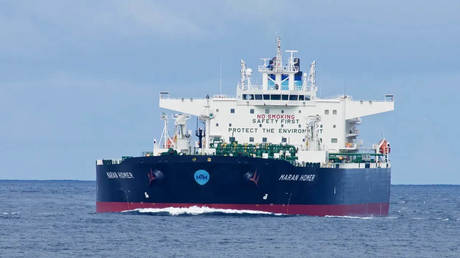
The recent kinetic engagement involving an oil tanker off the Russian coast represents more than a localized security breach; it is a stress test of the "Shadow Fleet" logistics model and the resilience of Grade-A maritime insurance boundaries. When a strategic transport vessel is targeted in contested waters, the immediate physical damage is secondary to the catastrophic shift in the risk-premium calculus for global energy traders. This incident exposes three critical vulnerabilities in the current Russian energy export architecture: the fragility of the Black Sea-Azov corridor, the diminishing returns of AIS (Automatic Identification System) spoofing as a defensive measure, and the cascading failure of non-Western hull and machinery (H&M) insurance structures.
The Kinematics of Maritime Interdiction
To understand the impact of an attack on an oil tanker, one must evaluate the engagement through the lens of maritime interdiction geometry. Unlike naval warships, commercial tankers are "soft" targets with high thermal and radar signatures. Their defense relies entirely on the avoidance of detection or the presence of a sovereign escort.
The attack profile indicates a shift toward low-cost, high-asymmetry assets—likely Unmanned Surface Vessels (USVs) or precision-guided aerial munitions. These assets exploit the high inertia and low maneuverability of a fully laden Aframax or Suezmax vessel.
The cost-to-damage ratio in these encounters is heavily skewed. A USV costing less than $100,000 can effectively neutralize a hull carrying $50 million to $80 million in Urals crude, while simultaneously triggering a regional spike in Protection and Indemnity (P&I) club premiums that can exceed $1 million per transit. The bottleneck is not the availability of oil, but the availability of "clean" hulls willing to enter a high-threat environment without sovereign guarantees.
The Three Pillars of Navigational Risk
The escalation of hostilities in Russian littoral zones necessitates a re-categorization of risk for maritime operators. These risks are no longer incidental; they are structural.
1. The Failure of Electronic Masking
For the past twenty-four months, "dark" fleet operators have relied on AIS spoofing—generating false GPS coordinates—to obfuscate their proximity to sanctioned terminals or high-risk zones. However, the proliferation of synthetic aperture radar (SAR) satellite constellations has rendered electronic masking obsolete. SAR can penetrate cloud cover and darkness to identify vessel silhouettes in real-time, matching them against known AIS signatures. When a vessel's physical position deviates from its broadcasted data, it becomes a high-priority target for interdiction, as the lack of transparency signals a lack of international legal protection.
2. Kinetic Vulnerability of the Hydrocarbon Load
The structural integrity of a double-hulled tanker provides significant protection against grounding, but it is not designed to withstand high-velocity kinetic impacts or shaped charges. An attack at the waterline threatens the longitudinal strength of the ship. If the hull girder is compromised, the vessel risks "breaking its back," leading to a total loss of cargo and an environmental catastrophe that would close the shipping lane to all traffic, effectively self-sanctioning the port of origin.
3. The Insurance Liquidity Trap
Most of the vessels currently operating off the Russian coast are insured outside the International Group of P&I Clubs. This "shadow insurance" often lacks the re-insurance depth of Western markets. In the event of a major kinetic strike, the ability of these niche insurers to pay out on a Total Loss Only (TLO) basis is unproven. This creates a liquidity trap where shipowners may find themselves with a destroyed asset and a worthless policy, leading to a rapid contraction in the number of vessels willing to service Russian ports.
The Logistics Cost Function
The price of Russian crude is fundamentally tied to the "Freight Distance Tax." As kinetic risks increase, the cost function of transporting a barrel of oil from Novorossiysk or Primorsk shifts from a linear model based on distance to an exponential model based on risk-adjusted insurance.
$C(r) = f(d) + i(k) + p(s)$
Where:
- $C(r)$ is the total delivered cost.
- $f(d)$ is the standard freight rate based on distance.
- $i(k)$ is the kinetic risk premium (insurance).
- $p(s)$ is the "Shadow Fleet" premium, reflecting the scarcity of hulls.
As $i(k)$ increases due to successful attacks, the discount at which Russian oil must be sold to remain competitive (the Urals-Brent spread) must widen. If the spread does not widen sufficiently to cover the surge in $i(k)$, the trade route becomes economically non-viable for independent owners. This forces the state to internalize the risk, either by providing state-backed insurance or by deploying naval assets that are already overextended.
Strategic Displacement of the Shadow Fleet
The attack serves as a catalyst for a "flight to safety" among mid-tier tanker operators. While the most committed shadow operators will remain, the "grey" fleet—vessels that occasionally dip into the Russian trade when margins are high—will likely exit the market. This contraction of vessel supply creates a logistical bottleneck.
When vessel supply drops, the remaining operators demand higher day rates. In a high-interest-rate environment, the capital expenditure required to maintain an aging shadow fleet (often 15+ years old) becomes unsustainable if the vessels are also facing high-intensity combat risks. We are observing the beginning of a mechanical degradation of the shadow fleet’s operational capacity.
The Bottleneck of the Turkish Straits
Any disruption in the Black Sea eventually converges at the Bosporus and Dardanelles. Turkey’s role as the maritime gatekeeper becomes increasingly complex as kinetic incidents occur closer to its territorial waters. Increased risk of a disabled tanker drifting into the straits or causing a spill in the Marmara Sea will lead to stricter "Right of Innocent Passage" inspections.
Increased inspections translate to longer wait times. For a tanker, every day of delay costs between $30,000 and $70,000 in demurrage. If a kinetic event leads to a mandatory tug escort for all Russian-origin tankers, the throughput of the Black Sea energy bypass will drop by an estimated 15% to 20%, regardless of whether the ports themselves are operational.
Operational Pivot to the Northern Sea Route
The vulnerability of the Black Sea and Baltic routes is forcing an acceleration of the Northern Sea Route (NSR) as a primary export artery. However, the NSR is not a "seamless" alternative. It requires:
- Ice-Class Tankers: There is a global shortage of ice-class 1A and 1B tankers.
- Nuclear Icebreaker Availability: Logistics are tied to the schedule of the Rosatomflot fleet, creating a centralized point of failure.
- Severe Seasonal Constraints: Despite climate trends, the NSR remains a seasonal path with high mechanical stress on vessel hulls.
The transition to the NSR represents a strategic retreat from the more efficient, high-volume southern routes. It is a transition from a market-driven logistics model to a state-subsidized survival model.
Re-evaluating Global Energy Security Paradigms
The attack on the Russian coast tanker signals the end of the "Sanctions-But-Stable" era of energy exports. The assumption that the global community would permit the flow of Russian oil as long as it remained under a price cap is being challenged by kinetic reality. If the sea lanes are no longer safe, the price cap becomes irrelevant because the physical delivery of the product cannot be guaranteed.
Market participants must now price in a "Geopolitical Friction Coefficient." This coefficient accounts for the reality that a significant portion of the global tanker fleet is now operating outside of the standard regulatory and safety frameworks, making them both targets for aggression and liabilities for maritime safety.
The strategic play for energy stakeholders is a rapid diversification away from reliance on littoral zones in active conflict. For buyers, this means securing long-term contracts for North American or Middle Eastern grades to hedge against a sudden collapse in Black Sea throughput. For shipowners, the move is toward "Green" or "White" fleet certification—ensuring vessels are strictly compliant with Western insurance and regulatory standards to avoid being caught in the kinetic crossfire of the shadow trade. The maritime landscape is bifurcating; the middle ground of the "grey" fleet is disappearing, replaced by a binary choice between high-compliance safety and high-risk state-backed gambling.