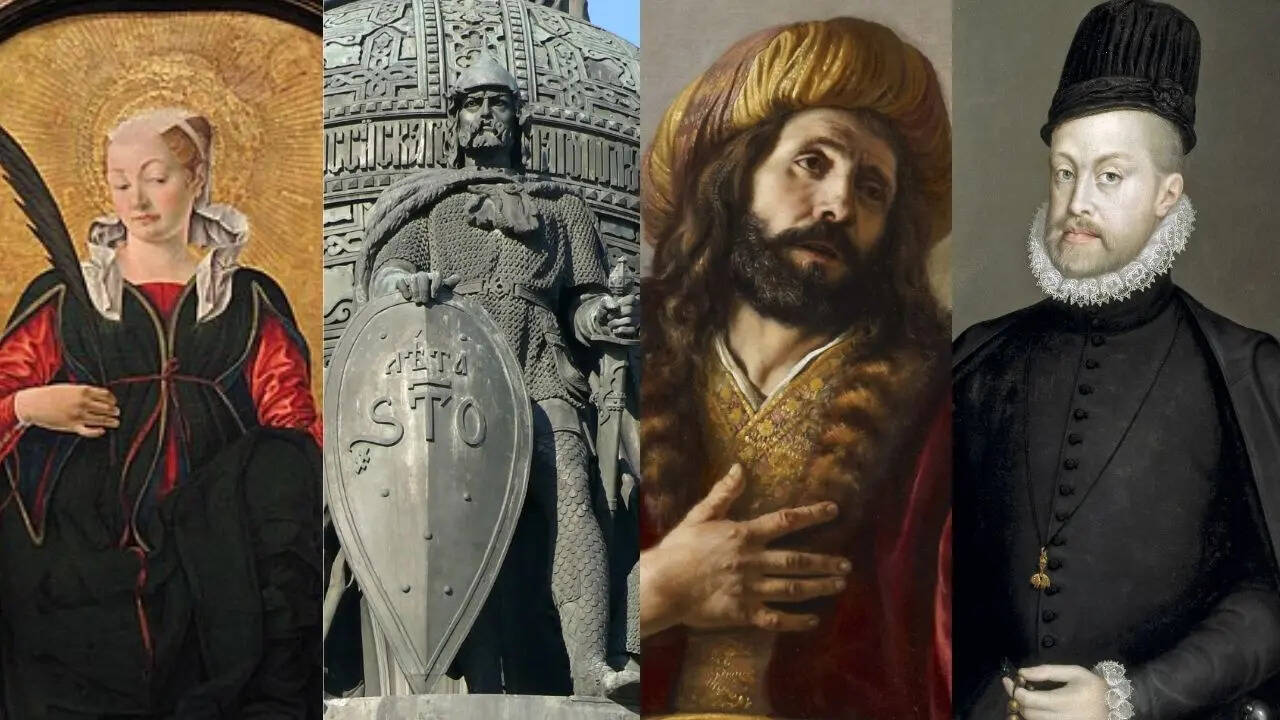
Names are heavy. If you walk through the dust-choked streets of a city like Samarkand or stand beneath the brutalist, rain-slicked spires of Moscow, you aren't just walking on soil. You are walking on a legacy. You are walking inside the memory of men who died long before you were born.
Most people look at a map and see borders. They see ink lines and jagged edges. But if you look closer, the map is actually a family tree of strangers. We live in a world where entire nations are branded with the signatures of the dead. Some are names of pride. Others are names of survival. All of them are reminders that geography is rarely about rocks and rivers; it is about ego and the desperate human need to be remembered.
Take Uzbekistan. It sounds like a simple descriptor, a place where a certain group of people live. But the "Uzbek" identity traces back to Öz Beg Khan, a 14th-century ruler of the Golden Horde. Imagine being a teenager in modern Tashkent, checking your phone, scrolling through global news, and realizing your very passport is a tribute to a medieval warlord who brought Islam to the steppe. Your identity is a 700-year-old echo.
The name isn't just a label. It’s a weight.
The Architect of the Red Map
Russia is different. It doesn't bear the name of a single man in the way a kingdom might, but for nearly a century, its internal map was a frantic, obsessive shrines-list to the Bolsheviks.
Consider the worker in 1924. They lived in a village that had been there for five hundred years. Suddenly, the local committee arrives with buckets of red paint. The village is no longer the "Place of the Birch Trees." It is now Leninsk. Or Stalinsk. Or Kaliningrad.
In the Soviet era, the map became a weaponized hagiography. Mikhail Kalinin was a man of modest origins who became a figurehead for Stalin. He died in 1946. Today, Königsberg—a city of Prussian philosophers and Baltic winds—is still Kaliningrad. The man is gone. The empire he served is a pile of rusted rebar and faded photographs. Yet, millions of people still wake up every morning and brush their teeth in a city named after him.
Why do we do this? Because naming a place after a person is the ultimate act of terrestrial squatting. It is saying: "I was here, and you will say my name every time you give someone directions to your house."
The Men Behind the Borders
We see this pattern repeat across the globe, often in places where the blood of revolution hasn't quite dried.
Bolivia exists because Simón Bolívar didn't just want to liberate a continent; he became the continent's secular god. To live in Bolivia is to live inside the ambition of a man who died broken and disillusioned, famously claiming that those who served a revolution "plowed the sea." Yet the sea he plowed is now a sovereign state of twelve million souls.
Then there is Rhodesia. It’s a name that has largely vanished from the maps, replaced by Zimbabwe in 1980. Cecil Rhodes, the arch-imperialist, wanted his name to stretch from Cape to Cairo. He succeeded for a while. But names that are forced upon a landscape like a brand on a hide rarely last when the campfire burns out. When the people reclaimed the land, they scrubbed his name off the signs first.
It is a visceral, emotional cleansing. Changing a map isn't just about administrative updates. It’s about exorcism.
The Accidental Namesakes
Not every name is a grab for power. Sometimes, it’s a misunderstanding or a tribute that got out of hand.
Think of the Americas. Amerigo Vespucci was a navigator who realized, "Wait, this isn't Asia." For that moment of clarity, two entire continents and dozens of nations bear a Latinized version of his first name. We could have lived in the United States of Columbia—and for a long time, that was the poetic preference—but the map-makers in a small French office in 1507 went with "America."
One man’s epiphany became a hemisphere’s destiny.
There is something haunting about the randomness of it. We are born into these linguistic cages. We identify as Americans, or Colombians, or Filipinos (named for King Philip II of Spain, a man who likely never imagined the tropical archipelago that would carry his name into the 21st century). We go to war for these names. We paint them on our faces at sporting events. We cry when we see them on a flag.
But behind the flag is just a guy. Usually a guy who was just as flawed, frightened, and temporary as the rest of us.
The Uzbekistan Paradox
In Central Asia, the naming of nations is a delicate dance between ancient heritage and modern soul-searching.
When you look at the "Stans," you see a region defined by its people. Kazakhstan is the land of the Kazakhs. Kyrgyzstan is the land of the Kyrgyz. But the "Uzbek" part of Uzbekistan is the outlier because it anchors itself to that singular figure of the Khan.
It creates a strange, invisible tension. To be a citizen of a country named after a person is to be part of a permanent fan club you never asked to join. It suggests that the land belongs to the legacy, rather than the legacy belonging to the land.
Compare this to a place like Ukraine ("The Borderland") or Iceland. These names are grounded in the physical reality of the earth. They feel permanent. They feel like they belong to everyone and no one. They don't require you to honor a ghost.
The Erasure of the Self
There is a psychological toll to living in a place that is a monument.
In the wake of the Soviet collapse, the map of the East underwent a massive identity crisis. St. Petersburg was no longer Leningrad. Chemnitz was no longer Karl-Marx-Stadt. People had to learn new addresses. They had to rewrite their own histories.
Imagine a woman in her eighties living in the same apartment her entire life. She hasn't moved an inch, but she has lived in three different "cities" because the men in charge kept changing the name on the gate. First, it was the Tsar's city. Then it was the Comrade's city. Now, it is a city trying to remember who it was before the names started fighting.
For her, the map isn't a guide. It's a scar.
The Power of the Unnamed
The most powerful places on Earth are often the ones that don't need a man's name to justify their existence.
China (The Middle Kingdom). Japan (The Land of the Rising Sun). These names are cosmic. They are elemental. They don't rely on the biography of a conqueror to give them weight. They exist because the sun rises there, or because they believe they are the center of the world's heart.
When we name a country after a person—whether it’s Saudi Arabia (the House of Saud) or the Marshall Islands (Captain John Marshall)—we are making a bet. We are betting that the person’s reputation will outlast the mountains.
History shows us that’s a bad bet.
Mountains don't care about kings. Rivers don't remember the names of the people who drowned in them or the generals who crossed them. We are the only ones who care. We cling to these names because without them, we are just monkeys on a wet rock, spinning through a void. The name gives us a tribe. The tribe gives us a purpose.
The Ghost in the Passport
Tonight, someone in the Philippines will look at a coin featuring a Spanish king's legacy. Someone in Bolivia will walk past a statue of a man who died in exile. Someone in Uzbekistan will look at the horizon and see the same dust that the horsemen of Öz Beg Khan kicked up centuries ago.
We are all living in the shadow of giants who were actually just men.
We think we own the land. We think we define the borders. But the names on our maps prove that we are mostly just tenants in a house built by the egos of the past. We walk through their hallways. We sleep in their rooms. And we wait for the day when our own names might be whispered by a city that hasn't been built yet.
The map is a graveyard. And we are the ones keeping the grass trimmed.
Think about that the next time you look at a globe. Don't look for the countries. Look for the people hiding behind the ink. Look for the ghosts who still demand that you call their name every time you tell someone where you’re from.


