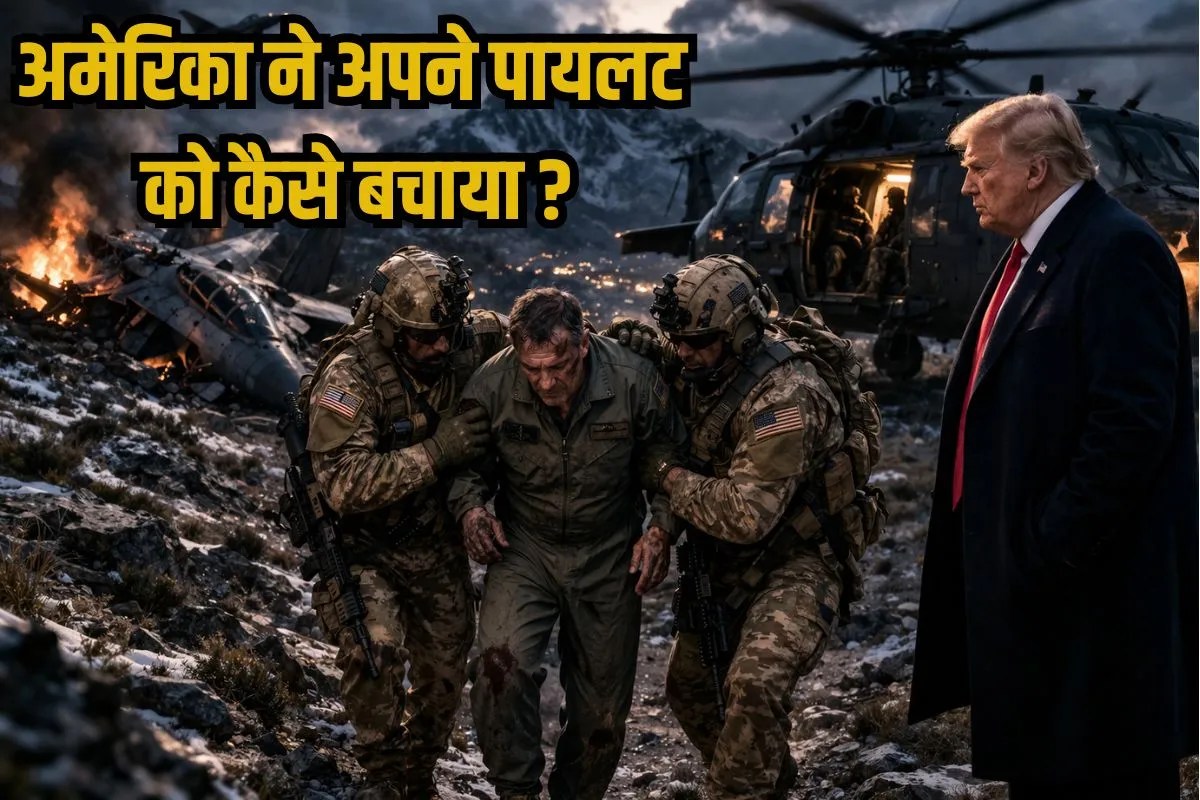
The successful extraction of a downed American pilot remains the ultimate litmus test for military credibility and national resolve. When Donald Trump recently lauded the rescue of a U.S. aviator, stating that the nation does not leave its "war fighters" behind, he wasn't just offering a political soundbite. He was reinforcing a foundational tenet of American military culture that carries immense geopolitical weight. This isn't merely about individual bravery or the technical proficiency of a search and rescue team. It is about a silent contract between a government and those it sends into harm's way. If that contract breaks, the entire framework of offensive air power begins to crumble.
The mechanics of these rescues are often shielded by layers of classification, but the strategic necessity is clear. Losing a pilot is not just a loss of human life or a multi-million dollar aircraft. It is a potential propaganda goldmine for adversaries and a devastating blow to domestic morale. In the high-stakes environment of modern aerial warfare, the rescue operation itself often involves more resources and personnel than the original mission that led to the crash.
The Calculus of Personnel Recovery
Rescuing a pilot in hostile territory is an exercise in managed chaos. The moment an ejection seat fires, a clock begins ticking that favors the enemy. This isn't a simple pickup. It is a coordinated surge of electronic warfare, localized air superiority, and ground-level grit.
The United States maintains specialized units whose entire existence revolves around this single, terrifying scenario. These teams operate under the Joint Personnel Recovery Agency (JPRA), coordinating across branches to ensure that "Leave No Man Behind" is an operational reality rather than a slogan on a patch.
When a pilot goes down, the first priority is establishing communication. Modern survival radios are miracles of engineering, capable of transmitting encrypted bursts that reveal a location without giving the pilot’s position away to local trackers. However, the physical environment remains an uncompromising enemy. Whether it’s dense jungle, arid desert, or freezing water, the pilot is often injured, disoriented, and hunted.
The Technological Edge in Survival
We have moved far beyond the days of signal flares and mirrors. Today’s pilots carry an array of gear designed to keep them invisible until the precise moment of extraction.
- Combat Survivor Evader Locator (CSEL): This radio system provides global satellite positioning and secure two-way messaging, allowing the pilot to communicate with rescue centers anywhere on the globe.
- Thermal Camouflage: Specialized blankets and clothing help mask the pilot’s heat signature from drones equipped with infrared sensors.
- Sub-Surface Signaling: For naval aviators, acoustic beacons can signal submarines or surface ships even when visual contact is impossible.
Despite these tools, the human element remains the weakest link. A pilot who is unconscious or severely injured cannot operate a radio. This has led to the development of automated distress signals that trigger upon the deployment of a parachute, immediately alerting the entire theater of operations that a "mishap" has occurred.
Political Capital and the Optics of Rescue
Donald Trump’s enthusiastic response to the recent rescue highlights how these events are perceived in the oval office. For a commander-in-chief, a rescued pilot is a victory that transcends the battlefield. It serves as a powerful rebuttal to any narrative of weakness.
The history of American conflict is littered with the ghosts of those who weren't recovered. The Vietnam War’s POW/MIA issue created a deep, lasting scar on the national psyche. By prioritizing recovery at almost any cost, the military prevents the enemy from using a captured American as a bargaining chip or a prop in a televised interrogation.
This policy also has a direct impact on how pilots fly. An aviator who knows that an entire strike group will move heaven and earth to find them is more likely to take the calculated risks necessary to achieve mission objectives. If that trust is eroded, the aggression and decisiveness required for air superiority vanish.
The Rising Cost of Extraction
While the sentiment of "No Man Left Behind" is absolute, the cost of upholding it is skyrocketing. Adversaries are no longer just using small arms fire to interfere with rescue operations. They are employing sophisticated Anti-Access/Area Denial (A2/AD) systems.
Attempting a rescue in an environment saturated with S-400 surface-to-air missiles or advanced electronic jamming changes the math. In some cases, sending in a traditional rescue helicopter is a suicide mission. This reality is forcing the military to look toward autonomous systems.
Unmanned Recovery Vehicles are currently being tested to serve as the first point of contact. These drones can provide immediate medical supplies, suppress enemy fire, and even transport a pilot out of a "hot" zone without risking additional aircrews. It is a cold, mechanical solution to a deeply emotional problem, but it may be the only way to maintain the rescue doctrine in a peer-to-peer conflict.
The Shadow of Failure
Every successful rescue reported in the news is a testament to planning and luck, but we must acknowledge the operations that never make the headlines because they ended in tragedy or were deemed too risky to attempt. The decision to "wave off" a rescue attempt is the heaviest burden a commander can carry.
When a pilot is captured, the dynamic changes from a military operation to a diplomatic crisis. We saw this during the 1995 downing of Scott O'Grady over Bosnia and the 1999 rescue of an F-117 pilot in Serbia. These events became defining moments of their respective conflicts. They showed that even "stealth" is not a guarantee of safety and that the rescue mission is often the most dangerous flight of the war.
Intelligence Gaps and the Search for Truth
There is a frequent disconnect between the public celebration of a rescue and the internal investigation that follows. The military must determine why the aircraft went down in the first place. Was it mechanical failure? Pilot error? Or has the enemy developed a counter-measure to current technology that we didn't see coming?
The debriefing of a rescued pilot is a grueling process. While the public sees a hero returning home, intelligence officers see a data source. Every detail of the evasion—what the pilot saw, how the enemy moved, which frequencies were jammed—is scrubbed for information that can protect the next person in the cockpit.
The recent event praised by Trump likely involved a massive, invisible web of support. For every one pilot pulled from the dirt, there were likely hundreds of analysts, satellite operators, and fuel tanker crews working in the shadows.
The Geopolitical Ripple Effect
Rescuing a pilot isn't just about the pilot. It’s about the allies watching from the sidelines. Nations that partner with the United States do so under the assumption that American logistical and rescue capabilities are the best in the world. When a rescue is executed flawlessly, it reinforces the value of that alliance.
Conversely, if an American pilot is paraded through the streets of a hostile capital, it signals a failure of that protective umbrella. It emboldens regional rivals and makes smaller nations question the wisdom of hosting American bases or participating in joint task forces.
The "No Man Left Behind" policy is a strategic asset as much as it is a moral obligation. It is the invisible thread that holds a modern air force together. When the President speaks of being "grieved" or "elated" by these outcomes, he is speaking as the custodian of that thread.
The reality of 21st-century warfare is that the sanctuary of the sky is shrinking. As sensors get better and missiles get faster, the frequency of these high-stakes rescue scenarios will likely increase. The technology will change, and the drones might eventually replace the human rescuers, but the core objective remains the same. A nation that can bring its people home from the most dangerous places on earth is a nation that remains a formidable global force.
The rescue is the message. The pilot is the proof. The commitment is the deterrent.
We are entering an era where the proximity of the "next" rescue attempt is always closer than we think, dictated by the shifting borders of global tension. The ability to execute under fire will continue to define the limits of American power.