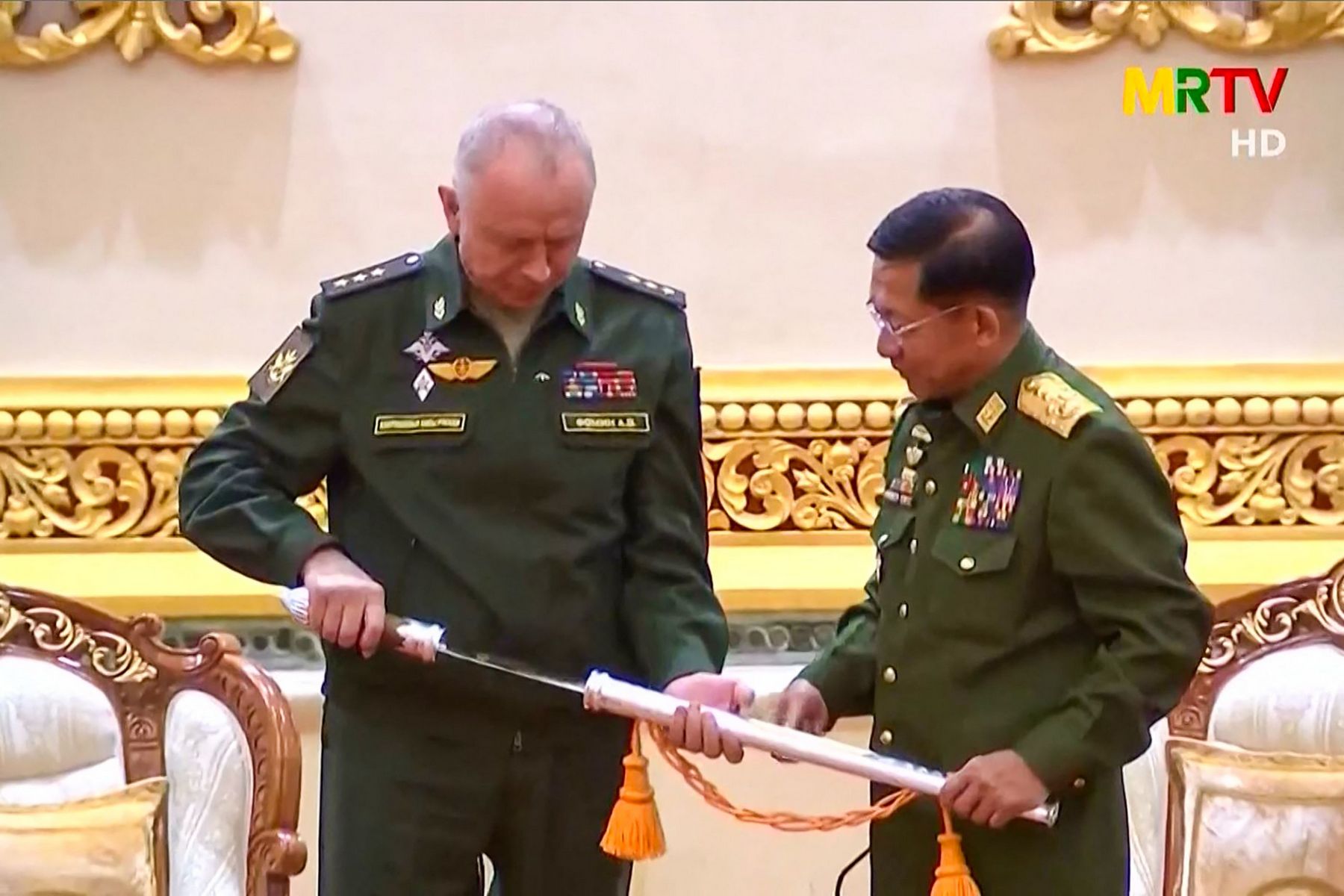
The mainstream media loves a funeral. It provides a tidy narrative arc: a fallen hero, a grieving nation, and a solemn promise of continuity. When Mali recently buried a high-ranking member of its military junta—a man central to the regime’s "sovereignty" project—the reporting followed the usual script. They focused on the pomp, the medals, and the defiant rhetoric against "terrorist" groups.
They missed the point.
The state funeral held in Bamako wasn't an act of strength. It was a desperate branding exercise for a government that has traded French dependence for Russian mercenaries, only to find that the body count remains the same. If you’re looking at the burial of a junta figure as a moment of national mourning, you’re asking the wrong question. The real question is: How many more "key figures" can this regime lose before the internal architecture of the Malian state collapses entirely?
The Sovereignty Myth is Dying in the Desert
For three years, the ruling military council has sold a specific brand of populist nationalism. The pitch was simple: kick out the French, tell the UN to pack its bags, and reclaim the north through sheer force of will. This "Mali Kura" (New Mali) was supposed to be a fortress.
Instead, it has become a sieve.
The recent militant assaults that claimed the life of this junta official weren't isolated skirmishes. They were surgical strikes into the heart of the regime's security apparatus. When a government loses its top-tier strategists in the capital’s backyard, the "sovereignty" argument isn't just under pressure—it’s dead.
I’ve watched geopolitical transitions in the Sahel for a decade. Usually, when a regime shifts its security partners, there’s a honeymoon period of "aggressive stabilization." We aren’t seeing that. We are seeing a retreat into heavily fortified bubbles while the rural periphery—and now the urban centers—burns. The funeral was a distraction from the fact that the junta can no longer protect its own inner circle, let alone the average citizen in Gao or Timbuktu.
The Wagner Tax No One Admits to Paying
Let’s talk about the Russian elephant in the room. The transition from the French-led Operation Barkhane to the Africa Corps (formerly Wagner Group) was framed by the junta as a move toward "true independence."
It’s a lie.
You don’t achieve independence by swapping one foreign master for another who charges in gold mines instead of diplomatic favors. The "contrarian" take here isn't that Russia is failing; it’s that Russia isn't even trying to win. Their business model thrives on perpetual, low-level instability. If they actually "cleared" the militants, their services would no longer be required.
The death of a junta pillar proves that the Russian security blanket is made of tissue paper. They provide "regime security"—meaning they keep the colonels from getting couped in the middle of the night—but they are demonstrably incapable of providing "state security." When the militants can strike high-value targets during major coordinated assaults, it means the intelligence networks the junta relies on are compromised or non-existent.
Why Military Funerals are Bad Data Points
If you look at the "People Also Ask" sections on search engines regarding Mali, you see questions like: Is Mali getting safer? or Who is winning the war in Mali? These questions are fundamentally flawed. In the Sahel, "winning" isn't about territory; it’s about legitimacy. A military funeral is designed to manufacture legitimacy through tragedy. It uses the visual language of a functioning state—parades, uniforms, national anthems—to hide the fact that the state's reach stops where the asphalt ends.
Here is the brutal truth:
- Tactical wins are irrelevant: The junta claims they are "neutralizing" hundreds of militants. If that were true, the groups wouldn't have the logistical capacity to hit Bamako.
- The "Nationalist" trap: By framing every critique as "foreign interference," the junta has silenced the very internal experts—Malian civil servants and local leaders—who actually understand the social drivers of the insurgency.
- The attrition problem: You can replace a foot soldier in a week. You cannot replace a "key junta figure" with fifteen years of institutional memory and tribal connections. Every funeral is a brain drain.
The Illusion of the "Strongman" Stability
We have this obsession with the idea that a military junta provides a "hard" shell that protects against chaos. History proves the opposite. Military regimes are brittle. They don't bend; they snap.
In a democracy, the death of a high-ranking official is a tragedy. In a junta, it’s a power vacuum. Every funeral in Bamako triggers a silent, vicious scramble for influence among the remaining colonels. Who gets his portfolio? Who controls his slice of the budget? Who gets to command the Russian-backed units he oversaw?
The media reports on the mourning. They should be reporting on the knives being sharpened in the barracks behind the funeral pyre.
Stop Looking for a "Solution" in Bamako
The consensus view is that Mali needs more equipment, better drones, and more "boots on the ground." This is a failure of imagination. Mali is a political problem disguised as a security crisis.
The militants aren't winning because they are better armed; they are winning because they are more consistent. They offer a (brutal) form of governance in places where the state hasn't been seen in years. When the junta holds a massive funeral in the capital, they are signaling to the rest of the country that their priorities are internal. They are mourning their own, while the villages are being told to defend themselves.
If you want to understand the trajectory of West Africa, ignore the speeches given over coffins. Look at the logistics. Look at the fact that the "key figures" are being targeted with increasing frequency. That isn't the behavior of an insurgency on the ropes. That is the behavior of an insurgency that has already won the intelligence war.
The funeral wasn't a tribute to a hero. It was a 21-gun salute for a strategy that has already failed. The state is crying because it knows it's next.
Stop buying the narrative of the resilient junta. Every time they bury a general, the hole they're digging is for the country itself. The ceremony is over. The reality is just beginning.