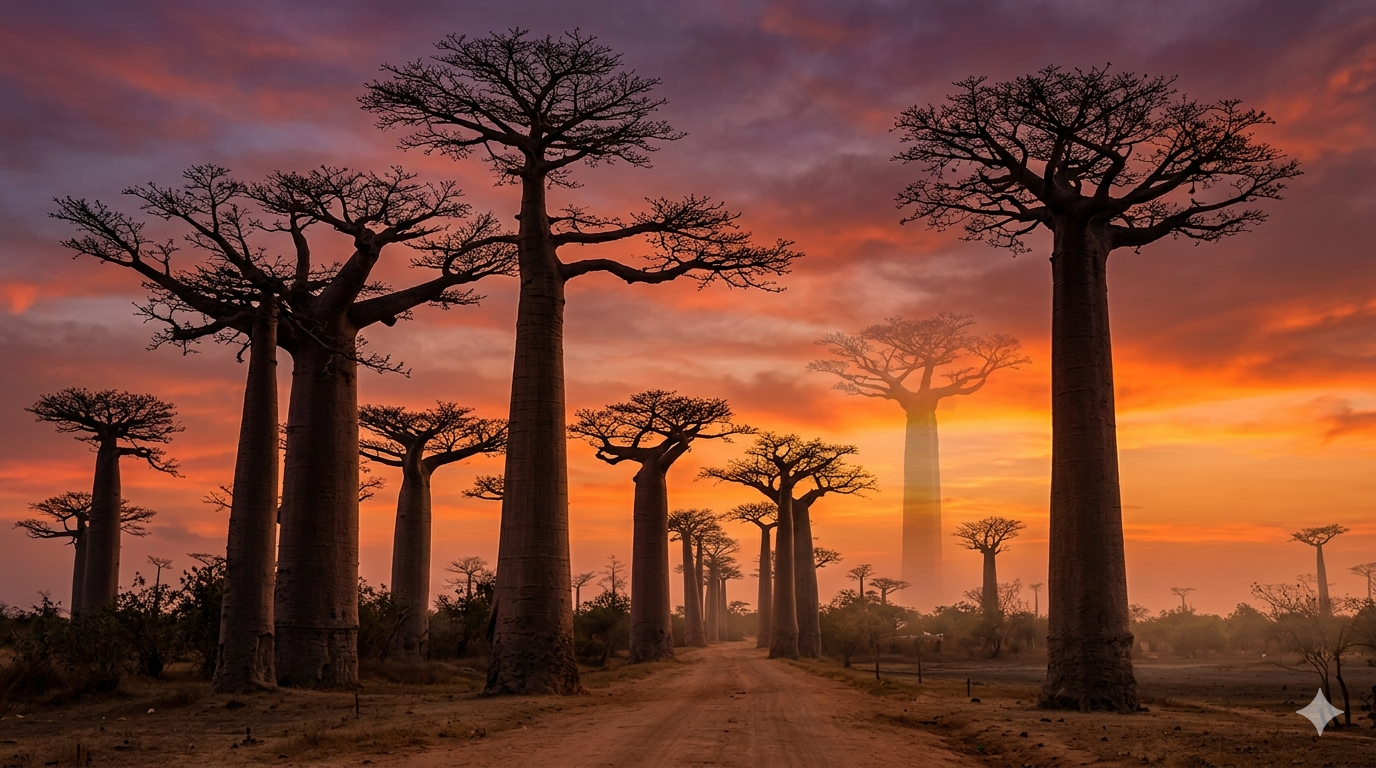
Madagascar's baobab trees aren't just weird-looking plants that survive in the scrub. They're biological hard drives. For 700 years, these massive "upside-down trees" have been recording every drop of rain and every heatwave in their wood. Recent research into their growth rings is finally giving us a crystal-clear look at how East Africa’s climate has shifted since the 1300s. It turns out the Indian Ocean is a lot more volatile than we thought.
If you’ve ever seen a baobab, you know they look like something from another planet. They have trunks that can hold thousands of liters of water. This is a survival trick for a dry island. But that same water-storage system makes them difficult to study. Most trees have obvious rings you can count like a calendar. Baobabs are different. Their wood is pulpy and faint. You can't just count the lines with a magnifying glass. Scientists had to use radiocarbon dating and stable isotope analysis to pull the data out of the fibers.
Why 700 years of tree rings change everything
Most climate records in the Southern Hemisphere are spotty. We have satellite data from the last few decades and some handwritten logs from colonial ships, but that’s about it. We’ve been guessing about the long-term patterns of the Indian Ocean Dipole. The baobabs changed that.
By looking at the oxygen and carbon isotopes trapped in the wood, researchers from institutions like the University of Arizona and international partners have mapped out seven centuries of rainfall. This isn't just academic trivia. It’s the longest continuous climate record for this part of the world. It shows us exactly how the "Little Ice Age" affected the subtropics. It also shows that the current drying trend in southern Madagascar isn't just a random bad streak. It’s part of a massive shift in how moisture moves across the ocean.
People usually think of climate change as something that started with the industrial revolution. The baobabs tell a more complex story. They show periods of extreme drought in the 1600s that lasted decades. They show how the Intertropical Convergence Zone—the "rain belt" of the world—shifted south and then north again. We're seeing that the weather systems over Madagascar are tied directly to what’s happening in the Pacific and Indian Oceans. When one gets warm, Madagascar dries out.
The struggle to read a tree with no rings
You’d think a tree that lives for a millennium would be easy to date. It’s actually a nightmare. Baobabs are succulents, basically. Their wood is more like a sponge than a piece of oak. Because they don't produce consistent annual rings in every environment, researchers have to look at the chemistry of the wood itself.
They use a process called "bomb pulse" dating for the newer sections. This tracks the spike in Carbon-14 caused by mid-20th-century nuclear tests. For the older sections, they rely on mass spectrometry. They’re looking at the ratio of Oxygen-18 to Oxygen-16. When it’s dry, the lighter oxygen evaporates faster from the leaves, leaving the wood "heavy" with Oxygen-18. It’s a perfect, unchangeable record of every drought the tree survived.
I've seen researchers struggle with these samples. You can’t just take a core sample easily because the wood is so soft it often collapses. Sometimes the trees are hollow. The oldest ones—the giants of the Grandidier’s species—are often the most fragile. We're racing against time to get this data because these "living ancestors" are dying off at an alarming rate.
Climate shifts and the collapse of ecosystems
The data reveals something scary about the last 50 years. The intensity of the droughts is hitting levels the trees haven't recorded in centuries. This correlates with the warming of the Agulhas Current. Madagascar is the "canary in the coal mine" for the Indian Ocean.
The baobabs show that rainfall patterns are becoming more "peaky." We get massive, destructive floods followed by years of nothing. This is a disaster for the local lemur populations and the unique flora that can't move as fast as the climate changes. The trees themselves are starting to buckle. In the last 20 years, several of the oldest baobabs in Africa and Madagascar have collapsed. They aren't just dying of old age. They're dehydrated. Imagine a tree that can store 100,000 liters of water running dry. That’s where we are.
This 700-year perspective proves that what we're seeing now isn't just a natural cycle. The speed of the shift is the red flag. In the 1400s, a shift of this magnitude would have taken two centuries. Now, it’s happening in thirty years.
The human cost of the dry years
When the baobabs stop growing, people starve. Southern Madagascar is currently facing some of the worst food insecurity on the planet. The tree ring data helps us understand why the "Grand Sud" region is turning into a dust bowl.
The rain that used to be predictable has become erratic. Farmers who have worked this land for generations can't rely on the old signs anymore. By aligning the 700-year tree record with modern meteorological data, we can start to build better predictive models. We can tell the difference between a one-year blip and a ten-year trend.
This isn't just about saving a cool tree. It's about knowing how to manage water for millions of people. If the baobabs say the next 50 years will be drier than anything since the 1600s, we need to stop planting thirsty crops and start building infrastructure that assumes the rain isn't coming back.
Protecting the living archives
We need to treat these trees like we treat the Great Library or the Svalbard Seed Vault. They are repositories of information. Protecting them means more than just putting a fence around them. It requires a total shift in how we handle the surrounding forest.
- Stop the fragmentation. Baobabs need the surrounding forest to keep the soil moist. Isolated trees in a cleared field die faster.
- Support local carbon-dating initiatives. Most of this research is funded by Western universities. We need more local scientists in Toliara and Morondava to lead these studies.
- Integrate tree-ring data into policy. The Malagasy government and NGOs need to use these long-term records to decide where to invest in irrigation and where to focus on drought-resistant agriculture.
Check out the work being done by the Global Baobab Project if you want to see the raw data. They’re mapping these trees across the whole continent. The more we know about the past 700 years, the less we'll be blindsided by the next fifty. We can't fix the climate overnight, but we can at least stop acting like these changes are a surprise. The trees told us they were coming. We just had to learn how to read the wood.