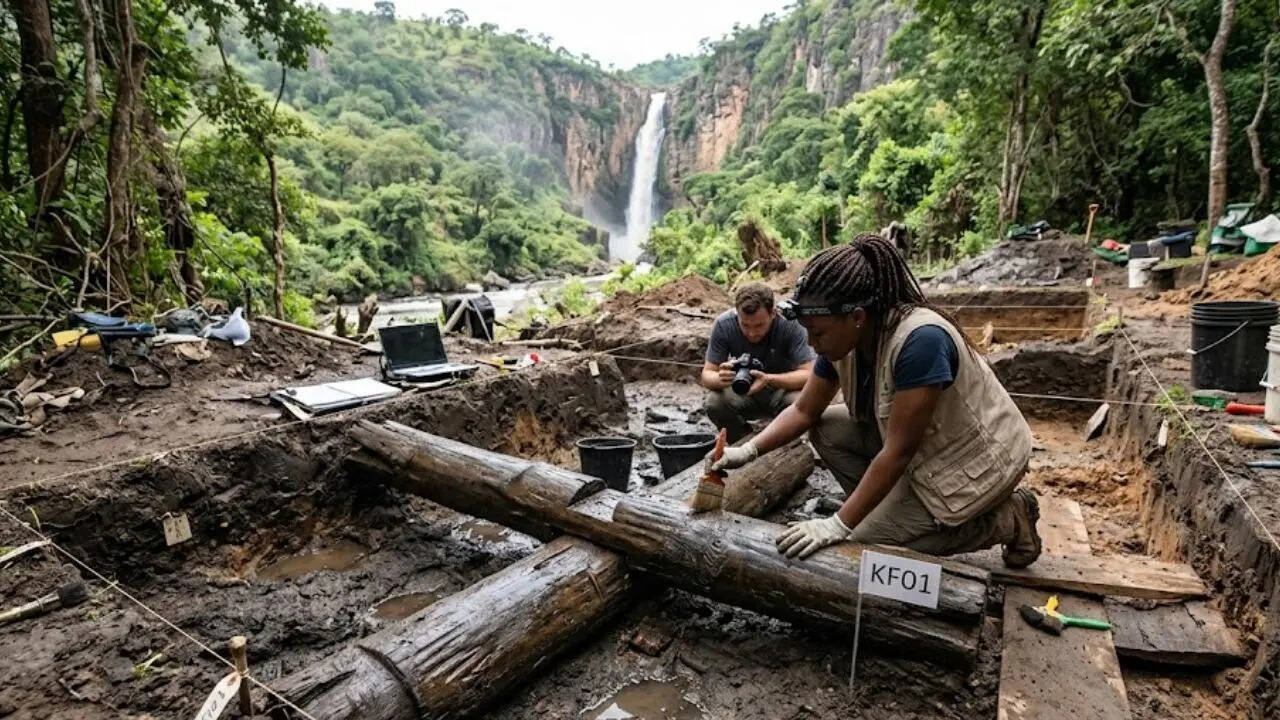
The water at Kalambo Falls doesn’t just fall; it thunders. It drops 221 meters off the edge of the plateau on the border of Zambia and Tanzania, a sheer curtain of white noise that has been roaring since before our species had a name. Most people come here for the view. They stand at the precipice, feel the mist on their skin, and take a photo of the second-highest uninterrupted waterfall in Africa.
But down in the riverbanks, buried in the suffocating embrace of wet sand and clay, lay a secret that should have rotted away half a million years ago.
When archaeologists first pulled the wood from the mud, it didn't look like much. It looked like debris. It looked like the kind of waterlogged timber you’d find after a heavy storm. Then they saw the notches. Two logs, one lying across the other, held together by a purposefully carved joint.
This wasn't a drift of wood. This was a blueprint.
The Persistence of the Impossible
We have been told a specific story about being human. In this version of history, our ancestors were wanderers, perpetual nomads driven by hunger and the changing seasons. They were "primitive." They held stones and shaped them into scrapers and hand-axes, but they didn't build. They didn't settle. They certainly didn't practice carpentry. According to the old textbooks, the ability to join two pieces of wood to create a larger structure was a "modern" innovation, something that happened long after Homo sapiens arrived on the scene.
Then came the date.
476,000 years.
Let that number sit in your lungs for a moment. It is a terrifyingly long time. To put it in perspective, our own species, Homo sapiens, is generally thought to have emerged around 300,000 years ago. The logs at Kalambo Falls were carved, notched, and fitted together nearly 200,000 years before we even existed.
This wasn't us. This was someone else. Likely Homo heidelbergensis, a common ancestor we share with Neanderthals. For decades, we viewed these predecessors as rough drafts of humanity—biological placeholders waiting for the "real" humans to show up with their art and their complex tools.
The logs prove we were wrong.
The Ghost in the Wood
Imagine a hypothetical craftsman. Let’s call him the Builder.
The Builder isn't a caveman from a cartoon. He is standing in the humid air near the Kalambo River, his hands calloused and stained with sap. He isn't just looking for a place to sleep; he is looking at a problem. Maybe the ground is too wet. Maybe he needs a walkway to reach the fishing spots, or a foundation for a shelter that won't wash away when the rains come.
He has a stone tool in his hand. It’s heavy, balanced, and sharp. He doesn't just hack at the wood. He measures. He calculates. He carves a U-shaped notch into a large piece of fruit-bearing willow, ensuring that another log will fit snugly inside it.
When he fits the two pieces together, he creates something that nature never intended: a right angle.
This is the moment the world changed. By joining two objects to make a third, more complex one, the Builder transitioned from using the environment to transforming it. He wasn't just surviving the landscape. He was engineering it.
The stakes were invisible but massive. If you can build a platform, you can stay in one place. If you stay in one place, you can store food. If you store food, you have time. And time is the most dangerous tool a hominid can possess. Time leads to language, to culture, to the slow-burning realization that the world can be bent to your will.
A Miracle of Mud
Usually, wood is a ghost. It disappears. In the archaeological record, we are obsessed with stone because stone is stubborn. It survives the crushing weight of millennia. Wood, however, breathes and dies. It rots, it burns, it is eaten by insects.
The only reason we know the Builder existed is because of a geochemical fluke. The high water table at Kalambo Falls created a permanent, oxygen-free tomb for these logs. Without oxygen, the bacteria that cause decay couldn't do their work. The wood was essentially pickled in time.
When the team from the University of Liverpool and Aberystwyth University used luminescence dating—a technique that measures when minerals in the surrounding sand were last exposed to sunlight—the results were so shocking they had to be verified repeatedly. The sand hadn't seen the sun in nearly half a million years.
The wood was older than our bones. It was older than our language.
It makes you wonder what else has been lost. We base our entire understanding of prehistoric intelligence on the few things that happen to be made of rock. We look at a stone hand-axe and see a simple tool. But what if that axe was just one part of a much larger, wooden machine? What if the "Stone Age" was actually the "Wood Age," and we’ve only been looking at the indestructible scraps of a sophisticated, biodegradable civilization?
The Myth of the Simple Ancestor
There is a certain arrogance in the way we study the past. We like to think of human progress as a straight line, a steady climb from the dirt to the stars. We want to believe that we are the smartest ones to ever walk the earth, and that those who came before us were stumbling in the dark.
Kalambo Falls suggests that the dark wasn't so dark after all.
The Builder and his kin had a sense of permanence. You don't notch logs and build structures if you plan on leaving tomorrow. They saw the river and decided to stay. They looked at a tree and saw a floor, a roof, a bridge.
This discovery forces us to sit with a heavy truth: the capacity for abstract thought and complex construction is far older than we are. It is not a "human" trait in the way we’ve traditionally defined it. It is an ancient legacy, a spark of ingenuity that was passed down through branches of the evolutionary tree that eventually died out.
We aren't the inventors of the world. We are just the latest tenants in a house that has been under construction for five hundred millennia.
Touching the Past
Working in the field of archaeology is often a lesson in frustration. You spend years sifting through dust for a single tooth or a flake of flint. But when the researchers touched those logs, they were touching the actual grip of another soul from 476,000 years ago.
The wood still bore the marks of the tools. You could see where the wood had been shaped, smoothed, and fitted. It was a physical handshake across an unthinkable chasm of time.
It's easy to feel small when looking at these dates. In the grand timeline of the earth, our modern lives—with our skyscrapers, our digital clouds, and our glass-and-steel cities—are a mere blink. We are so proud of our infrastructure, yet the Builder’s infrastructure survived under the mud while empires rose and fell above it.
The logs are currently being preserved in specialized tanks, kept wet to prevent them from crumbling into dust now that they’ve been exposed to the air. They are fragile things. But the idea they represent is indestructible.
We have always been builders.
We have always looked at the raw materials of the earth and imagined something more. Whether it is a notched log in a Zambian riverbed or a space station orbiting the planet, the impulse is the same. We find a gap, and we build a bridge.
The roar of Kalambo Falls continues, indifferent to the humans who stand on its banks. The water flows over the edge, just as it did when the Builder finished his work, wiped the sweat from his brow, and stood back to look at what he had made. He didn't know he was changing history. He was just making a home.
And in the end, that is perhaps the most human thing of all, even if he wasn't quite human yet.
The logs are back in the dark now, preserved for a future that will undoubtedly find new ways to be surprised by them. We are left with the mist, the noise, and the unsettling realization that our ancestors were much more like us than we ever dared to imagine. The past isn't a foreign country. It’s just a house we forgot we built.


