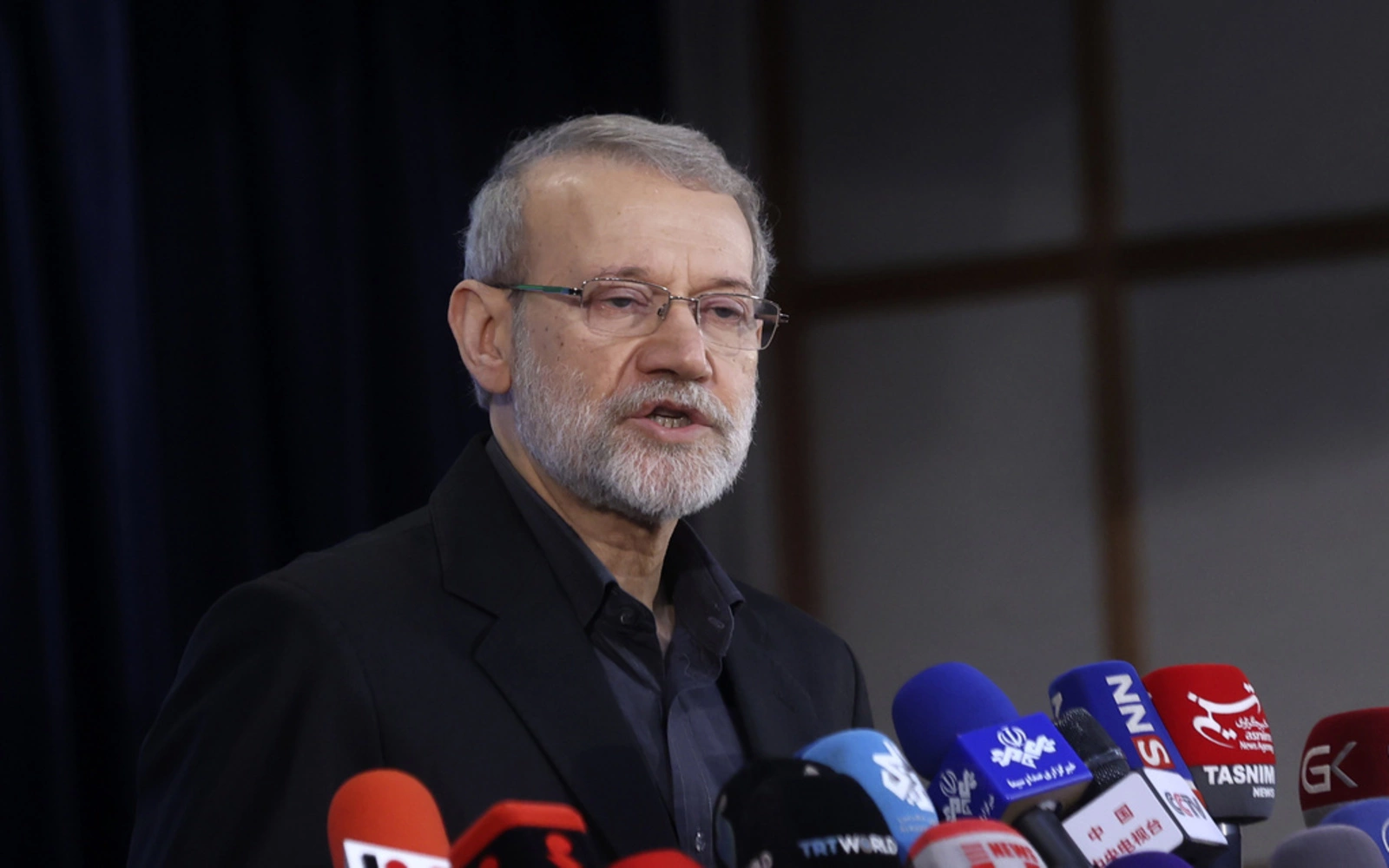
Ali Larijani represents the terminal point of the "Pragmatic Conservative" model within the Islamic Republic of Iran. To understand his trajectory is to understand the mechanics of the Nezam (the System)—specifically how it balances ideological purity against the functional requirements of a modern state. Larijani did not merely hold offices; he functioned as a high-frequency dampener between the volatile demands of the IRGC (Islamic Revolutionary Guard Corps) and the bureaucratic necessities of international diplomacy.
His career serves as a case study in the diminishing returns of elite "insiderism." In a system increasingly favoring horizontal integration—where military, economic, and religious power collapse into a single hardline front—Larijani’s vertical expertise in legislative mediation became a liability.
The Triad of Power Base Construction
Larijani’s survival for four decades rested on a unique configuration of three distinct power capitals.
- Clerical Pedigree (The Legitimacy Variable): Born in Najaf to Grand Ayatollah Mirza Hashem Amoli, Larijani possessed "sacred DNA." This provided an insurance policy that secular technocrats lacked. His marriage to the daughter of Ayatollah Morteza Motahhari, a primary architect of the 1979 Revolution, hard-coded him into the regime’s founding mythos.
- Security Integration (The Operational Variable): Unlike civilian reformers, Larijani emerged from the IRGC. His tenure as the head of the IRIB (Islamic Republic of Iran Broadcasting) for a decade allowed him to master the state's narrative apparatus. He understood the "Red Lines" because he helped draw them.
- Bureaucratic Longevity (The Functional Variable): Serving as Speaker of the Parliament (Majlis) for 12 consecutive years (2008–2020), he turned a fractured legislative body into a tool of the Supreme Leader. He was the "fixer" who could translate the Leader’s vague strategic desires into specific legislative votes.
The Cost Function of Nuclear Diplomacy
Larijani’s most significant contribution—and the source of his eventual marginalization—was his management of the nuclear file. As the Secretary of the Supreme National Security Council (SNSC) from 2005 to 2007, he inherited a chaotic negotiating environment.
The Larijani doctrine on the nuclear program was built on Calculated Friction. He rejected the total suspension of enrichment (the reformist path) but avoided the total isolation sought by the ultra-hardliners (the Ahmadinejad path). He viewed the nuclear program not as a religious end, but as a geopolitical asset to be depreciated slowly in exchange for maximum strategic recognition.
This created a specific logical bottleneck. By successfully facilitating the JCPOA (Joint Comprehensive Plan of Action) in the Majlis in 2015—famously passing the bill in just 20 minutes—he demonstrated supreme tactical skill. However, this efficiency signaled to the "Deep State" that Larijani was too effective at compromise. In the zero-sum logic of Iranian hardliners, any mechanism that facilitates a deal with the West is eventually viewed as a security threat.
The Disqualification Pivot and Systemic Narrowing
The 2021 and 2024 presidential cycles marked a fundamental shift in the Nezam’s survival strategy. The Guardian Council’s disqualification of Larijani was not an indictment of his loyalty, but a declaration that his specific brand of "Elastic Conservatism" was obsolete.
The Logic of the Purge
The system transitioned from a Competition-Based Legitimacy model to a Cohesion-Based Stability model.
- In the Competition Model: Multiple factions (Reformists, Pragmatists, Principlists) compete to drive voter turnout, providing the regime with a veneer of democratic mandate. Larijani was the king of this era.
- In the Cohesion Model: The Supreme Leader’s office prioritizes a "Uniform Power" (Yek-dast) structure. To ensure a smooth succession for the next Supreme Leader, the system must be purged of individuals with independent power bases and the intellectual capacity to challenge the status quo.
Larijani’s disqualification revealed that even the most decorated insiders are subject to the Replacement Cost Principle. If the cost of managing a complex, multi-factional player like Larijani exceeds the benefit of his diplomatic expertise, the system will choose a less capable but more compliant loyalist.
Structural Constraints of the "Middle Path"
Larijani’s failure to secure the Presidency highlights the terminal flaw in centrist Iranian politics: the absence of a grassroots constituency.
- The Reformists have the urban middle class and youth.
- The Hardliners have the Basij, the IRGC, and the rural religious poor.
- Larijani had the "Grey Zone" of traditional merchants (the Bazaar) and senior clerics in Qom.
This middle-tier constituency has been hollowed out by a decade of hyperinflation and the centralization of the economy under IRGC-linked conglomerates. When the Bazaar lost its independence, Larijani lost his leverage.
The Mechanism of Legislative Control
As Speaker, Larijani utilized a "Gatekeeper Protocol." He managed the Majlis not through consensus, but through the strategic control of the agenda. He mastered the use of Special Committees to bypass the general floor when sensitive national security issues were at stake.
This created a "Buffer State" within the parliament. He protected the executive branch (specifically the Rouhani administration) from being cannibalized by radical Principlists, ensuring the state remained functional enough to pay its bills. This role, while vital for the state's survival, earned him the moniker of a "traitor" among the rising "Neo-Principlist" class who viewed any cooperation with the West as ontological pollution.
The Succession Variable
The ultimate context for Larijani’s current status is the looming succession of the Supreme Leader. The transition from Ali Khamenei to a successor requires a cleared field. Larijani, with his deep ties to the clerical establishment in Qom and his brother Sadeq Larijani’s former position as Chief Justice, represented a "Shadow Center of Gravity."
The systematic dismantling of the Larijani family's influence—including corruption investigations into Sadeq’s subordinates—was a pre-emptive strike to ensure that no "Aristocratic Faction" could influence the selection of the third Supreme Leader.
Strategic Forecast: The Ghost in the Machine
Ali Larijani remains an active advisor to the Leader, recently deployed as a special envoy to Lebanon and Syria. This indicates that while he is barred from the front-facing "Elective" positions, he remains an essential "Operational" asset.
The Iranian state is currently trapped in a Specialist’s Dilemma. It needs Larijani’s brain for high-stakes regional diplomacy, but it fears his ambition in domestic politics.
The move toward a more rigid, ideological governance structure has created a significant "Competency Gap" in Iranian foreign policy. As regional tensions with Israel and the United States escalate, the system will likely face a choice: reintegrate "insider-outsiders" like Larijani to manage the crisis, or risk systemic collapse by relying on ideologues who lack the nuance for complex escalation management.
The strategic play for the Iranian leadership is to keep Larijani in a state of "Consultative Limbo"—utilizing his diplomatic networks while ensuring he remains legally ineligible for the Presidency. This maximizes his utility while zeroing out his political risk. For Larijani, the path forward is a waiting game; he is betting that the current hardline mono-bloc will eventually buckle under the weight of economic mismanagement, forcing the system to return to the pragmatic "fixers" it recently discarded.