Rain does not merely fall in the Netherlands; it claims the land. In the summer of 1673, the outskirts of Maastricht were a shifting, treacherous soup of mud and blood. Men did not die for abstract borders here. They died for the ego of a Sun King, Louis XIV, who watched the siege from a safe, gilded distance while his soldiers clawed through the earth. Among those men was a veteran whose name would eventually outgrow his pulse, a man who would become a ghost, then a legend, and finally, a literary god.
Charles de Batz de Castelmore, better known to history and Hollywood as d’Artagnan, was not a young man when he met his end. He was in his sixties. His joints likely ached in the damp morning air. He had spent decades navigating the lethal corridors of the French court and the even deadlier trenches of European warfare. On that June day, during a desperate counter-attack on a fortification known as the Grand Hornwork, a musket ball tore through his throat.
He fell. The legend began. But the man—the actual, breathing human being who bled into the Dutch soil—was lost.
For three and a half centuries, the location of his remains has been the ultimate cold case of historical archaeology. We have the books. We have the films. We have the "All for one" slogans etched into our collective consciousness. Yet, the physical reality of the man who inspired Alexandre Dumas remained a void. Until a small, quiet church in the village of Wolder began to whisper.
The Geography of a Grave
History is often a matter of logistics. When a high-ranking officer fell in the 17th century, the clock started ticking. Bodies do not wait for the slow gears of international diplomacy or the long journey back to ancestral estates in Gascony. You buried a hero where the ground was consecrated and the distance was short.
Maastricht was a charnel house. The French lost thousands of men during the siege. While the common soldiers were tossed into mass pits, a Captain-Lieutenant of the Musketeers required something more. Protocol dictated a church. The nearest sanctified ground to the spot where d’Artagnan fell was the Church of St. Peter and Paul in Wolder.
Consider the scene: a frantic, muddy procession carrying a nobleman’s body through the smoke of a lingering battle. They wouldn't have traveled miles. They would have looked for the nearest steeple.
Wim Dijkman, an archaeologist and historian from Maastricht, has spent years pulling at these threads. He isn't looking for a man with a plumed hat and a rapier; he is looking for a skeleton that matches the trauma of a 1673 siege. The theory isn't based on a treasure map or a cryptic scroll. It is based on the brutal reality of 17th-century warfare. If you are d'Artagnan’s commander, and you have a dead icon on your hands, you put him in the floorboards of the closest house of God.
The Man Behind the Cape
We often struggle to separate the historical Charles de Batz from the swashbuckling hero of Dumas’s imagination. The real d’Artagnan was perhaps more interesting because he was more flawed. He was a fixer. He was the man Louis XIV trusted to arrest the powerful finance minister Nicolas Fouquet—a task that required not just a sword, but immense political discretion.
He lived in the tension between duty and morality. He was a career soldier who rose from a minor noble family to the highest reaches of the King’s inner circle through sheer, grinding competence. When we look at the possibility of his bones lying beneath a Dutch church, we aren't just looking for a celebrity. We are looking for the remains of a life defined by the transition from the old world of chivalry to the new world of absolute state power.
The stakes of finding him are invisible but profound. Finding d’Artagnan would mean grounding the myth. It would transform a character we think we know into a person we can finally pity.
The Silence of the Stones
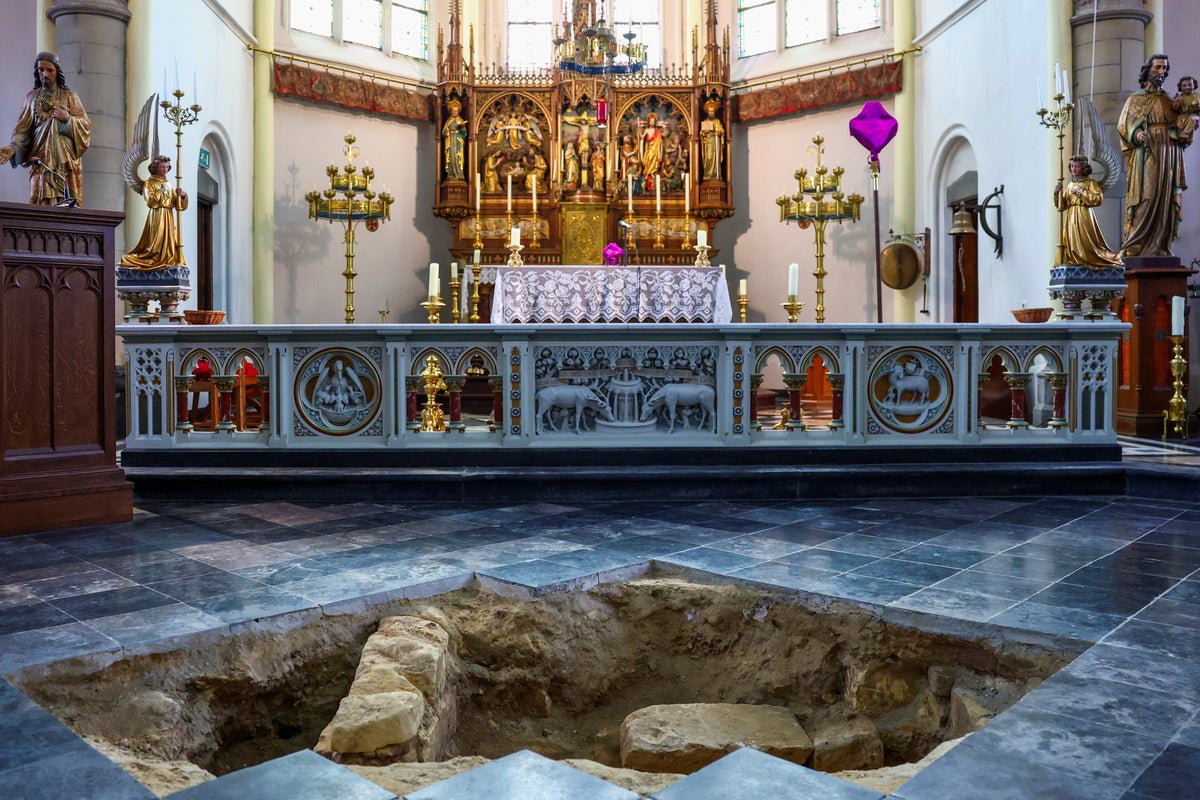
Excavating a church is not like a movie. There are no sudden collapses into secret chambers. It is a slow, agonizing process of brushing away centuries of dust. The current church in Wolder is not the same structure that stood in 1673; it was rebuilt in the 19th century. However, churches are almost always built atop their ancestors. The foundations of the old world remain, cradled by the new.
Researchers have identified several graves within the footprint of the older church. To find the Musketeer, they look for specific markers. A man in his sixties. Evidence of a violent death. Perhaps a fragment of a uniform or a lead seal.
But there is a catch.
History is messy. The French army was a machine of bureaucracy, yet even they lost track of their dead in the chaos of a protracted campaign. There are records of other high-ranking officers buried in the same vicinity. This is not a search for a needle in a haystack; it is a search for one specific needle in a box of identical needles.
Why We Still Care
It is easy to dismiss this as academic curiosity. Why does it matter where a 350-year-old Frenchman is buried?
It matters because d’Artagnan represents the last of something. He lived at the twilight of the age of the individual warrior. Shortly after his death, warfare became an industrial pursuit—massed batteries of cannons and faceless lines of infantry. He was the bridge between the knight errant and the modern soldier.
When we talk about the Musketeers, we are talking about a specific kind of friendship—the kind forged in the face of certain death. That resonates today because our own lives often feel fragmented and lonely. The idea of "One for all" is a visceral antidote to the hyper-individualism of the 21st century. If we find his bones, we find the physical proof that the man who inspired that ideal was real. He wasn't just ink on a page. He was a man who felt the cold, who worried about his men, and who eventually ran out of luck in a Dutch ditch.
The Cost of Discovery
There is a certain melancholy in the search. Right now, d’Artagnan is everywhere. He is in every library, every cinema, and every child’s imagination when they pick up a stick and pretend it's a sword. He is a ghost of the air.
Once you find the body, the mystery evaporates. The skeleton will be measured. The DNA will be sequenced. The musket ball hole in the vertebrae will be photographed and cataloged. We will have the facts, but we might lose some of the magic.
Archaeology is an act of reclamation, but it is also an act of finality. To find him is to finally let him die.
The researchers in Maastricht continue their work with a quiet intensity. They move through the archives and the soil, seeking a signature written in calcium. They are looking for a man who spent his entire life in the shadow of a king, only to become more famous than the monarch he served.
Outside the church in Wolder, the wind still carries the scent of the North Sea. The fields are green, hiding the scars of the trenches that once crisscrossed this land. Somewhere, perhaps only a few feet beneath the feet of unsuspecting parishioners, lies a soldier who never made it home to Gascony.
He is waiting in the dark. He is waiting for the light to hit his ribs one last time, proving that even the grandest legends are eventually reclaimed by the earth.
The shovel strikes the stone. The dust rises. The hero is almost within reach.