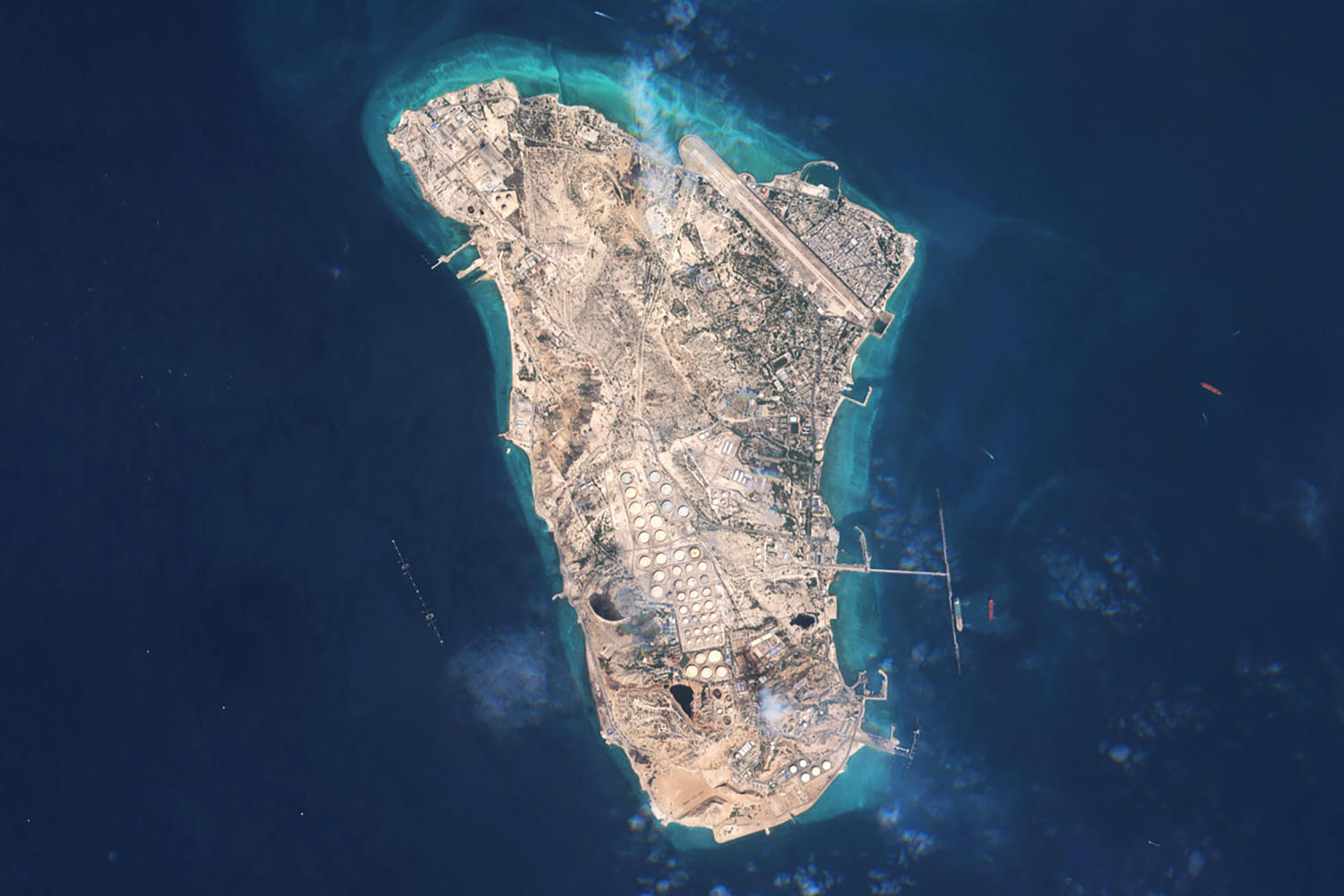
The United States is currently staring at a eight-square-mile coral limestone outcrop in the northern Persian Gulf that could either break the Iranian regime or shatter the global energy architecture. Kharg Island is not just a terminal. It is the jugular vein of the Islamic Republic, a facility that funnels 90% of Iran’s crude oil to the world, primarily to Chinese refineries that keep Tehran’s balance sheets from collapsing into total insolvency.
Recent strikes by U.S. and Israeli forces have already "tenderized" the island, according to Pentagon sources. While the March 13th sorties specifically targeted military radar installations and surface-to-air missile batteries, the message from the Trump administration was anything but subtle. The pipes were spared, for now. But the White House’s increasingly vocal contemplation of a full-scale seizure or a "permanent blockade" of the island represents a fundamental shift in Middle Eastern warfare. This is no longer about containment. It is about a forced liquidation of the Iranian state’s primary asset.
The Crown Jewel in the Crosshairs
Kharg Island sits roughly 15 miles off the Iranian coast, a proximity that makes it both an easy target for Western air power and a nightmare for any potential occupying force. For decades, the logic was simple: don't touch Kharg. If you destroy Kharg, Iran has nothing left to lose and will burn the rest of the Gulf’s energy infrastructure in a "Samson Option" of regional proportions.
The Trump administration appears to be betting that this old logic is dead. By systematically dismantling the air defenses surrounding the island, the U.S. has effectively turned Kharg into a high-security warehouse with no doors. The strategic "why" is driven by a desire to force an end to the blockade of the Strait of Hormuz. Iran has choked the strait, sending Brent crude prices into a vertical climb. The American response is a classic leverage play: you take our shipping, we take your oil.
A Logistics Suicide Mission
The talk of "boots on the ground" on Kharg Island sounds decisive in a briefing room, but on the water, it looks like a recipe for a self-imposed hostage crisis. Veteran naval planners are quietly sounding alarms about the "seize and hold" strategy.
- The Kill Zone: Kharg is only 25 kilometers from the Iranian mainland at Bushehr. This puts every American soldier on that island within range of Iranian shore-based anti-ship missiles, swarming drone boats, and tube artillery.
- The Infrastructure Trap: You cannot simply "turn off" Kharg and wait. The island is fed by a complex web of subsea pipelines. If Iran's Revolutionary Guard decides to sabotage the pumping stations on the mainland, the U.S. would be left holding a dry, multibillion-dollar ruin while still taking fire from the coast.
- The China Factor: Almost every barrel leaving Kharg is destined for China. Seizing the island isn't just a blow to Tehran; it is a direct physical intervention in Beijing’s energy supply chain.
We are seeing a move away from the "maximum pressure" of sanctions into a new era of "kinetic foreclosure."
The Resilience of the Terminal
History suggests Kharg is harder to kill than it looks. During the "Tanker War" of the 1980s, Iraq struck the island more than 2,000 times. The Iranians proved remarkably adept at "jury-rigging" repairs, using floating terminals and ship-to-ship transfers to keep the revenue flowing.
The current administration’s plan assumes that modern precision munitions and a physical occupation can achieve what Saddam Hussein’s air force could not. But the technical reality of oil logistics is that you don't need a pristine terminal to export crude. You just need a pipe and a way to get a hose to a tanker. Even if the U.S. occupies the main berths, Iran can—and likely will—utilize its Jask terminal outside the Gulf or increase "ghost" transfers at sea.
The $120 Barrel Reality
If the order is given to "take out" the oil infrastructure rather than occupy it, the global market reaction will be instantaneous and brutal. Analysts at Deutsche Bank and JPMorgan are already modeling scenarios where Brent crude surpasses $120 per barrel within 48 hours of a confirmed hit on Kharg’s loading arms.
The irony of the current strategy is that while it aims to punish Iran for high energy prices, the act of neutralizing Kharg would likely cement those high prices for years. Iran’s 1.6 million barrels per day would vanish from the global ledger. While OPEC+ technically has the spare capacity to fill that gap, the geopolitical premium added to every barrel coming out of the Gulf would negate any benefit of increased supply.
Beyond the Pipes
The real danger isn't just the oil. It is the shift in the "rules of the game." For fifty years, even at the height of the Cold War or the various Gulf conflicts, energy infrastructure was largely treated as a "no-go" zone because of the mutual economic destruction its loss would entail.
By putting Kharg Island on the chopping block, the U.S. is signaling that the era of the petrodollar truce is over. Iran has already hinted at its counter-move: if Kharg goes, the desalination plants that provide 90% of the drinking water for Kuwait, Oman, and the UAE become valid targets. We are no longer talking about a war for oil. We are talking about a war that could leave the most strategic region on earth without water or power.
The decision to move on Kharg Island is being framed as a surgical strike to end a war. In reality, it is a high-stakes gamble that assumes the enemy will fold once their bank account is frozen. But as we have seen in every conflict from the 1980s to the present, when a regime's survival is at stake, they don't look at the balance sheet. They look for the biggest match they can find to set the whole room on fire.
Monitor the movement of the Bataan Amphibious Ready Group. If those ships move north of the Strait of Hormuz, the gamble has begun.