The Israeli military’s current push into Southern Lebanon is not a localized tactical correction. It is a fundamental attempt to rewrite the security architecture of the Levant through a high-stakes campaign of attrition. While the stated goal remains the return of displaced residents to northern Israel, the operational reality on the ground suggests a much broader ambition: the systematic dismantling of Hezbollah’s subterranean infrastructure and the imposition of a new "buffer" logic that the region hasn't seen in two decades. This isn't a repeat of 2006. It is a calculated grind.
The core of the strategy relies on a "limited" ground incursion supported by an unprecedented air campaign. By striking the Dahiyeh suburbs of Beirut and the Bekaa Valley simultaneously, the Israel Defense Forces (IDF) are attempting to sever the logistical arteries connecting Hezbollah’s command centers to its frontline fighters. However, the sheer density of the Litani River corridor means that "limited" is a relative term. As armor moves across the Blue Line, the IDF faces a landscape literally carved into a fortress over eighteen years.
The doctrine of graduated suffocation
Military analysts often look for a "decisive blow" in Middle Eastern conflicts. They rarely find one. Instead, the current Israeli approach is one of graduated suffocation. Rather than a lightning strike toward Beirut, the IDF is conducting a series of methodical, village-by-village sweeps designed to uncover and destroy "Nature Reserves"—the Hezbollah term for hidden rocket launch sites and tunnel networks.
This strategy acknowledges a hard truth. You cannot defeat an entrenched guerrilla force with airpower alone. But the ground cost is steep. Hezbollah has spent nearly two decades preparing for this exact maneuver, utilizing the rugged topography of Southern Lebanon to negate Israel’s technological edge in thermal imaging and drone surveillance. In the narrow wadis and limestone ridges, high-tech sensors often lose their utility, forcing the conflict back into the brutal, close-quarters infantry engagements that defined the 1990s.
The military leadership in Tel Aviv is betting that by decapitating the senior leadership—most notably through the strike on Hassan Nasrallah—they have induced a systemic paralysis. But history shows that decentralized insurgencies often find their most lethal form when the chain of command is broken. Local commanders, acting with autonomy, are often more unpredictable and more desperate.
The logistics of the subterranean war
To understand why this conflict is dragging, one must look below the surface. Hezbollah’s tunnel network is not a series of primitive crawl spaces. It is a sophisticated, reinforced concrete grid that allows for the movement of motorcycles, anti-tank guided missiles (ATGMs), and even small vehicles.
The IDF's primary objective isn't just to push fighters back; it is to collapse these arteries. This requires specialized engineering units like the Yahalom, who must clear tunnels that are often booby-trapped with "daisy-chained" explosives. This is slow work. It is dangerous work. And it is work that cannot be done from 30,000 feet.
The presence of the Kornet anti-tank missile remains the single biggest threat to Israeli armor. These Russian-designed, laser-guided projectiles can pierce the most advanced Merkava tanks if they catch them at the right angle. By operating from hidden apertures in the hillsides, Hezbollah teams can fire and vanish back into the earth before an Israeli drone can reset its targeting loop. This "whack-a-mole" dynamic explains why the IDF is moving with such uncharacteristic caution, often flattening entire city blocks to ensure no fire positions remain.
The displacement trap
While the military maneuvers dominate the headlines, the demographic shift is the real metric of success or failure. Over a million Lebanese citizens have fled North, while 60,000 Israelis remain unable to return to their homes in the Galilee.
Israel is attempting to create a "pressure cooker" effect. The hope is that the displacement of the Shiite population will turn the rest of Lebanon’s sectarian mosaic against Hezbollah. This is a recurring theme in Israeli strategy, yet it historically yields the opposite result. Displaced populations often become more radicalized, and the vacuum left by a weakened state is almost always filled by the very militia groups Israel seeks to destroy.
The Lebanese Armed Forces (LAF) remain a bystander in this. Patched together with international funding and tasked with maintaining a neutrality that is functionally impossible, the LAF cannot intervene without risking a total civil collapse. This leaves the UNIFIL peacekeepers in an even more precarious position. Their presence, intended to be a buffer, has become a logistical obstacle for both sides.
The Iranian shadow and the red line
Tehran’s role is the silent variable that dictates the ceiling of this escalation. For Iran, Hezbollah is the "crown jewel" of the Axis of Resistance. It is the primary deterrent against a direct strike on Iranian nuclear facilities. If Israel moves to completely annihilate Hezbollah’s military capacity, Iran faces a binary choice: watch its multi-billion dollar investment evaporate or intervene directly.
The October missile barrages from Iran were a signal that the red lines have shifted. We are no longer in an era of proxy-only warfare. The risk of a regional conflagration is no longer a theoretical talking point for think tanks; it is the baseline for current military planning. Israel’s strategy depends on the assumption that Iran is too weak, or too cautious, to commit to a full-scale war. It is a gamble predicated on the internal stability of the Islamic Republic.
Tactical shifts in the North
- Precision Intelligence: The IDF is utilizing AI-driven target acquisition to map out Hezbollah's mid-level commanders in real-time.
- Active Defense: The Iron Dome and David’s Sling systems are being pushed to their intercept limits by high-volume rocket barrages.
- Economic Attrition: Israel’s economy is feeling the strain of a multi-front war, with reserve call-ups draining the tech and agricultural sectors of vital manpower.
The attrition isn't just happening on the battlefield. It's happening in the bank accounts and the psyche of the Israeli public. The "forever war" sentiment is growing, even as the military reports tactical successes.
The Litani limit
UN Resolution 1701, which ended the 2006 war, called for Hezbollah to withdraw north of the Litani River. It never happened. Now, Israel is attempting to enforce that resolution through kinetic force. But even if the IDF clears the area to the river, the question remains: who holds it?
Occupation is a dirty word in Israeli politics for a reason. The "Security Zone" that existed from 1985 to 2000 became a quagmire that bled the IDF for fifteen years. Military planners are desperate to avoid a permanent presence, yet they cannot guarantee safety for northern residents without one. This is the paradox of the Lebanese border. A retreat without a viable third-party force—something more capable than the current UNIFIL mandate—simply resets the clock for the next round of violence.
The sheer volume of ordnance being used is also a factor. The IDF is burning through munitions at a rate that requires constant replenishment from the United States. This creates a political tether. Washington’s appetite for a prolonged Lebanese campaign is shrinking, especially as the humanitarian situation in Gaza remains a global focal point. Israel is racing against a diplomatic clock that is ticking much faster than the military one.
The tech gap and the human factor
Despite the emphasis on "smart" bombs and cyber warfare, the war in Lebanon remains a contest of wills. Hezbollah fighters are indigenous to this soil. They know every cave, every trail, and every basement. The IDF, while superior in every measurable technical category, is fighting as an expeditionary force.
We are seeing a convergence of old-school trench warfare and new-age drone swarms. Hezbollah has begun using FPV (First Person View) drones to target Israeli staging areas, a tactic borrowed directly from the battlefields of Ukraine. This democratization of precision strike capability means that even a technologically inferior force can inflict high-profile damage on a modern army.
The IDF's response has been to saturate the electronic spectrum, jamming GPS and communication signals across northern Israel and southern Lebanon. This has turned the border into a "dark zone" where traditional navigation fails, and pilots must rely on inertial guidance and visual landmarks. It is a return to a more primal form of combat, hidden behind a veil of electronic noise.
The erosion of the "Buffer" concept
For decades, the buffer zone was seen as a geographical solution to a political problem. But in an era of hypersonic missiles and long-range drones, geography is losing its protective power. A ten-mile strip of land does little to stop a ballistic missile launched from the heart of Beirut or the deserts of Iraq.
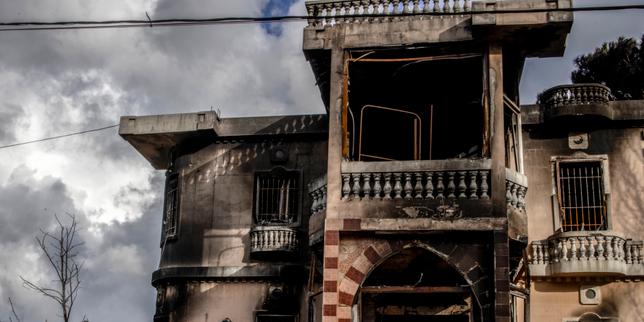
Israel’s strategy is therefore transitioning from a geographical buffer to a functional one. They are trying to destroy the capability to launch, rather than just seizing the ground from which launches occur. This requires a much higher level of destruction. It requires the total neutralization of any building or structure that could house a launcher. The result is a wasteland where villages once stood.
This "wasteland strategy" creates its own set of long-term security risks. A scorched earth policy may provide a temporary reprieve, but it ensures that the eventual political settlement will be built on a foundation of absolute resentment. In the Middle East, today’s tactical victory is almost always the seed of tomorrow’s strategic crisis.
The IDF is currently trapped in a cycle of tactical excellence and strategic ambiguity. They are winning the battles, clearing the tunnels, and killing the leaders. Yet, the rockets continue to fall, and the border remains a ghost town. The military can clear the path, but it cannot force a population to feel safe. Until the political reality in Beirut and Tehran shifts, the Israeli army is merely managing a fire it cannot extinguish.
The road to the Litani is paved with high-tech sensors and heavy armor, but it leads to a destination that looks remarkably like the past. The only difference this time is the scale of the firepower and the speed at which the region can spiral. Every house demolished in a Lebanese border village is a data point in a much larger, much more dangerous calculation that neither side has fully solved.
The true test of this strategy will not be the number of tunnels destroyed, but whether a single Israeli family feels comfortable enough to sleep in their own bed in Metula or Kiryat Shmona. Until that happens, the war in Lebanon isn't a strategy; it's a holding pattern.
The mission is clear, the execution is ruthless, and the outcome remains as murky as the morning fog over the Galilee.
Stop looking for an exit strategy. There isn't one. There is only the next ridge.