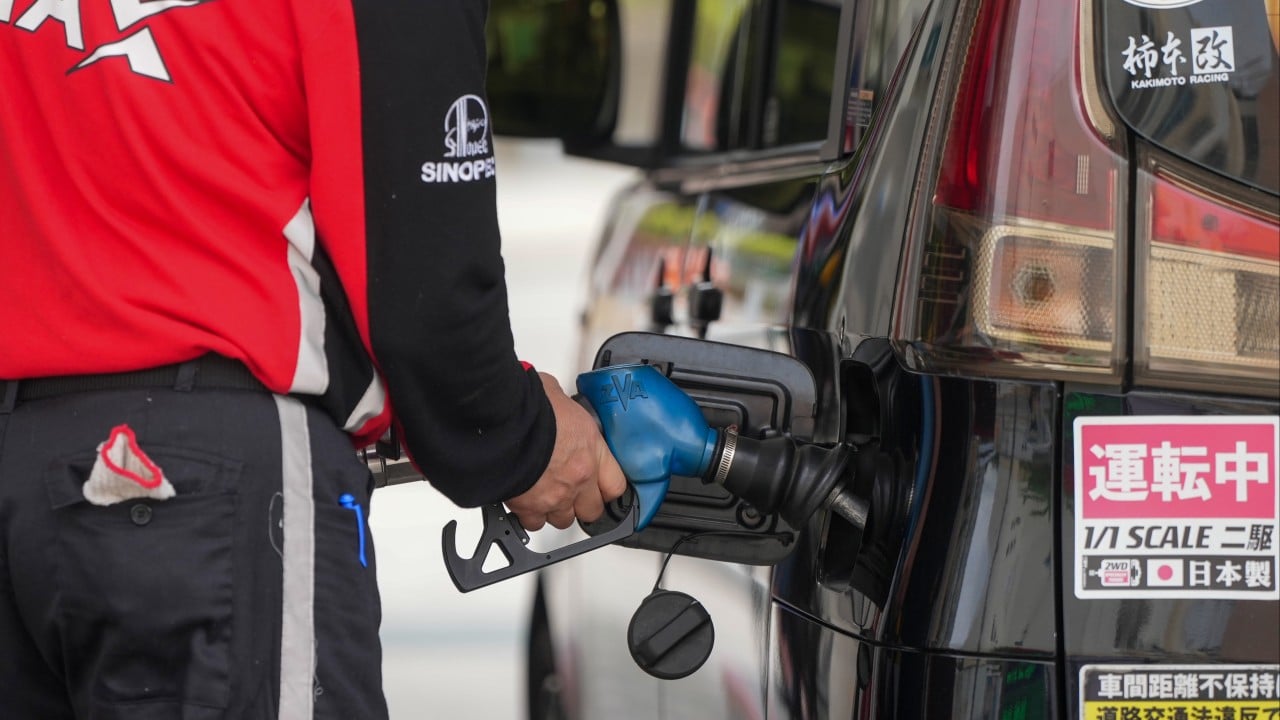
Hong Kong motorists are paying some of the highest pump prices on the planet, and the standard explanation—that we live in a land-starved city with no local refineries—no longer holds water. While global crude prices fluctuate, the cost at local stations remains stubbornly high, trailing market drops with a glacial pace while mirrors every spike with immediate precision. This "rocket and feather" pricing mechanism suggests something far more systemic than simple logistics. The city is currently facing a crisis of transparency where the gap between import costs and retail prices has widened to a point that defies traditional economic logic.
For decades, the government has maintained a hands-off approach, citing the virtues of a free market. However, a market is only free if there is genuine competition. In Hong Kong, a handful of players dominate the physical sites, the supply chain, and the pricing structures. When every station from Kennedy Town to Kwun Tong displays identical prices down to the cent, the consumer isn't looking at a competitive market. They are looking at an oligopoly protected by high entry barriers and a land policy that prioritizes premium revenue over affordable infrastructure.
The Import Price Disconnect
To understand why you are being squeezed, you have to look at the "spread." This is the difference between the Mean of Platts Singapore (MOPS) benchmark—the price at which oil companies buy refined product—and the price at the pump. Historically, this margin covered operating costs, land premium, and a reasonable profit. In recent years, that margin has decoupled from reality.
When international oil prices crashed during global downturns, the savings passed to Hong Kong drivers were fractional. Conversely, when tensions in the Middle East or production cuts by OPEC+ push crude up by a few dollars, the local pumps react within hours. This isn't just an observation; it’s a mathematical trend. Data indicates that the retail price of unleaded petrol in Hong Kong has risen at a rate that significantly outpaces the increase in import costs over the last decade.
The oil majors argue that their "land costs" and "operating expenses" are unique to Hong Kong’s hyper-dense environment. It’s a convenient shield. While it is true that labor and electricity have risen, they haven't risen by the 40% to 60% margins we see reflected in the price gap. The reality is that the companies are padding their bottom lines because there is no regulatory floor—or ceiling—to stop them.
The Land Premium Trap
The government is not a neutral observer in this struggle. In fact, the way petrol filling station sites are tendered is a primary driver of high prices. Sites are auctioned to the highest bidder. Because the number of available plots is strictly limited by urban planning, oil companies must pay astronomical sums to secure a footprint.
These companies are not charities. Every dollar paid to the government in a land tender is eventually clawed back from the person filling up their tank. This creates a circular economy where the government nets massive one-off revenues from land sales, while the public pays a perpetual "tax" through inflated fuel costs.
- Limited Supply: New players cannot enter the market because there are no new sites being zoned.
- High Sunk Costs: Only the biggest multinational corporations can afford the upfront capital for a 21-year lease.
- Lack of Incentives: Once a company wins a site, there is zero incentive to lower prices, as their neighbors are likely facing the same high overheads and similar corporate mandates for ROI.
If the government truly wanted to lower fuel prices, they would change the tender process. Instead of awarding sites to the highest bidder, they could award them to the company that guarantees the lowest profit margin or the most competitive pricing for the duration of the lease. They choose not to.
The Myth of the Discount Culture
Walk into any station and you’ll see a wall of promotions. Credit card tie-ins, loyalty points, "Super" grade versus "Regular" grade, and weekend specials. This is a deliberate distraction. By creating a complex web of discounts, the oil companies make it nearly impossible for the average consumer to track the actual base price.
This "shrouded pricing" is a classic tactic used in industries where true competition is failing. If everyone is confused about what they are actually paying, they stop shopping around. They stick to the brand that gives them the most "points," even if the base price is $5 higher than it should be.
More importantly, these discounts are often funded by the higher margins on "premium" fuels. Most modern cars in Hong Kong do not require the ultra-high-octane fuel marketed as "Gold" or "Platinum," yet these products are pushed aggressively. By narrowing the availability of standard-grade fuel, companies force drivers into a higher price bracket under the guise of "engine health."
Why the Competition Commission is Toothless
There have been calls for the Competition Commission to intervene. They have investigated. They have published reports. And yet, nothing changes. The problem lies in the legal definition of "collusion." Under current laws, it is not illegal for companies to follow each other's prices. This is known as "parallel pricing" or "price leadership."
As long as the oil companies don't sit in a smoke-filled room and sign a document agreeing to fix prices, they are technically within the law. They simply watch their competitor across the street and match their price movement within minutes. In a small, concentrated geography like Hong Kong, this is easy to do without ever picking up the phone.
To break this, we don't need more reports. We need a fundamental shift in how fuel is classified. If fuel is treated as a public utility—similar to electricity or water—the government could implement a "Scheme of Control." This would limit the profit margins of oil companies in exchange for their right to operate on public land.
The Electric Vehicle Pivot is a False Hope
Some suggest that the rise of Electric Vehicles (EVs) will solve the problem. As more people switch to Teslas and BYDs, the demand for petrol will drop, theoretically forcing prices down. This is a misunderstanding of how dying industries behave.
As the volume of petrol sold decreases, the fixed costs of maintaining the stations and the supply chain stay the same. To maintain their profit levels on lower volume, oil companies are more likely to increase margins, not decrease them. We are entering a "death spiral" phase for fossil fuels in Hong Kong, where those who cannot afford an EV or don't have a place to charge one—usually the working class and commercial drivers—will bear an even heavier burden.
Logistics companies, van drivers, and taxi operators are the backbone of the city’s economy. Every cent added to a liter of diesel or petrol ripples through the supply chain. It makes your groceries more expensive. It makes your furniture delivery more expensive. This isn't just a "driver's problem"; it is an inflationary pressure on the entire SAR.
The Path to Transparency
If the administration is serious about "sharing the wealth" and reducing the cost of living, the first step is a mandatory disclosure of the import-to-retail price ladder. The public deserves to see exactly how much of that $25 per liter goes to the producer, how much goes to the government in duty, how much covers the land premium, and how much is pure, unadulterated profit.
We also need to look at the fuel terminal at Tsing Yi. This critical infrastructure is the gateway for all fuel entering the city. If the gatekeeper of that terminal is also a retail competitor, they have an inherent advantage. Opening up terminal access to independent "unbranded" fuel importers would allow smaller, cheaper stations to pop up, breaking the grip of the big four.
The current system is a comfortable arrangement for the companies and a lucrative one for the Treasury. The only person losing is the one holding the nozzle. Without a structural overhaul of how station land is leased and a firm cap on profit margins relative to MOPS, Hong Kong will remain the world's most expensive place to keep a car running.
Demand a breakdown of the land premium's impact on your daily commute. Use your voice to push for "utility-style" regulation of fuel prices. Check the daily MOPS rates against your local pump price every Monday and ask why the gap is wider today than it was five years ago.