The pre-dawn light in a small apartment in Ohio doesn’t look like a geopolitical flashpoint. It looks like Elias, a father of two, staring at a digital thermostat. He’s calculating a silent, brutal math. If he turns the heat up three degrees to take the chill off his daughter’s cough, he might have to skip the good eggs at the grocery store. This isn't a story about a thermostat. It is a story about a viscous, dark liquid buried miles beneath the earth’s crust that dictates the tempo of Elias’s life, and yours.
Most people think of the price of oil as a number on a rotating sign at a gas station. They see it as a nuisance, a fluctuating tax on their commute. That is a dangerous oversimplification. Oil is not just fuel. It is the molecular ghost in the machine of modern existence. It is the reason your aspirin costs four dollars instead of forty, and the reason your strawberries can travel four thousand miles without rotting. When the price of a barrel shifts in a glass-walled office in London or Dubai, a vibration travels through the world, rattling every shelf, every paycheck, and every dinner table.
The Invisible Ingredient in Everything
Look around the room where you are sitting. If you see plastic, you are looking at oil. If you see synthetic fabric in your carpet or your clothes, you are looking at oil. If you are holding a smartphone, you are holding a complex lattice of petroleum derivatives.
Consider a single head of lettuce. To a casual observer, it’s a product of sun, water, and soil. To an economist, that lettuce is a vessel for diesel. A tractor burned oil to plant it. A harvester burned oil to pick it. A truck burned oil to refrigerate it and haul it across a continent. Even the fertilizer that made it grow was likely synthesized using natural gas, which moves in lockstep with oil markets. When crude prices climb, the lettuce doesn't just get more expensive because of the shipping. The very cost of its "birth" rises.
This is why inflation is often just a shadow cast by energy prices. When oil spikes, the cost of doing literally anything increases. This isn't a linear progression. It's a cascade. A manufacturer sees their electricity bill rise because the grid relies on peak-load gas plants. Their raw material costs go up because the plastic resin they buy is oil-based. Their shipping fleet costs more to run. They have two choices: go bankrupt or pass that cost to you. They always choose the latter.
The Geopolitical Seesaw
We like to believe we live in an era of digital dominance, where silicon and code rule the world. We are wrong. We still live in the age of the carbon atom. The price of oil is the ultimate geopolitical leverage, a dial that can be turned to enrich a nation or starve a regime.
Imagine a hypothetical country, let’s call it Petrostania. Their entire national budget—schools, roads, military, social safety nets—is predicated on oil staying above $70 a barrel. If the global price drops to $50 because of a production surge in the Permian Basin or a diplomatic spat in the Middle East, Petrostania doesn't just lose profit. It loses its mind. It faces civil unrest. It might even start a war to reclaim its relevance.
Conversely, when prices skyrocket, wealth transfers at a rate that would make a Viking raid look like a bake sale. Trillions of dollars flow from consuming nations to producing ones. This isn't just "business." It's a fundamental restructuring of global power that happens every time you pull the trigger on a gas pump. We are all participants in a massive, involuntary redistribution of wealth.
The Velocity of the Ripple
There is a lag time to this pain. That’s what makes it so insidious. When the price of Brent Crude jumps on a Monday, you might not feel it at the grocery store until a month later. By then, you’ve forgotten the headline about the tanker seizure or the OPEC+ meeting. You just know that your life feels suddenly, inexplicably more expensive.
This creates a psychological weight. Economists call it "consumer sentiment," but that sounds too sterile. It’s actually a form of low-grade, collective anxiety. When people see gas prices rising, they stop spending on "extra" things. They skip the movie theater. They delay the dental work. They don't buy the new shoes.
The economy is a giant, interconnected web of expectations. If enough people like Elias in Ohio decide to hold onto their money because the "signs" (the literal gas station signs) look bad, the entire engine begins to stall. Small businesses fail. Jobs are cut. The ripple becomes a wave.
The Great Transition Paradox
We are told we are moving away from oil. We hear about the "Green Revolution" and the "Energy Transition" every single day. And it’s true; the world is changing. But here is the uncomfortable reality: the more we try to leave oil behind, the more volatile its price becomes.
Investments in new oil fields have slowed down because banks are under pressure to fund renewables. Yet, global demand for oil is still hitting record highs. We are caught in a middle ground where we aren't producing enough new oil to ensure stability, but we aren't yet at a point where we can live without it. This creates a "supply crunch" that acts like a spring under tension. The slightest touch—a storm in the Gulf, a pipeline leak, a tweet—sends the price screaming upward.
We are living in the era of the "Fragile Middle."
Even the electric vehicles (EVs) that are supposed to save us are currently tethered to the price of oil. The steel in their frames, the chemicals in their batteries, and the tires on their wheels (which are almost entirely petroleum-based) all fluctuate based on the energy market. You cannot build a post-oil world without using a staggering amount of oil.
The Human Cost of a Dollar
Back to Elias.
He finally decides to keep the heat low. He puts on a sweater. He tells himself it’s good for his kids to learn "resilience." But later that night, as he looks at his bank statement, he feels a sense of powerlessness that is hard to name. He has done everything right. He works hard. He saves. Yet, his ability to provide comfort for his family is being undermined by forces he can’t see and people he will never meet.
That is the true significance of the price of oil. It is the cost of freedom. It is the cost of warmth. It is the invisible tax on human dignity that rises and falls with the tides of global greed and necessity.
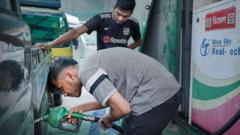
When you hear that oil has gone up five dollars a barrel, don't think about the stock market. Don't think about the profits of Exxon or Shell. Think about the logistics of a single loaf of bread. Think about the ambulance that needs fuel to reach a heart attack victim. Think about the millions of people living on the edge of a "just okay" life who are suddenly pushed into a "not okay" life.
The world doesn't run on money. It runs on energy. Money is just the way we keep score of who has the energy and who needs it. Until we find a way to decouple the very fabric of our physical reality from this dark, ancient liquid, we are all just passengers on a ship we don't control, watching the waves and praying for calm water.
The man in Ohio turns off the light. He doesn't know that three thousand miles away, a technician is closing a valve, or that ten thousand miles away, a prince is changing his mind. He only knows that tomorrow will be a little bit harder than today. He closes his eyes and waits for a morning that he hopes he can afford.