A man sits in a high-rise office in Dubai, watching the sunset bleed into the Persian Gulf. He isn’t looking at the view. He is looking at a spreadsheet that represents the survival of a nation. To him, the numbers aren’t abstract data points; they are the oxygen keeping a neighbor alive.
Money is often described as the sinew of war. We talk about the cost of missiles, the price of fuel, and the budget for boots on the ground. But we rarely talk about the price of the silence that follows. Right now, three massive, tectonic shifts in global capital are moving beneath the surface of the Middle East. They are the hidden bills of a conflict that has outgrown its borders, and they are about to be collected.
The UAE’s Quiet Rescue
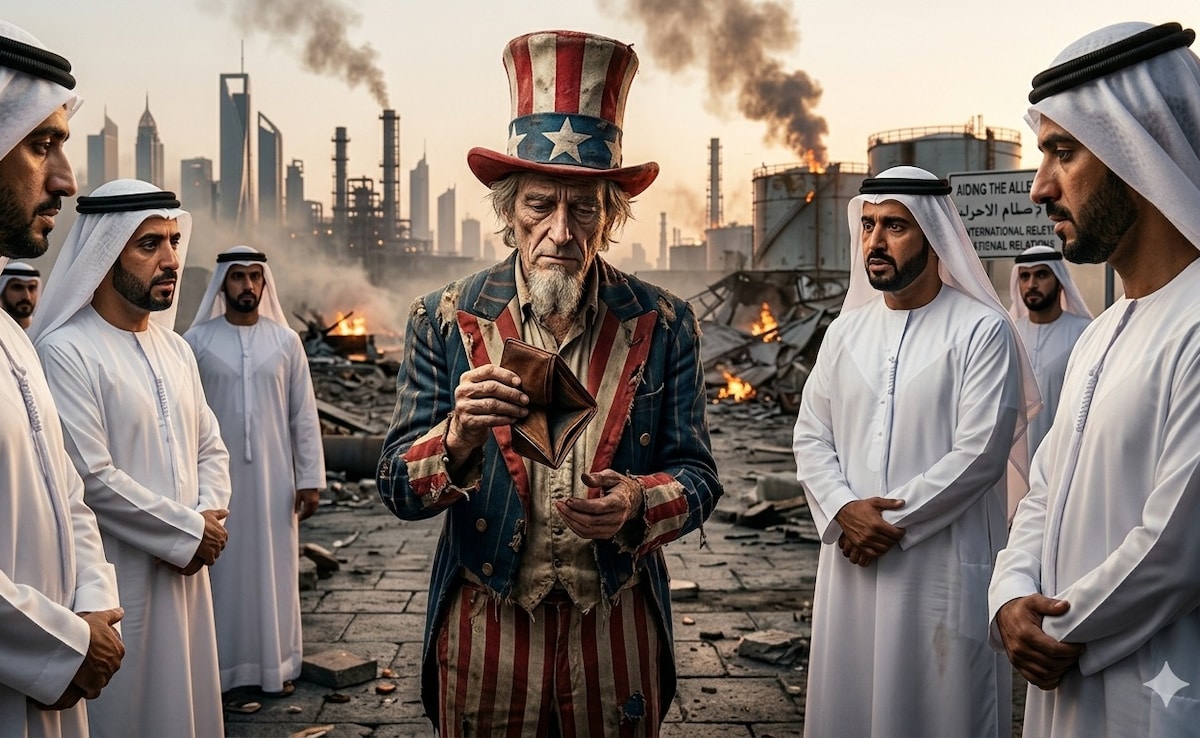
While the world watches the smoke over Gaza and the borders of Lebanon, a different kind of intervention is happening in the bank vaults of Abu Dhabi. The United Arab Emirates has stepped into the role of the region's ultimate insurer.
Think of a bridge that has been hit by a storm. The engineers are busy arguing about who caused the weather, but the traffic has stopped. The UAE is the crew showing up in the middle of the night to pour concrete into the cracks before the whole structure collapses into the sea.
They aren’t doing this out of pure altruism. Stability is the most valuable commodity in the desert. For the Emirates, a total economic collapse in Egypt or a localized depression in the Levant isn't just a humanitarian crisis; it’s a direct threat to their own vision of a post-oil future. They are writing checks to prevent the contagion of chaos. When you see a multi-billion dollar "investment" or a currency swap agreement announced with little fanfare, understand what it actually is. It’s a bailout designed to keep the lights on so the anger doesn't spill into the streets.
The $270 Billion Shadow
Then there is the number that haunts the dreams of Western diplomats: $270 billion.
This is the estimated value of Iran’s frozen assets, its oil revenue potential, and the complex web of its sanctioned economy. For years, the strategy was simple: starve the engine. If the money stays locked in foreign banks, the influence stays contained. But pressure is a strange thing. Apply it to a pipe, and the water doesn't just vanish; it seeks the smallest, most invisible leak.
Iran has mastered the art of the shadow economy. They have built a ghost fleet of tankers and a labyrinthine network of front companies that make the traditional financial system look like a child’s drawing. The $270 billion isn't just a pile of gold sitting in a vault waiting for a key. It is a psychological weight.
To the laborer in Tehran, that number represents the medicine his daughter can’t get or the inflation that eats his paycheck before he can reach the grocery store. To the hardliners, it is a grievance to be weaponized. The "bill" here isn't just financial. It’s the cost of a decade of economic warfare that has pushed a nation into a corner where the only way out is through escalation. We are reaching a point where the cost of maintaining the status quo is becoming more expensive than the cost of a messy, imperfect resolution.
The Search for the Exit
In Washington, the air is thick with the scent of an election and the desperate need for a "win." Donald Trump’s return to the conversation has introduced a specific, transactional energy to the geopolitical stage. He isn't looking for a grand philosophical peace; he’s looking for an off-ramp.
Imagine a gambler who has been at the table too long. He doesn't care about the ethics of the game anymore; he just wants to walk away with his dignity and enough chips to claim he won. This is the search for the transactional exit.
The strategy being floated isn't about traditional diplomacy. It’s about a deal. It’s the "Art of the Deal" applied to a centuries-old blood feud. The premise is straightforward: if you can make peace more profitable than war, the rational actors will eventually stop shooting. But the Middle East is rarely governed by the "rational actor" model taught in business schools. It is governed by memory, by pride, and by the ghosts of those who came before.
The off-ramp being constructed relies on a massive assumption. It assumes that every player has a price. It assumes that the UAE will keep paying, that Iran will settle for a partial thaw, and that the American electorate will accept a peace that looks more like a business merger than a moral victory.
The Weight of the Ledger
When we aggregate these three "bills," the total is staggering. It’s not just the trillions of dollars. It’s the human capital.
Consider a young entrepreneur in Cairo. She has a brilliant idea for a tech startup, but she can't get a loan because the bank's liquidity is being used to prop up the national currency. She is a line item in the UAE’s bailout. Consider the student in Isfahan who spends his nights learning code but can't access the global market because of the $270 billion wall. He is the collateral damage of the shadow economy.
These aren't dry policy points. They are lives on hold.
The tragedy of the current moment is that the people writing the checks and the people signing the sanctions rarely have to live with the consequences of their pens. They see the macro. They see the "landscape." They don't see the kitchen table where a father explains to his children why they are moving to a smaller apartment.
The reality of 2024 and beyond is that the traditional tools of statecraft are breaking. You cannot sanction a country into a democracy, and you cannot buy a lasting peace with a one-time wire transfer. The "off-ramp" might lead us off the highway, but it doesn't guarantee the road beneath us won't crumble.
We are watching a high-stakes game of musical chairs where the music is the sound of distant artillery and the chairs are made of burning oil. The UAE is trying to provide more chairs. Iran is trying to break the ones that are left. And the American political machine is trying to convince everyone that the game was their idea all along.
The bill is coming due. It won't be paid in a single currency. It will be paid in concessions that hurt, in compromises that feel like betrayals, and in the quiet realization that in this part of the world, you don't solve problems. You only manage them until the next sunset.
The man in the Dubai high-rise turns away from the window. The sun is gone. The spreadsheet is still there, glowing in the dark, a digital map of a debt that can never truly be settled. He sighs, hits save, and wonders if the concrete they poured today will be dry by morning.