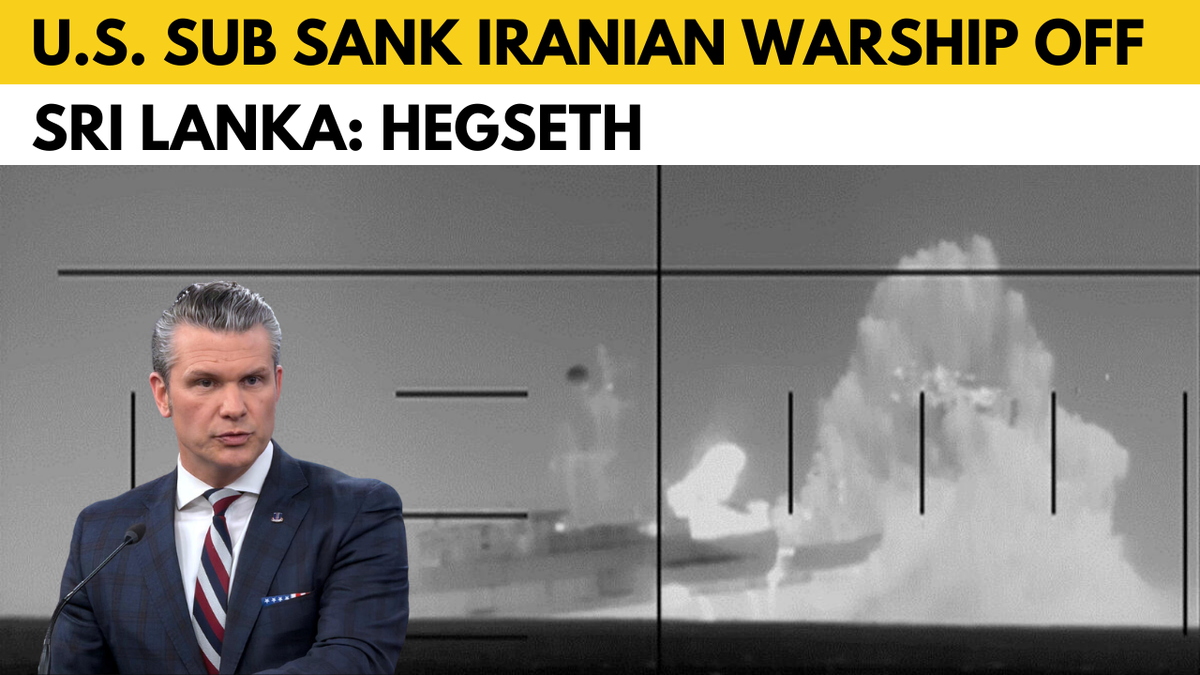
The recent destruction of an Iranian naval vessel in the Indian Ocean by a U.S. torpedo marks a violent departure from years of "shadow war" etiquette. While the Pentagon has remained tight-lipped about the specific engagement rules triggered, the raw footage of the hull splitting confirms a direct, lethal application of force that we haven't seen in this theater for decades. This wasn't a warning shot or a cyber-attack on a control system. It was a kinetic liquidation.
For years, the Indian Ocean and the Persian Gulf have served as a chessboard for "grey zone" conflict—actions that hurt the enemy but stay just below the threshold of open war. We saw limpet mines attached to tankers and drones hounding carrier groups. This sinking changes the math. By opting for a heavyweight torpedo rather than a missile or a boarding action, the U.S. Navy sent a message about terminality. When a Mark 48 ADCAP torpedo hits a ship, there is no "repairing" the situation. The vessel is erased.
The Anatomy of the Strike
Military analysts looking at the debris field and the thermal signatures of the event note that the Iranian vessel, likely an auxiliary or a modified logistics ship used for forward staging, had no time to deploy countermeasures. This suggests a failure of both onboard sensors and the broader intelligence net Iran maintains in the region.
A submarine-launched torpedo offers a level of stealth that an aerial strike cannot match. There is no radar signature of an incoming jet. There is no smoke trail from a Harpoon missile. There is only the acoustic signature of a high-speed screw, and by the time a hull-mounted sonar picks that up, the ship has seconds to live.
The use of this specific weapon system points to a calculated decision to leave no ambiguity. Missiles often leave a ship burning but afloat, providing a propaganda victory for the victim. Torpedoes use the physics of the water column itself to break the ship’s back. The explosion happens beneath the keel, creating a void. The ship falls into that void, and the weight of the ocean snaps the steel. It is a total loss.
Redefining Red Lines
Washington’s pivot to lethal force in the Indian Ocean suggests that the "harassment" phase of maritime diplomacy is over. To understand why this happened now, one has to look at the increasing sophistication of Iranian-backed maritime interference. It wasn't just about small speedboats anymore. Tehran had begun deploying "mother ships" that acted as floating bases for long-range suicide drones and intelligence gathering.
These vessels allowed Iran to project power far beyond the Strait of Hormuz, threatening shipping lanes that are vital for the global flow of liquefied natural gas and oil. The destroyed vessel was suspected of coordinating drone telemetry for attacks on commercial shipping. By removing the node, the U.S. didn't just sink a boat; it blinded a regional network.
Critics of the strike argue that this escalates the conflict into a hot war. They are half right. It escalates the stakes, but it also restores a sense of consequence that had been eroded by years of diplomatic hand-wringing. When there is no physical price for maritime aggression, aggression becomes the default state.
The Silent Service Steps Out
The most significant takeaway from this engagement is the overt role of the U.S. submarine fleet. Usually, the "Silent Service" operates under a veil of total secrecy. For the Pentagon to essentially confirm—or at least fail to deny—a torpedo strike, they are signaling that the ocean floor is no longer a neutral hiding place.
Subsurface dominance is the only card the U.S. can play that Iran has no meaningful way to counter. Iran’s navy is built for asymmetric coastal defense. They have hundreds of fast attack craft and land-based missile batteries. However, they have almost zero anti-submarine warfare (ASW) capability in deep water. If the U.S. is moving the fight to the deep Indian Ocean, Iran is playing a game where they can't even see the opponent’s pieces.
Engineering a New Deterrence
Modern naval warfare is often discussed in terms of "carrier killer" missiles and hypersonic threats. This incident brings the focus back to the fundamentals of displacement and pressure.
Consider the technical requirements for a successful torpedo intercept. A ship needs sophisticated towed-array sonar and active acoustic decoys. Most of the Iranian fleet, consisting of aging Western designs from the 1970s or domestically produced light frigates, lacks the signal processing power to isolate a modern torpedo signature from background sea noise.
- Acoustic Masking: The torpedoes used in these engagements utilize sophisticated mapping to approach from "dead zones" in the target's sonar coverage.
- Thermal Layering: Submarines use the different temperature gradients in the Indian Ocean to hide their noise, popping up only to deliver the payload.
- Proximity Fuzing: The weapon doesn't even need to touch the ship; it senses the magnetic field of the hull and detonates at the precise moment of maximum structural vulnerability.
This is a lopsided technological reality. Iran can build very effective drones for a few thousand dollars, but they cannot build a sonar system that can find a Virginia-class submarine for any amount of money.
The Strategic Vacuum
There is a hollow center in the international response to this sinking. Usually, such an event would be followed by an immediate emergency session of the UN Security Council. Instead, there is a wary silence. This suggests that many regional players, including those who publicly criticize U.S. presence, are privately relieved to see the Iranian "mother ship" strategy dismantled.
Shipping insurance rates in the region have been climbing for eighteen months. Every time a drone hits a tanker, the cost of doing business globally ticks upward. By removing the source of the data-linking for those drones, the U.S. is effectively subsidizing global trade security through kinetic action.
However, the risk remains. If Iran feels its conventional naval assets are too vulnerable, they will likely retreat further into the shadows. We should expect an increase in cyber-attacks on port infrastructure or the use of "civilian" dhows to drop sea mines. When a tiger realizes it can't fight a shark in deep water, it moves back to the shallows where it can hide in the reeds.
Beyond the Horizon
This engagement was not an isolated incident. It was a proof of concept. The U.S. Navy is demonstrating that it can and will strike assets that provide "command and control" for proxy forces.
The technical superiority of the U.S. underwater fleet is currently the only thing preventing the Indian Ocean from becoming a lawless corridor. This sinking was a reminder of that disparity. It was a cold, calculated move to strip away the anonymity of the Iranian operations.
Navies are built for two things: projecting power or protecting trade. Iran was using its vessel for the former, and the U.S. used a torpedo to enforce the latter. The debris on the ocean floor is a testament to the fact that in naval warfare, being "clever" with proxies eventually runs into the hard reality of a high-explosive warhead.
Watch the deployment patterns of the remaining Iranian forward-deployed vessels. If they retreat toward the coast, the strike worked. If they stay, the Indian Ocean is about to become a very loud place.