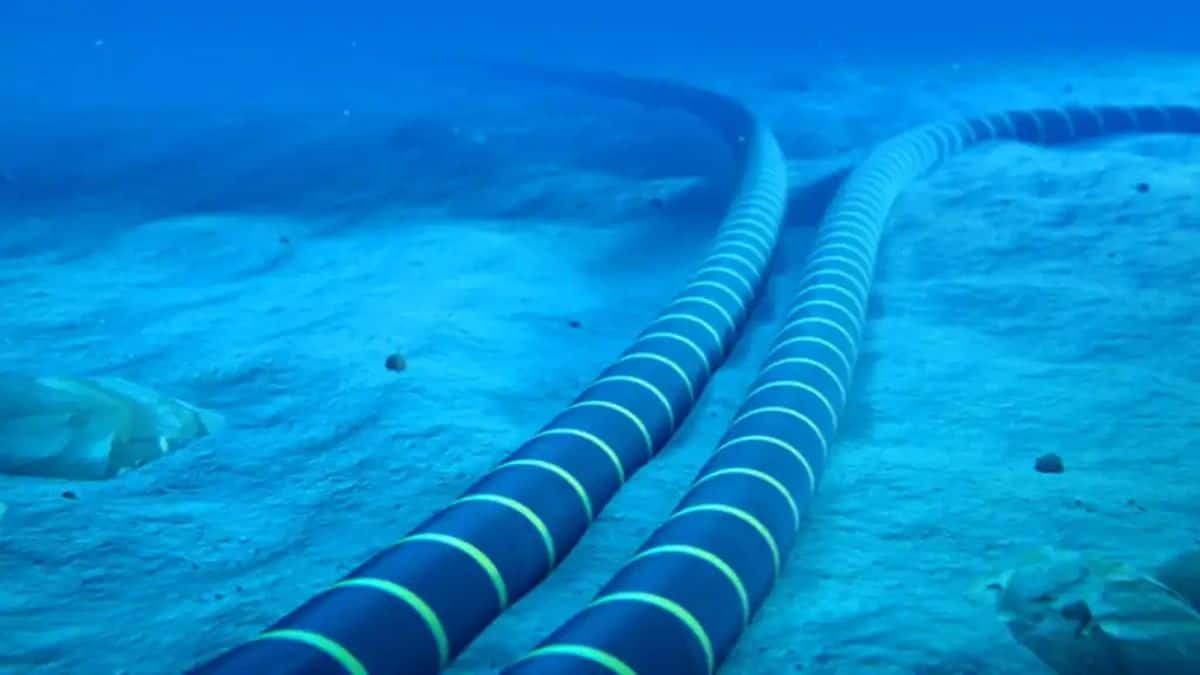
The physical security of the Strait of Hormuz is traditionally viewed through the lens of crude oil benchmarks and global energy inflation. This perspective is incomplete. For India’s digital economy, the Strait represents a concentrated failure point where geopolitical friction intersects with the physical layer of the internet. While data is intangible, its transport relies on high-density subsea fiber-optic cables that mirror historical maritime trade routes. Any disruption in this corridor does not merely slow down browsing speeds; it destabilizes the operational integrity of India’s IT-enabled services (ITeS) and financial settlement systems.
The Architecture of Digital Dependency
India’s internet backbone is not a decentralized web but a series of high-capacity pipes clustered in specific geographic landing points. The vulnerability of these systems can be categorized into three structural layers:
- The Landing Point Concentration: Mumbai and Chennai handle over 90% of India’s international data traffic. A significant portion of the western outbound traffic must transit the Arabian Sea and the Gulf of Oman to reach European exchange points.
- The Shallow Water Risk Profile: Cables in the Strait of Hormuz and surrounding areas are laid in relatively shallow waters. Unlike deep-ocean cables that rest 3,000 meters below the surface, cables in this region are susceptible to "accidental" physical damage from dragging anchors, bottom trawling, or targeted sabotage.
- The Latency-Throughput Trade-off: While satellite links like Starlink exist, they cannot match the terabit-per-second throughput or the sub-100ms latency required for high-frequency trading and real-time enterprise resource planning (ERP) syncs.
The Mechanics of a Data Chokepoint
When a subsea cable is severed or intercepted in a high-tension zone like the Strait of Hormuz, the impact follows a predictable kinetic-to-digital chain of causality.
Phase 1: Immediate Routing Failure
Most modern networks utilize the Border Gateway Protocol (BGP) to find the shortest path for data. If the Hormuz-aligned cables (such as the BBG or EIG systems) go dark, BGP attempts to reroute traffic through eastern paths via Singapore or terrestrial routes through Central Asia. This creates an immediate surge in "hop counts," increasing latency.
Phase 2: Congestion Collapse
The remaining functional cables are rarely provisioned for 100% redundancy at peak load. As traffic from the severed western routes floods the southern or eastern routes, these cables reach their capacity limits. Packet loss increases, and encrypted sessions (SSL/TLS) begin to time out, effectively "breaking" secure web applications even if a nominal connection exists.
Phase 3: Economic Decoupling
For India’s GCC (Global Capability Centers), which serve as the back office for Fortune 500 companies, a 200ms increase in latency is catastrophic. Voice-over-IP (VoIP) becomes unusable, and synchronized databases suffer from "split-brain" syndrome, where data entries on the Indian side diverge from the master server in North America or Europe.
Quantifying the Risk The Cost Function of Disruption
The economic impact of a Hormuz digital blackout is not linear; it is exponential based on the duration of the outage.
- Repair Latency: In a conflict zone, "Cable Ships" (specialized vessels required for subsea repair) cannot operate. The repair cycle for a deep-sea cable is usually 10 to 20 days. In a contested maritime environment, this window can extend indefinitely, turning a temporary glitch into a permanent degradation of service.
- Sovereign Data Risk: If traffic is rerouted through terrestrial cables in China or Russia to reach Europe, the data is subject to foreign intercept. For the Indian banking sector, this represents a non-negotiable security breach, forcing institutions to throttle their own traffic rather than risk exposure.
Strategic Divergence Terrestrial vs. Subsea
The primary failure of current Indian digital strategy is the over-reliance on the "Suez-Hormuz" corridor. To mitigate the Hormuz Chokepoint, a shift in infrastructure investment is required:
The Trans-Himalayan Alternative
India must pursue high-capacity terrestrial fiber through the International North-South Transport Corridor (INSTC). While terrestrial fiber is harder to maintain across mountainous terrain, it provides a physical bypass of the Arabian Sea. This reduces the "maritime risk premium" associated with subsea cables.
The Rise of Indefeasible Rights of Use (IRU) Diversification
Indian Telecom Service Providers (TSPs) often buy capacity on the same consortium cables. This creates "hidden commonality." A structural audit of IRUs would reveal that while a company claims to have three backup routes, all three may transit the same 50-mile wide corridor in the Gulf of Oman. True redundancy requires geographic separation—routes that exit via the Bay of Bengal and bypass the Middle East entirely.
The Logic of the Digital Shield
A resilient Indian internet requires the decoupling of connectivity from volatile maritime geography. This involves:
- Edge Computing Deployment: Moving the "compute" closer to the Indian user. If the critical data is cached or processed within Indian borders, the reliance on the Hormuz pipes for every single micro-transaction decreases.
- Mandatory Multi-Path Provisioning: Regulatory frameworks should mandate that "Critical Information Infrastructure" (CII) must have at least one non-Hormuz, non-Suez path active at all times, rather than keeping it as a "failover" that may not work during a crisis.
The Strait of Hormuz is no longer just a naval concern; it is a fundamental risk to the uptime of the Indian state. The shift from "just-in-time" connectivity to "just-in-case" infrastructure is the only viable path for a nation aiming for a five-trillion-dollar digital-first economy.
Final strategic move: Indian enterprises must immediately audit their Tier-1 transit providers to identify "Hormuz Exposure." If more than 60% of your outbound traffic relies on the Mumbai-Marseille corridor, you are operating on a single point of failure. Diversify to East-bound routes via Chennai-Singapore-Japan to the US West Coast to ensure survival in a contested maritime future.