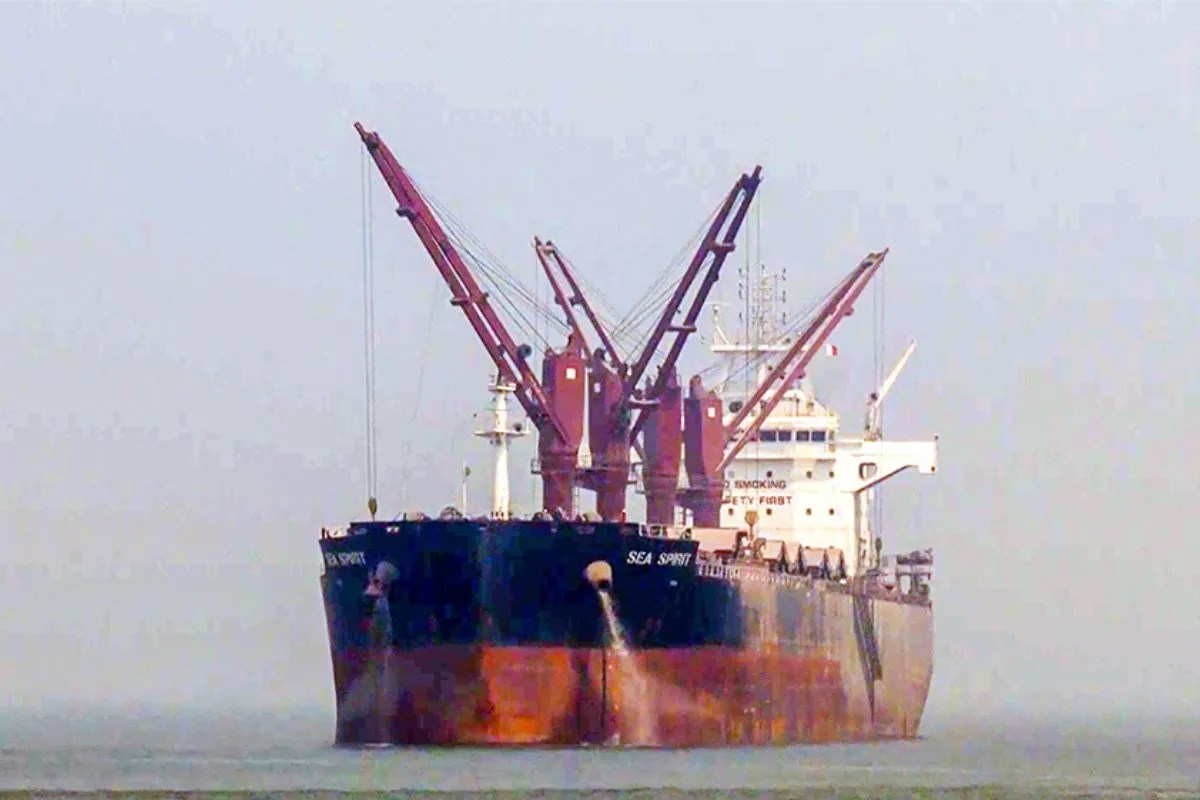
The media is obsessed with the "mystery" of how a third Iranian-linked tanker just slipped through the Strait of Hormuz despite a supposed American blockade. They frame it as a failure of intelligence or a lucky break for Tehran. They are wrong. There is no mystery, and there is certainly no blockade.
What we are witnessing isn't a game of cat and mouse. It is a high-stakes performance where the cat has no teeth and the mouse owns the floorboards. To understand why these tankers move with such impunity, you have to stop looking at the Strait as a military choke point and start seeing it for what it actually is: a sovereign toll road where the "police" have no legal standing to pull anyone over.
The Sanctions Delusion
Most analysts treat U.S. sanctions as if they were a physical wall. They aren't. They are a series of financial memos that only carry weight if you care about using the U.S. dollar. The "failure" of the blockade to stop these tankers isn't a tactical lapse; it’s a fundamental misunderstanding of maritime law and global commodity appetite.
The U.S. cannot "blockade" the Strait of Hormuz without a formal declaration of war or a UN Security Council resolution. Neither exists. Under the United Nations Convention on the Law of the Sea (UNCLOS), ships enjoy the right of transit passage. If a tanker is flagged in a country that doesn't care about Washington’s feelings, and it’s sailing through international waters or the Omani/Iranian territorial overlap, the U.S. Navy has as much right to stop it as you have to pull over your neighbor for driving a car you don't like.
The Ghost Fleet is the Global Market
The "lazy consensus" says Iran is "sneaking" oil out. That implies they are hiding. In reality, they are operating a massive, sophisticated logistics network that the West is too slow to counter. This isn't a few rusty boats with their transponders turned off. This is the "Ghost Fleet"—a multi-billion dollar shadow industry that has perfected the art of the Ship-to-Ship (STS) transfer.
I’ve watched analysts pore over satellite imagery of the Persian Gulf like they’ve found a smoking gun. They see two tankers huddled together in the Gulf of Oman and call it a "sanctions violation." The market calls it a "Tuesday."
By the time that oil reaches a refinery in Ningbo or Dongying, it has been blended, rebranded, and papered over three times. It isn't "Iranian oil" anymore; it’s "Malaysian Blend" or "Middle Eastern Crudes." The sheer volume of this trade proves that the global appetite for discounted energy far outweighs the fear of secondary sanctions. When you offer a $10-a-barrel discount in a high-inflation world, the "blockade" evaporates.
Why the U.S. Won't Pull the Trigger
If you think the U.S. is "trying and failing" to stop these tankers, you’re missing the most cynical part of the equation. Washington doesn't actually want to stop the flow of Iranian oil entirely.
Imagine a scenario where the U.S. actually successfully enforced a zero-export policy on Iran. You would instantly remove roughly 1.5 to 2 million barrels of daily supply from the global market. In a tight energy market, that would send Brent crude screaming past $120 a barrel.
No American administration is going to commit political suicide by causing a global energy price shock just to prove a point to Tehran. The "blockade" is a diplomatic posture designed to satisfy domestic hawks and pressure Iranian negotiators. It is theater. The "leaky" nature of the sanctions is a feature, not a bug. It keeps the oil flowing and the prices stable while allowing the U.S. to claim it is being "tough."
The AIS Dark Ship Fallacy
Journalists love to talk about tankers "going dark" by turning off their Automatic Identification System (AIS). They treat it like a magic invisibility cloak. It’s a joke.
Every intelligence agency and half the private maritime data firms on the planet know exactly where these ships are. You don't need a transponder to track a 300-meter-long piece of steel reflecting radar and infrared signatures. The ships go dark not to hide from the U.S. Navy, but to provide "plausible deniability" to the buyers. If the ship is "dark," the refinery can claim they didn't know the origin. It’s a legal fig leaf, not a tactical maneuver.
The China Factor
We need to be brutally honest about who is actually running the show in the Strait. China is the primary destination for this "sanctioned" oil. They aren't paying in USD. They are using the digital yuan or simple barter systems for infrastructure and technology.
By continuing to buy Iranian crude, China is effectively subsidizing the survival of the Iranian state and building a parallel financial system that is completely immune to Western pressure. Every tanker that passes through Hormuz isn't just a delivery of oil; it’s a nail in the coffin of the dollar's hegemony over global energy.
The U.S. can't stop China from buying, and they can't stop Iran from selling without starting a kinetic war that would destroy the very global economy they are trying to protect.
The Real Risk Nobody Talks About
The danger isn't that a third tanker "slipped through." The danger is the erosion of maritime norms. By forcing Iran to operate a shadow fleet, we’ve created a massive fleet of aging, under-insured, and poorly maintained vessels traversing some of the most sensitive ecological zones on earth.
We are trading "geopolitical pressure" for the certainty of a massive environmental disaster. When one of these ghost tankers—operating without standard P&I (Protection and Indemnity) insurance—breaks apart or collides in the Strait, there will be no one to sue and no one to pay for the cleanup. The "blockade" isn't hurting Iran's bank account nearly as much as it’s risking the collapse of the world’s most vital maritime artery.
Stop asking why the U.S. isn't stopping the tankers. Start asking why we are still pretending that they can. The "blockade" is a ghost, the "sanctions" are a suggestion, and the tankers are simply following the money. The only people surprised by this are the ones still reading the old playbook.
The Strait of Hormuz isn't a trap for Iran. It’s a mirror reflecting the terminal decline of Western leverage in the energy market.