The floor of a specialized glass factory in Wallonia is not quiet. It is a percussive environment, a symphony of hissing pneumatic valves and the rhythmic clinking of sheets meeting rollers. But if you talk to the men and women who have spent thirty years navigating these aisles, they will tell you the sound has changed. It feels thinner. The vibration in the concrete under their boots doesn't carry the same weight of permanence it once did.
They are watching a slow-motion vanishing act.
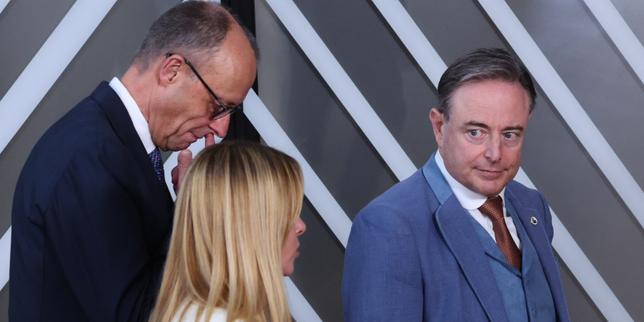
When the Belgian Prime Minister stood before the European stage recently, he wasn't just delivering a dry report on trade deficits or industrial policy. He was describing a ghost story. He spoke of an economy being "devastated" by a systemic, state-sponsored rival: China. To the bureaucrats in Brussels, this is a matter of anti-dumping duties and carbon border adjustments. To the person holding the soldering iron or the glass cutter, it is a fight for the right to exist in a world that seems to have decided their labor is an expensive luxury.
We often talk about global trade as if it is a polite game of chess. We assume everyone sits at the board with the same set of rules, moving pieces under the same light. But the reality is more like a marathon where one runner is fueled by nothing but their own lungs, while the other is being towed by a fleet of silent, invisible trucks.
The Subsidy Shadow
Consider a hypothetical manufacturer named Marc. For twenty years, Marc’s family firm has produced high-grade steel components. He pays his workers a fair wage. He invests in expensive filtration systems to keep the local river clean. He pays high electricity costs because his country is trying to move away from coal. These are the "costs of civilization." They are the prices we pay to live in a society that values the environment and the individual.
Then, a shipment arrives at the port of Antwerp.
The steel in those containers is identical to Marc’s. Sometimes, it is even slightly better because the factory it came from is brand new. But the price tag on that steel is impossible. It is lower than the cost of the raw materials Marc has to buy. How? Because the factory in the East isn't just a business; it is an organ of a state. It receives free land, zero-interest loans that never need to be repaid, and electricity priced at a fraction of the market rate.
This isn't competition. It is an extraction.
The Belgian Prime Minister’s warning is rooted in the realization that Europe has been playing a different game. While we focused on the "invisible hand" of the free market, China moved with a very visible, very heavy fist. By flooding the European market with subsidized goods—from electric vehicles to solar panels and wind turbines—they aren't just selling products. They are buying the future. They are liquidating the competition until there is no one left to compete with.
The Dependency Trap
There is a specific kind of vertigo that comes with realizing you no longer know how to make the things you need.
During the dark months of 2020, Europe learned this lesson with masks and basic medicines. We looked at our empty hands and wondered how we had let the blueprints slip away. Now, the stakes are higher. The green transition—the great moral project of our century—is currently being built on a foundation of Chinese minerals and Chinese manufacturing.
If we want to save the planet, we need batteries. If we want batteries, we currently need China.
This is the "devastation" the Prime Minister referred to. It isn't just the closing of a factory in a small town; it’s the erosion of sovereignty. When an economy loses its industrial base, it loses its ability to choose its own path. It becomes a client state, a giant boutique mall where people sell things they can no longer invent.
Europe’s response has historically been a series of polite coughs and minor paperwork. We launch an "investigation." We "express concern." Meanwhile, the industrial heart of the continent is being hollowed out. The Belgian call to action is a demand to stop treating trade as a purely economic equation and start seeing it as a security frontier.
The Myth of the Level Playing Field
We have been told for decades that "the consumer wins" when prices are low. If a car is cheaper because it was made under a different political system, shouldn't we be happy?
Ask the worker whose pension is tied to the survival of a plant that just shuttered. Ask the engineer whose specialized knowledge is now redundant. The "savings" we get at the checkout counter are often just a loan taken out against our own children’s career prospects.
The math is brutal. $15,000$ for an electric car sounds like a miracle until you realize that price is only possible because of a total disregard for the market logic we hold sacred. If a competitor can lose money on every unit sold for ten years just to bankrupt you, they aren't a better businessman. They are a predator.
To "replicate" or respond, as the Prime Minister suggests, Europe doesn't necessarily need to become a closed fortress. Isolationism is its own kind of slow death. Instead, it requires a loss of innocence. It means acknowledging that the era of the "neutral market" is over.
The Cost of Waking Up
What does a response actually look like? It looks like friction. It looks like "Buy European" requirements. It looks like carbon taxes that finally force foreign factories to pay for the pollution they dump into our shared atmosphere. It is messy, it is expensive, and it will almost certainly lead to a trade war that makes the current tension look like a playground spat.
But the alternative is the "devastation" already in progress.
Walking through an industrial park that has been converted into "luxury lofts" is a haunting experience. You can still see the ghosts of the gantries. You can almost smell the ozone and the hot oil. Those lofts represent a shift from a society that produces to a society that merely consumes. A society that consumes is a society that can be switched off by whoever controls the supply line.
The Belgian leader’s rhetoric isn't about hate or xenophobia. It’s about a fundamental instinct for survival. It’s the realization that if Europe doesn't start acting like a unified power, it will end up as a museum—a beautiful, historic place where people come to look at the ruins of an economy that once led the world.
The quiet in the workshop isn't peace. It’s an ending.
The question left hanging in the air above Brussels isn't whether we can afford to fight back. It’s whether we can afford to keep losing so politely. The clinking on the factory floor in Wallonia needs to get louder. It needs to be backed by the weight of a continent that remembers how to build, how to protect, and how to say "no" to its own obsolescence.
The sun is setting on the era of easy, cheap, and thoughtless trade. In the twilight, the shapes of the new world are becoming clear. They are made of steel, silicon, and lithium. And if we don't own the means of their creation, we don't own our own story.
The furnace is cooling. There is still time to throw more coal on the fire, but the vents are narrowing. Every day we wait for a "perfect" solution is a day the vibration in the concrete grows a little fainter, a little more like a memory.