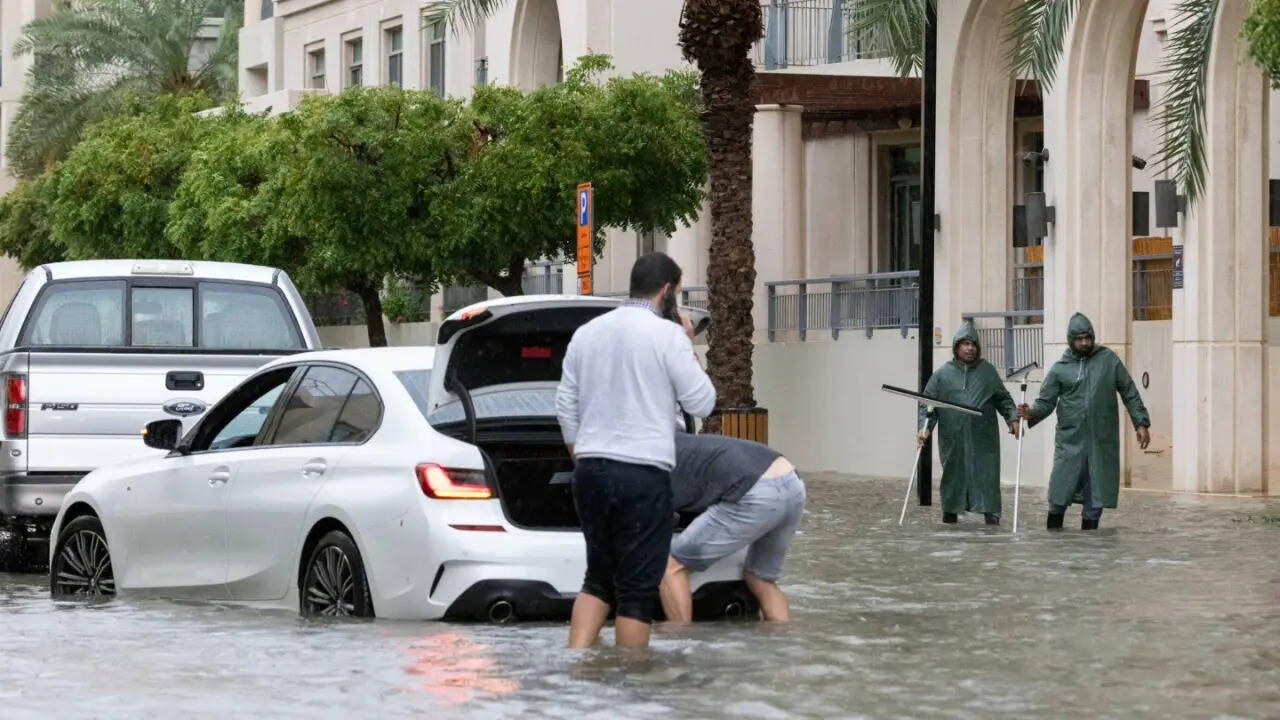
When the skies over Dubai and Abu Dhabi turn an ominous charcoal gray, the immediate instinct for most employees is to check their weather apps and pray for a remote work announcement. But for those already behind the wheel, trapped in a gridlock of rising floodwaters and stalled engines, a much more pressing question arises: Does this count as part of my workday? Under the current UAE Labor Law, specifically Federal Decree-Law No. 33 of 2021, the answer is a hard no. In almost every standard scenario, time spent stuck in traffic—even during extreme weather—is considered personal time, not paid labor.
This reality hits hard for thousands of workers across the Emirates. Despite the UAE’s rapid push toward advanced infrastructure and forward-thinking work cultures, the legal code remains remarkably traditional when it involves the transition from your front door to the office lobby. Unless you are traveling between different job sites as part of your core duties, or unless your employer has provided specific, written provisions to the contrary, you are effectively on your own clock the moment you turn the ignition key.
The Default Position of the Labor Law
The foundational rule is simple. Working hours begin when you are at your employer’s disposal. This means you have reached the designated workplace and are ready to execute your tasks. The commute is historically and legally viewed as a private responsibility. If a drive that usually takes twenty minutes suddenly stretches into three hours due to a flash flood, that extra time does not translate into overtime or a reduction in your shift requirements.
Employers in the UAE are not legally mandated to compensate for transit time. Even during "unforeseen weather conditions," the responsibility to arrive on time rests with the individual. This creates a friction point between the law and the reality of a city that can occasionally be paralyzed by an afternoon of intense rainfall. While the Ministry of Human Resources and Emiratisation (MOHRE) often issues advisories urging flexibility during these periods, an advisory is not a law. It is a suggestion, a nudge toward corporate empathy that carries no legal penalty if ignored.
Why the Commute Stays Off the Clock
There are structural reasons for this. If the government were to mandate that travel time counts as paid work, it would open a logistical Pandora’s box for every business in the country. Companies would suddenly be liable for where their employees choose to live. A worker living in Sharjah and commuting to an office in Dubai Marina could theoretically claim two hours of paid time every morning, while a colleague living in the Greens would only get five minutes. This would lead to hiring biases based on zip codes, a scenario the UAE’s diverse labor market wants to avoid.
The Critical Exception of Work Related Travel
The rule changes only when the travel itself is the job. If your manager asks you to drive from a site in Al Ain to a warehouse in Jebel Ali, that travel time is absolutely part of your paid hours. In this context, you are already under the "control and supervision" of the employer.
The gray area appears when companies provide their own transportation. Some argue that if you are on a company bus, you are technically under the employer's care. However, courts and labor officials generally still view this as a convenience provided to the worker, not a start to the workday. Unless you are performing tasks—such as a driver conducting a safety check or a supervisor managing the passengers—the clock doesn't start until the bus doors open at the office or site.
The Weather Factor and Remote Work Mandates
During the record-breaking rainfall of early 2024, the UAE government took unprecedented steps by advising the private sector to adopt remote work patterns. This blurred the lines. When a government advisory "urges" remote work, and an employer insists on physical attendance, the employee faces a dilemma. If you choose to brave the floods and get stuck for four hours, that time is lost. If you stay home and work, your commute time is zero, and your productivity begins the moment you log in.
The real shift isn't coming from a change in the law, but from a change in policy. Smart firms are now building "Extreme Weather Protocols" into their internal contracts. These protocols often state that in the event of a red or orange weather alert from the National Center of Meteorology (NCM), employees are pre-authorized to work from home. This bypasses the debate over commute time entirely by removing the commute from the equation.
Safety and Liability During the Storm
What happens if you are in an accident while commuting in heavy rain? This is where the law becomes even more granular. While the time spent driving isn't paid, injuries sustained during a commute can sometimes be classified as work-related injuries under specific conditions of the UAE Social Security Law and Labor Law.
If an employee is traveling directly from their home to their workplace, without making any personal detours, an accident during that window may be covered for medical expenses or compensation. This is a crucial distinction. The law recognizes the journey as a necessary risk of employment, even if it doesn't recognize it as a paid hour of labor.
Key Factors for Commute Injury Claims:
- The path taken must be the usual, direct route.
- The accident must occur within a reasonable timeframe relative to the start or end of the shift.
- No personal errands or stops can occur during the transit.
If you decide to stop for groceries on a flooded road and get into a fender bender, you have broken the direct link between home and work. At that point, any hope of claiming it as a work-related incident vanishes.
The Disconnect Between Salary and Hours
For those on a fixed monthly salary, the argument over whether a three-hour commute is "paid" is often a philosophical one. Your paycheck remains the same whether the drive takes ten minutes or ten hours. The real issue is the deduction of leave or salary for lateness.
Can an employer dock your pay if the rain makes you two hours late? Technically, yes. The law requires employees to be present during their contracted hours. However, doing so during a natural weather event is a high-risk move for employer branding and staff retention. Most HR departments will offset the lateness against future hours or simply "write it off" as an act of God. But from a purely legal standpoint, the employer holds the cards. They are paying for your presence during specific hours. If you aren't there, you aren't fulfilling your end of the contract.
Hypothetical Scenario: The Stuck Delivery Driver
Consider a hypothetical delivery driver. If their motorcycle is caught in a flood and they spend five hours waiting for water to recede, their situation is different from an office worker. Because their "office" is the road, and they are in possession of company property (the bike and the goods), they are on the clock. Their presence on the road is the primary function of their job. For this demographic, extreme weather is a workplace hazard that occurs during paid hours.
Moving Toward a Modern Interpretation
The UAE is currently in a transitional phase. We are seeing a move away from the rigid "clock-in, clock-in" mentality of the 1990s and toward a more output-based evaluation of work. In this new environment, the question of whether a commute is paid becomes less relevant than whether the work gets done.
However, for the millions in manufacturing, construction, and retail, the commute remains a massive, unpaid hurdle. The law as it stands is designed for stability and clear boundaries. It protects the employer from unpredictable costs and protects the system from endless litigation over traffic jams.
If you are an employee looking for a way to make your commute count, your only real lever is the employment contract itself. Negotiating a "travel allowance" or "flexible start window" during the hiring phase is the only way to ensure your time on the road is recognized. Without that specific language, you are simply a resident of a desert nation experiencing a very wet, very unpaid morning.
The next time the rain starts to fall, don't look at the clock and wonder how much you’re earning while stuck on Sheikh Zayed Road. You aren't earning anything. You are simply moving between two points on your own time, bearing the risks of the road yourself. The only way to win the commute game in the UAE is to find a way to stop playing it when the clouds gather.
Check your internal company handbook for a "Force Majeure" or "Inclement Weather" clause. If it isn't there, you are working under the default rules of the 2021 Labor Law, which offers no shelter from the storm.