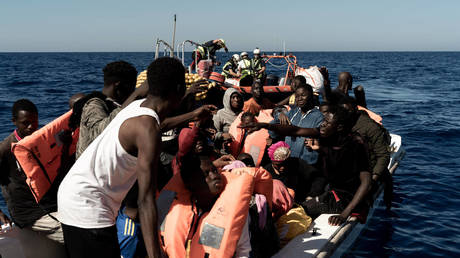
The sea does not care about policy. To a fisherman in the Aegean, the water is a source of life; to a politician in Athens, it is a border; to a man named Omar, huddled in a basement in Tripoli, it is a wide, salt-crusted graveyard that represents his only hope for a future.
Current estimates from the Greek Ministry of Migration suggest that over 500,000 people are currently gathered in Libya, their eyes turned toward the European horizon. That is not just a statistic. It is the entire population of a city like Lyon or Manchester, stripped of their homes and waiting in a state of suspended animation. They are the human overflow of a fractured world, caught in a bottleneck that is becoming increasingly pressurized.
The Geography of Desperation
Libya has become the world’s most dangerous waiting room. Since the collapse of central authority years ago, the country has functioned as a chaotic transit hub. To understand why 500,000 people would risk everything to be there, you have to look past the headlines and into the mechanics of the journey.
Most of these individuals didn't start in Libya. They came from the scorched fields of sub-Saharan Africa, from the rubble of Syrian suburbs, or from the political silence of Central Asian dictatorships. They crossed the Sahara—a journey often more lethal than the sea crossing—driven by a singular, burning logic: anywhere is better than here.
Greek Migration Minister Dimitris Kairidis recently voiced the growing alarm in the European Union. He pointed to the shifting winds of geopolitics. When one route closes, another bleeds open. As security tightens on the land borders between Turkey and Greece, the maritime path from Libya grows more attractive, despite its staggering mortality rate.
A Hypothetical Morning in Tripoli
Consider a man we will call Elias. He is thirty-two. Back home, he was a teacher. Now, he is a "client" of a smuggling network that operates with the cold efficiency of a logistics firm.
Elias spends his days in a crowded warehouse. The air is thick with the smell of unwashed bodies and cheap cigarettes. He has paid three thousand dollars—his family’s entire life savings—for a seat on a rubber dinghy that was never designed to leave the sight of land. He knows the boat is a deathtook. He has seen the photos on social media of washed-up life jackets.
But Elias isn't thinking about the statistics. He is thinking about the fact that his daughter needs medicine he cannot buy, and that the war behind him is more certain to kill him than the ocean in front of him. This is the math of the migrant. It isn't a calculation of risk; it is a choice between two different ways to die, one of which offers a slim, shimmering chance of survival.
The Pressure Cooker of the Greek Coast
Greece sits at the sharp end of this crisis. For the people of the islands like Crete or Gavdos, the abstract talk of "migration flows" feels very different when a boat carrying seventy dehydrated souls arrives on a Tuesday afternoon.
The infrastructure is buckling. Minister Kairidis has been vocal about the need for a unified European response, arguing that Greece cannot be expected to act as the continent's sole shield. The numbers are staggering. If even ten percent of those 500,000 people move at once, it would create a humanitarian emergency that the current systems are simply not built to handle.
We often talk about migration as if it is a tide—something natural and inevitable. It isn't. It is a result of specific failures. It is the result of climate change turning farmland into dust, of civil wars fueled by foreign weapons, and of a global economy that requires cheap, undocumented labor while simultaneously criminalizing the people who provide it.
The Business of Human Cargo
The smugglers in Libya are not monsters from a fairy tale. They are often banal, business-minded men who have found a niche in a lawless land. They use Facebook and WhatsApp to market their "services." They offer different tiers of travel: the "safe" wooden boat for a premium, or the "budget" rubber tube for those who have nothing left.
They monitor the weather, but not for safety. They look for windows where the Libyan Coast Guard is less likely to patrol or where the European NGO rescue ships are stationed. To them, the 500,000 people are not refugees; they are inventory. When a boat sinks, it is merely a lost shipment. There is always more inventory waiting in the warehouses.
The Greek government is currently pushing for more cooperation with Egypt and more support from the EU's border agency, Frontex. The goal is "deterrence." But how do you deter someone who has already lost everything? You can build walls in the sea, but the water will always find a way through the cracks.
The Invisible Stakes
If we look closely, this isn't just a story about border security. It is a story about the fragility of our own stability. We watch the news from the comfort of our living rooms, separated from the 500,000 by a screen and a few thousand miles of geography.
We feel a twinge of pity, perhaps a flash of fear about "swarms" or "invasions." But we rarely recognize the reflection. These are people who, only a few years ago, had lives exactly like ours. They had favorite songs, annoying neighbors, and dreams of retirement. The distance between a citizen and a refugee is much shorter than we like to admit. It only takes one failed harvest, one stray missile, or one sudden collapse of the currency.
The Mediterranean is currently the world’s most active crime scene. Every day, people are being extorted, beaten, and drowned. The 500,000 in Libya are a ticking clock. They represent a collective failure of global diplomacy to provide a path for people that doesn't involve a smuggler's boat.
Beyond the Horizon
Minister Kairidis and his counterparts in Brussels are trapped in a cycle of reactive policy. They talk about quotas, processing centers, and deportation flights. These are necessary parts of a functioning state, but they are bandages on a gaping chest wound.
The real problem isn't the half-million people in Libya. The problem is the world that created the conditions for them to be there. Until the root causes—the instability in the Sahel, the frozen conflict in Libya itself, and the lack of legal migration pathways—are addressed, the number will only grow.
Tonight, the moon will rise over the Mediterranean. On the coast of Libya, thousands of people will look out at the dark water. They will check their phones for messages from smugglers. They will pray to gods of all names for a calm sea and a blind patrol.
They are not an army. They are not a "flow." They are 500,000 individual stories, each one a desperate gamble against the house. And as long as the world remains divided into those who have safety and those who are willing to die for it, the boats will keep launching into the dark.
The sea remains indifferent, cold and deep, waiting to swallow the next name that history decides to forget.