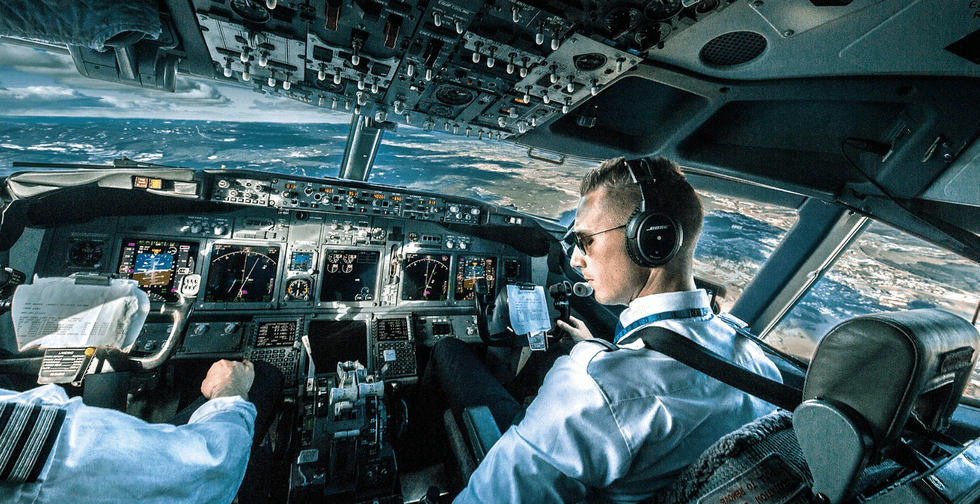
The silver wings of a Boeing 737 catch the early morning light over O’Hare, a silent promise of connection that we have taken for granted for seventy years. Below, in the terminal, a grandmother from Des Moines clutches a printed itinerary. She is flying to see a grandson she has only ever known through a pixelated FaceTime screen. Across the aisle, a logistics manager checks a tablet, tracking a shipment of specialized medical valves that need to be in a Houston surgical theater by dawn.
These are the quiet, rhythmic heartbeats of an $11.7 trillion global industry. It is a machine of staggering complexity, held together by delicate international treaties, open borders, and the predictable flow of human beings.
Now, imagine the sound of that machine grinding to a halt.
Recent political tremors have sent a chill through the spine of the aviation world. The threat of sweeping tariffs, tighter border restrictions, and a "Fortress America" isolationism isn't just a matter of diplomatic posturing. It is a direct challenge to the physics of modern travel. When we talk about an "aviation quagmire," we aren't just discussing stock prices or airline margins. We are talking about the sudden, jarring evaporation of the freedom to move.
The Friction of the Frontier
Trade wars are rarely fought with bayonets anymore. They are fought with paperwork, landing rights, and visa delays.
Consider the hypothetical case of Elena, a software consultant who spends forty weeks a year in the air. For Elena, the "industry" isn't a statistic; it’s a series of frictionless handshakes between nations. Her passport is a key. But if the proposed 20% universal baseline tariffs or targeted levies on foreign-made aircraft parts become reality, Elena’s world shrinks.
Airlines operate on razor-thin margins—often as low as $6 per passenger after expenses. When the cost of a replacement engine part from Toulouse or a new wide-body jet from a global consortium suddenly jumps by double digits, that cost doesn't stay on the balance sheet.
It lands on Elena.
It’s the $800 economy ticket to London that becomes $1,400. It is the three-hour "pre-clearance" line that used to take twenty minutes. Suddenly, the world is much larger, much more expensive, and much more closed.
The 11.7 trillion dollars we cite isn't a pile of gold in a vault; it’s the kinetic energy of people moving. It’s the hotel maid in Orlando whose job depends on a family from Rio de Janeiro. It’s the tech firm in Seattle that can't send its engineers to a fabrication plant in Taiwan.
When the flow stops, the economy doesn't just slow down. It hardens.
The Invisible Stakes of a Borderless Sky
We have spent decades building a world where the "open skies" are the default. This is a fragile consensus. It relies on reciprocal agreements—if we let your planes land here, you let ours land there.
If the American administration moves toward a protectionist stance that penalizes international carriers or restricts the movement of labor, the retaliation will be swift and symmetrical.
Europe will close its gates. Asia will redirect its tourism dollars.
We forget how much of our domestic prosperity is fueled by the curiosity and capital of the "Other." International travelers spend significantly more on average than domestic ones. They stay longer. They eat at more restaurants. They visit the National Parks.
If we build a wall around the aviation sector, we aren't just keeping people out. We are locking ourselves in.
Imagine the empty jetways at JFK. Think about the silence in a luxury hotel in Las Vegas that was built for a demographic that is now being told, subtly or explicitly, that they are no longer welcome.
A Chain of Broken Links
The aviation industry is an ecosystem. Like any ecosystem, if you pull one thread, the whole web begins to unravel.
Take the pilot shortage, for example. The industry is already gasping for qualified crew. If immigration policies become so restrictive that international flight training programs are shuttered, or if the "Open Skies" agreements that allow for seamless pilot certification between nations are torn up, the cockpit remains empty.
Canceled flights. Stranded passengers.
Then there is the matter of the aircraft themselves. A modern jet is a marvel of global cooperation. The wings might be made in the UK, the engines in a joint venture between the US and France, the avionics in Israel, and the assembly in South Carolina or Washington.
A "buy American" mandate sounds patriotic in a thirty-second campaign ad. In the reality of a global supply chain, it is a death sentence for a project that requires parts from forty different countries. If you can't get the specialized titanium from a trade partner without a 60% tariff, you don't build the plane.
If you don't build the plane, the airline can't retire its aging, gas-guzzling fleet.
If the fleet doesn't modernize, fuel costs rise.
If fuel costs rise, the ticket price for that grandmother in Des Moines goes up again.
The Cost of Uncertainty
Markets hate a vacuum, but they despise chaos even more. The current political climate creates a "quagmire" because it removes the one thing the travel industry needs to survive: long-term predictability.
An airline doesn't buy a plane for next week; it buys a plane for the next twenty years. A hotel chain doesn't break ground on a new resort based on this month's numbers; it looks at decades of projected growth.
When the leader of the world’s largest economy suggests that alliances are optional and trade agreements are temporary, the investment stops.
The money stays in the bank. The jobs aren't created. The innovation—the sustainable aviation fuels, the supersonic return, the electric short-haul flights—simply dies on the vine.
We are at a crossroads where the rhetoric of "America First" might accidentally ensure that America is left behind in the very industry it pioneered.
The Pulse of the Terminal
If you want to understand what is truly at risk, go to any international arrivals gate.
Watch the faces of people coming through the doors. Look at the businessman who just closed a deal that will keep his factory in Ohio running for another year. Look at the student coming to a university to study medicine, bringing a perspective that will eventually save lives. Look at the tourist who has saved for a decade to see the Grand Canyon.
The "quagmire" isn't just about tariffs or treaties. It’s about the soul of a nation that once defined itself by the horizon.
We are trading our reach for a perceived sense of security that doesn't actually exist in a globalized world. You cannot protect an economy by starving it of the people and ideas that make it grow.
The planes are still in the air for now. The schedules are still posted. The grandmother is still clutching her itinerary, and the software consultant is still checking her watch.
But the air is growing thin.
The world is watching to see if the United States will remain the world's greatest hub or if it will become a destination that people—and capital—simply learn to fly around.
One day, we might wake up to find the skies quiet, the terminals echoing, and the silver wings of our ambition grounded by a weight we chose to carry ourselves.