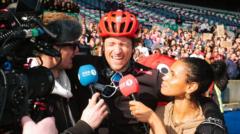
Greg James just finished his most ridiculous stunt yet. After eight days of pedaling a tandem bike across 1,000 kilometers of British tarmac, the Radio 1 Breakfast host rolled into Edinburgh’s Murrayfield Stadium. He didn't just bring a pair of very sore legs with him. He brought over £3.3 million for Comic Relief. By the time the final Red Nose Day telethon numbers started rolling in, that total comfortably cleared the £4 million mark.
It’s easy to get cynical about celebrity charity challenges. We’ve seen them all before. But there’s something different about the way Greg James does it. He doesn't just "do" a challenge; he drags the entire country along for the ride. This wasn't some polished, corporate PR exercise. It was 630 miles of sweat, tears, and a bike affectionately named "Tando Norris."
Why the Longest Ride was a logistical nightmare
Cycling from Weymouth to Edinburgh is hard enough on a standard road bike. Doing it on a tandem—a machine famously designed to test the patience of even the happiest couples—is a special kind of masochism. Greg spent roughly eight hours a day in the saddle. We're talking 90-mile stretches that mirror the intensity of a Tour de France stage, minus the elite athlete physique and the aerodynamic Lycra.
The gimmick that actually worked was the empty seat behind him. Greg wasn't alone for the whole trip. He turned the second seat into a rotating door of guests.
- Prince William hopped on in South Yorkshire, proving he’s a good sport even when tasked with powering a DJ through the rain.
- Joe Lycett joined for a stint, likely providing more jokes than actual pedal power.
- Geraint Thomas, an actual Tour de France winner, showed up to remind Greg what real cycling looks like.
- Listeners and charity beneficiaries also took turns, which grounded the whole thing in reality.
The route wasn't just a straight line north. It was a deliberate path through communities where Comic Relief actually spends its money. From the south coast through the Midlands and up the North East coast into Sunderland, the "village" Greg kept talking about showed up. Thousands of people lined the streets in the rain, waving soggy cardboard signs and handing over spare change.
The breaking point in Sunderland
By Day 7, the cracks started to show. If you listen to Radio 1, you heard it. Greg broke down on air. He described himself as feeling "rotten" and "depleted." This is where the challenge stopped being a fun radio bit and started being a grueling endurance test.
He talked about his "village"—his wife Bella, his dog, his parents, and the Breakfast Show team. It sounds a bit sappy until you realize why he was doing it. He acknowledged he’s lucky to have that support system. Many people don't. That’s the core mission of Comic Relief in 2026: helping people who are essentially "village-less" find food, shelter, and safety.
The money isn't just a vanity metric. A massive £1 million donation match from The Hunter Foundation earlier in the week acted like a shot of adrenaline for the fundraising total. When people saw their £5 becoming £10 instantly, the momentum became unstoppable.
What this means for Comic Relief in 2026
There’s been a lot of talk lately about whether big legacy charities like Comic Relief still matter. In a world where you can donate to a GoFundMe in three clicks, do we still need a guy on a tandem bike?
The answer is in the numbers. Raising £4 million through a single radio strand is an absurd achievement. It proves that the "collective" still has power. We’re living through a cost-of-living crisis that hasn't let up, yet the British public still found a few million quid down the back of the sofa because a guy they listen to every morning looked like he was about to collapse on a bike.
The funds are already being funneled into projects tackling:
- Food poverty: Supporting local food banks that are seeing record demand.
- Homelessness: Funding shelters and long-term housing solutions.
- Mental Health: Providing "village" style support for those isolated by illness or circumstance.
How to actually help now
If you missed the live tracker or didn't make it to the roadside, the window hasn't slammed shut. The best way to keep this momentum going isn't just by clapping for Greg’s ruined knees.
Check the official Comic Relief site to see where the money is going in your local area. Often, the charities receiving these grants are small, grassroots organizations you might already pass on your way to work. If you want to contribute, you can still donate via the Radio 1 website or buy the "Design-Yer-Nose" kits that were a hit this year. Don't just watch the highlights; look at the local impact. Greg did the hard work on the bike, but the "village" is supposed to keep the lights on for the other 364 days of the year.