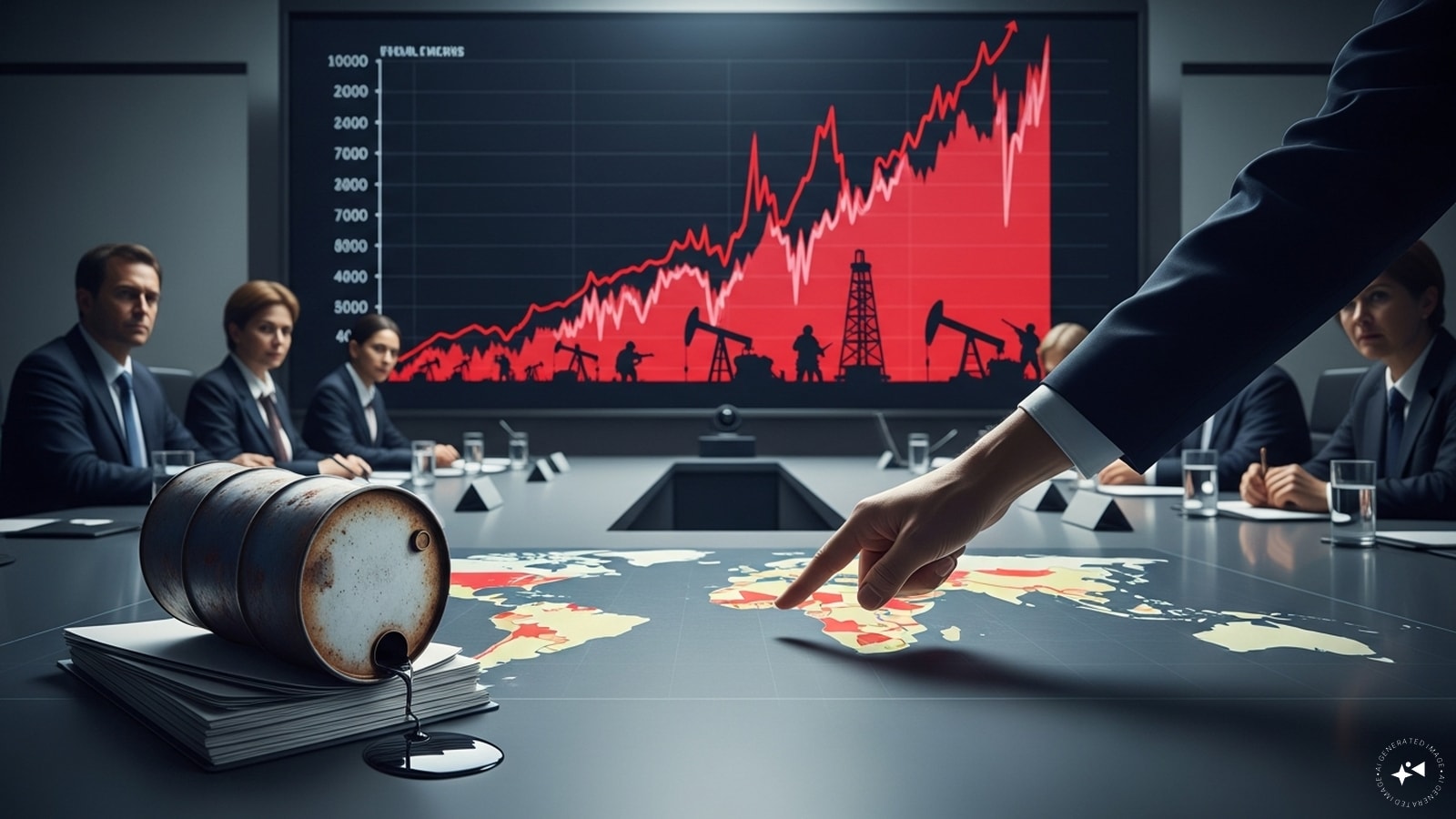
The sea does not care about contracts. For decades, the global oil trade has operated like a slow-moving, unbreakable clock. Giant tankers move along invisible tracks, governed by long-term agreements signed in quiet boardrooms years in advance. These are the "term contracts"—the steady, predictable pulse of the world’s energy. But recently, that clock began to skip beats.
Black smoke rising over distant terminals and the sudden silence of pipelines under fire have a way of tearing up even the most ironclad paperwork. When war disrupts the flow, the world doesn't stop needing fuel. It just starts looking for it in more desperate places.
The Ghost in the Machine
Consider a refinery manager in a coastal European city. Let’s call him Elias. For twenty years, Elias has known exactly where his crude comes from. It arrives on the same Tuesday of every month, a specific grade of sour crude tailored for his machinery. He doesn't have to think about it. It is as reliable as the sunrise.
Then, the alerts start hitting his phone. A conflict thousands of miles away has put a stranglehold on his usual supply route. The tankers aren't coming. The "force majeure" notices—legal speak for "an act of God has ruined our plans"—begin to pile up. Elias isn't just looking at a balance sheet; he’s looking at a massive, complex industrial organism that will begin to seize up if it isn't fed.
This is where the spot market enters the frame.
Most people think of the oil market as a monolithic entity, but it is actually two very different animals. There is the "term" market, which is a marriage, and the "spot" market, which is a series of frantic, expensive first dates. When the marriage fails because of a geopolitical explosion, everyone rushes to the spot market at once.
The Saudi Pivot
Saudi Arabia has long been the world’s ultimate guarantor of stability. They are the "central bank of oil." Usually, they prefer the long-term approach. They like the discipline of the term contract because it allows them to project revenue and manage their massive reservoirs with surgical precision.
But as the current disruption rippled through the global supply chain, the Kingdom did something tactical. They didn't just sit back and watch the chaos. They began offering extra cargoes of their crude on the spot market.
To the casual observer, this sounds like a dry logistical adjustment. To those in the industry, it was a flare sent up into a dark sky. It was a signal that the traditional plumbing of the global economy was leaking, and the world’s largest exporter was stepping in to mop up the mess—for a price.
By offering oil on the spot market, the Saudis provided a lifeline to people like Elias. But they also did something more subtle. they exerted control. In a world where supply is uncertain, the entity that can provide a cargo right now holds all the cards.
The Invisible Stakes of a Single Cargo
What does a "spot cargo" actually look like?
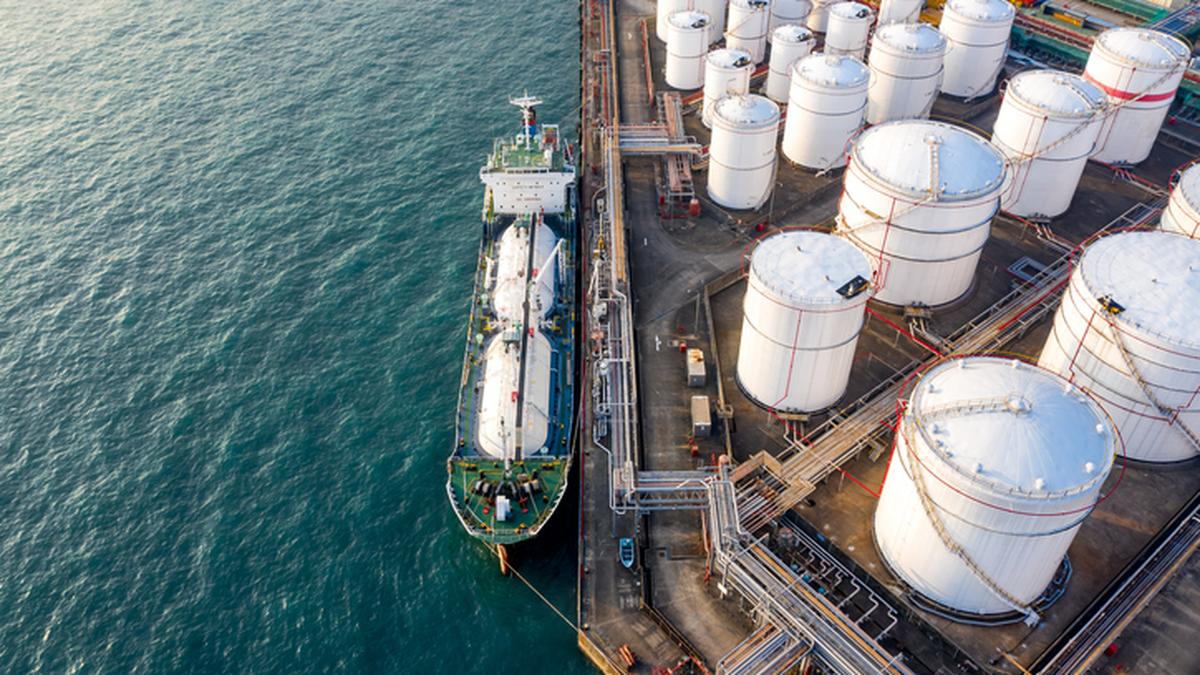
Imagine a vessel the size of three football fields, carrying two million barrels of oil. At current prices, that single ship represents a floating fortune of roughly $160 million. When that ship is sold on the spot market, it is often auctioned off in a high-stakes digital environment where minutes matter.
The buyers aren't just faceless corporations. They are teams of traders working in glass-walled offices in Singapore, London, and Houston, their eyes bloodshot from tracking satellite data. They are watching the weather, the movement of naval destroyers, and the insurance premiums that spike every time a new headline breaks.
These traders are the ones who decide whether a refinery in Greece stays open or whether a trucking fleet in Poland can afford to keep its engines running. They are the nervous system of the global economy, and right now, that nervous system is screaming.
The Cost of Uncertainty
There is a hidden tax on chaos. When Saudi Arabia moves oil from fixed contracts to the spot market, it reflects a shift from "just-in-time" delivery to "just-in-case" survival.
The spot market is inherently more volatile. It is sensitive to rumors. If a drone is spotted near a loading pier, the price of a spot cargo can jump by five dollars a barrel in the time it takes to pour a cup of coffee. For a country trying to manage inflation, these fluctuations are devastating.
We often talk about "oil prices" as a single number on the evening news. But for the person filling up their car or the farmer trying to buy diesel for the harvest, the price is a reflection of this invisible tug-of-war between Saudi exporters and desperate global buyers.
The Kingdom knows this. By increasing their spot offerings, they are essentially becoming the world’s emergency relief valve. It is a position of immense power. It allows them to bridge the gap left by sanctioned or war-torn competitors, effectively capturing market share that used to belong to others.
The Human Geometry of the Trade
It is easy to get lost in the sea of millions of barrels and billions of dollars. But the real story is found in the smaller details.
It’s in the harbor pilot who has to guide a massive VLCC (Very Large Crude Carrier) into a port that wasn't expecting it.
It’s in the bank officer who has to clear a letter of credit for a transaction that was negotiated in three hours instead of three months.
It’s in the family sitting around a kitchen table, wondering why the price of heating oil just spiked, unaware that a specific pipeline halfway across the globe was shut down by a regional commander they’ve never heard of.
The transition to the spot market is a symptom of a world that has lost its rhythm. We are no longer in the era of the steady, predictable clock. We are in the era of the scramble.
Why This Matters to You
You might think that the internal sales strategy of a Middle Eastern oil giant has nothing to do with your daily life. You would be wrong.
The global economy is a giant, interconnected web of energy. When the largest producer in that web changes how it sells its product, the vibrations are felt everywhere. It changes the cost of the plastic in your hand, the food on your plate, and the stability of your local currency.
When the Saudis offer oil on the spot market, they are acknowledging that the old world—the world of safe, boring, multi-year deals—is temporarily on fire. They are adapting. They are becoming more agile, more opportunistic, and more vital than ever before.
The move is a masterclass in geopolitical leverage. If you have the oil and everyone else has the anxiety, you don't just sell a commodity. You sell certainty. You sell the ability for a nation to keep its lights on for one more month.
The Final Reckoning
As the sun sets over the Persian Gulf, the cranes continue to move. The tankers continue to fill.
The war that started this disruption may continue for weeks or years. The contracts that were broken may never be mended. But the oil will find a way to the market. It always does. It is the blood of the modern world, and it will flow toward whoever is willing to pay the most, the fastest.
Elias, the refinery manager, finally sees a ship appearing on his radar screen. It isn't the ship he expected six months ago. It’s a spot cargo, diverted at the last minute, purchased at a premium in a frantic midnight deal.
He watches the digital icon creep toward the harbor. He knows that this one shipment isn't a victory; it’s a reprieve. He knows that tomorrow, the scramble begins all over again.
The tankers are no longer just ships. They are pieces on a chessboard where the rules are being rewritten in real-time, and the only thing that matters is who has the cargo when the music stops.
In the end, we are all just passengers on these ships, waiting to see if the next cargo arrives before the dark sets in.