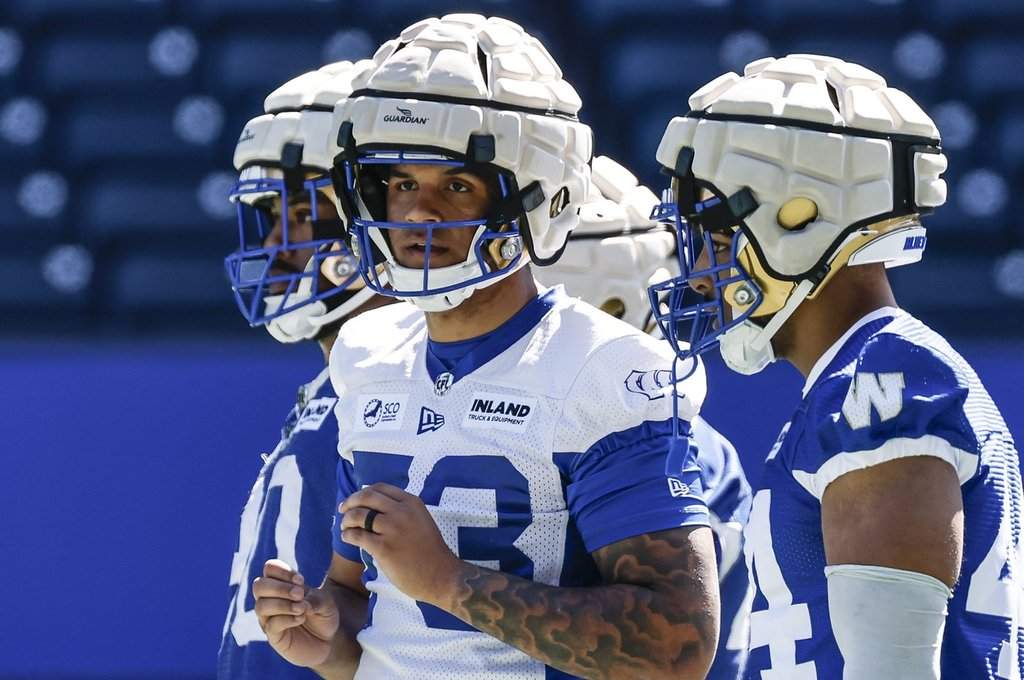
The air in Saskatchewan during football season doesn’t just blow; it bites. It is a dry, relentless cold that settles into the marrow of your bones, the kind of weather that makes every breath feel like swallowing glass. On the sidelines of a CFL stadium, the lights are so bright they bleach the world white, casting long, distorted shadows across the artificial grass. For Dante Daniels, those shadows are old friends. They represent a past that should have swallowed him whole long before he ever strapped on a helmet.
Most people see a professional athlete and imagine a straight line. They see talent, then hard work, then the inevitable reward of a jersey with a name on the back. It is a comfortable lie we tell ourselves about meritocracy. But for a kid lost in the labyrinth of the American foster care system, there are no straight lines. There are only jagged edges and dead ends.
To understand the weight of a touchdown, you first have to understand the weight of a trash bag.
The Standard Issue Suitcase
In the world of social services, a black heavy-duty trash bag is more than a disposal tool. It is a wardrobe. It is a safe. It is the only constant. When a child is moved from one temporary home to another—often with less than an hour’s notice—their entire existence is shoved into that plastic skin. Dante Daniels knew the crinkle of that plastic better than the sound of his own mother’s voice.
He moved through the system like a ghost passing through walls, never staying long enough to leave a mark, never certain if the bed he slept in on Monday would be his on Friday. This kind of existence creates a specific type of hyper-vigilance. You learn to read a room in seconds. You look for the exits. You learn that "family" is a term of convenience, not a blood oath.
Statistics suggest that children in this position are more likely to end up in a cell than on a professional sports roster. The numbers are a cold, calculated map of failure: higher rates of homelessness, lower rates of graduation, and a profound, echoing lack of stability. But statistics are just averages of human misery. They don't account for the stubbornness of a heart that refuses to stop beating.
The Sanctuary of the Lines
Football is a violent game, but for someone coming from a chaotic background, it is strangely peaceful. On the field, the rules are absolute. If you hit the gap, you gain yards. If you miss the block, you lose them. There is a terrifying clarity in that. Unlike the shifting whims of caseworkers or the unpredictable moods of foster parents, the yard markers never lie.
Dante found that the grass—whether it was the dusty patches of a neighborhood park or the pristine turf of a high school stadium—offered the only ground that didn't feel like it was shifting beneath his feet. He could control the outcome. He could use the anger, the feeling of being discarded, and turn it into a physical force.
When he ran, he wasn't just chasing a ball. He was running away from the black trash bags. He was running toward a version of himself that had a permanent address.
The transition from a high school standout to a collegiate prospect is difficult for anyone. For Dante, it was a tightrope walk over an abyss. Without a traditional support system, every injury is a potential catastrophe. Every failed grade is a ticket back to nothingness. There is no safety net. No father to call for a loan. No childhood bedroom to retreat to if things go south.
The Invisible Scars of the CFL
By the time he reached the professional ranks, the physical toll of the game was the least of his concerns. The Canadian Football League is a grind. It is a league of dreamers and castoffs, men who are often one bad play away from a regular job. For Dante, the pressure wasn't just about the scoreboard; it was about the platform.
He realized that his presence on a professional roster was an anomaly. He was a glitch in the system.
Consider the psychological burden of representing every "system kid" who didn't make it. When Dante stands in the huddle, he isn't just listening for a play call. He is carrying the silent hopes of thousands of children who are currently sitting in social workers' offices, waiting to find out where they will sleep tonight. It is a heavy armor to wear.
People often ask athletes about their "why." They want a catchy slogan or a sentimental memory of a childhood hero. Dante’s "why" is more primal. It is the memory of the silence that follows a door closing. It is the knowledge that for most of his life, he was a case file number before he was a person.
The Geometry of Belonging
In the locker room, the concept of a team takes on a different meaning for someone who grew up without a tribe. A team is a chosen family. It is a structure where your value is tied to your contribution to the whole, not your biological origin.
Dante’s journey through the CFL isn't just a sports story. It is a study in resilience. It’s about the moment a human being decides that their past will be the fuel, not the finish line.
There is a specific kind of beauty in a Canadian autumn. The sky turns a deep, bruised purple, and the lights of the stadium hum with a low, electric energy. When Dante Daniels walks out onto that field, he isn't just a running back or a special teams player. He is a living, breathing rebuttal to the idea that where you start determines where you end.
The crowd cheers for the catch. They roar for the tackle. But the real victory happened years ago, in a quiet moment when a boy looked at a black trash bag and decided he was worth more than what it could hold.
He doesn't need to imagine a different life anymore. He built one out of dirt, sweat, and a refusal to be forgotten. The game eventually ends for everyone. The cleats are hung up. The jersey is framed. But the ground stays solid. For the first time in his life, Dante Daniels isn't moving. He is exactly where he is supposed to be.
The whistle blows. The ball is snapped. And for sixty minutes, the only thing that matters is the forward progress of a man who spent his whole life refusing to be pushed back.