The air in Sacramento during a legislative session has a specific weight to it. It’s thick with the scent of expensive espresso, old paper, and the frantic, silent hum of ambition. If you stand near the north curve of the Capitol, you can almost hear the gears of the nation’s largest sub-national economy grinding toward an uncertain future.
For years, the hierarchy seemed settled. There was a natural order to California politics, a lineage of power as predictable as the seasonal arrival of the Santa Ana winds. But the latest numbers out of the Berkeley IGS poll haven't just ruffled feathers; they’ve shattered the stained glass of the party’s assumptions.
Gavin Newsom has pulled ahead.
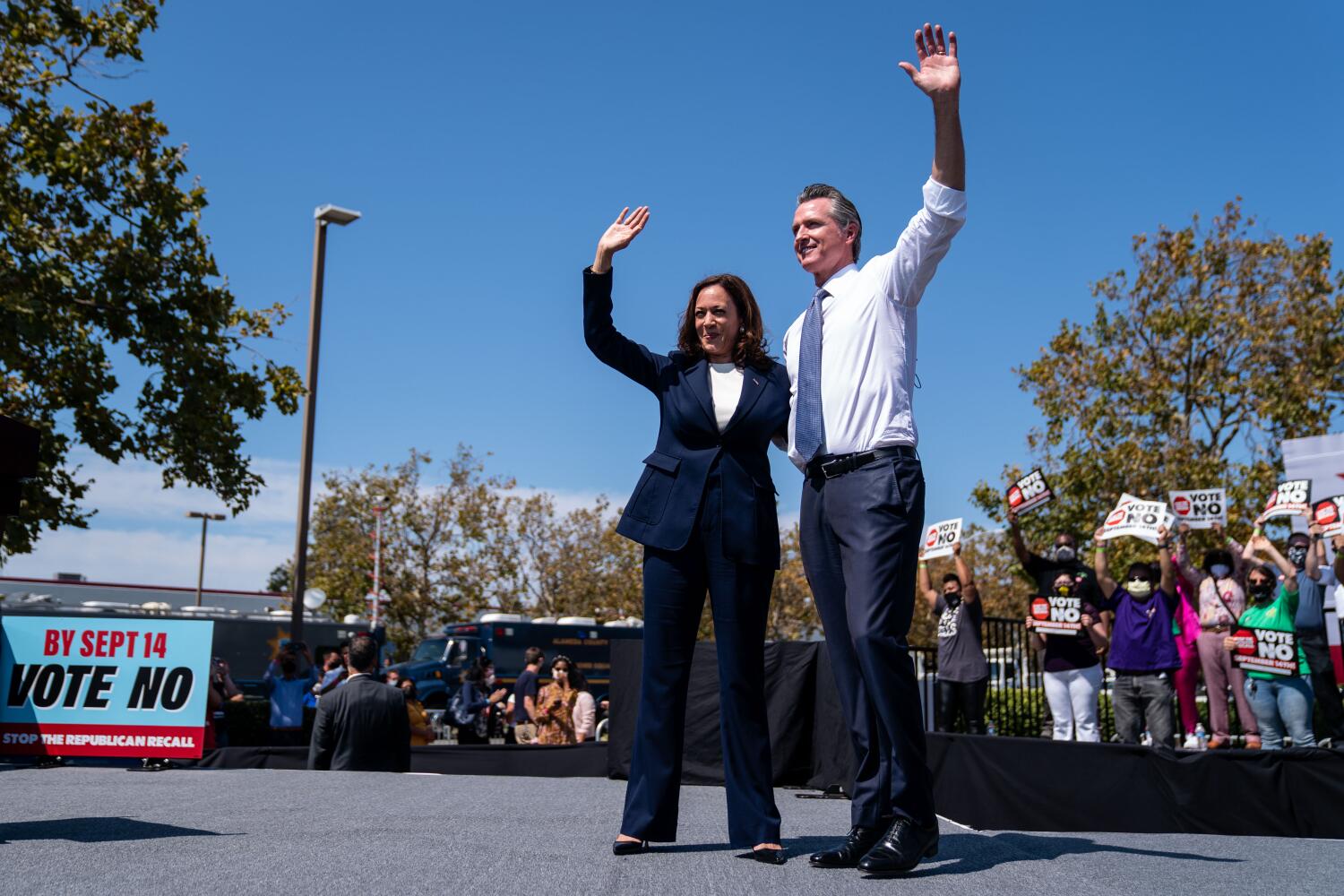
He hasn't just gained a few points. He has eclipsed Vice President Kamala Harris among the very people who know her best: California Democrats. In a hypothetical 2028 matchup, the Governor stands at 33% to the Vice President’s 15%.
Numbers are cold. They don't capture the visceral shift in the rooms where decisions are made. To understand why a sitting Vice President is trailing a Governor in her own backyard, you have to look past the spreadsheets and into the anxiety of the California voter.
The Architect and the Ambassador
Think of the California Democratic Party as a sprawling, multi-generational family estate. Kamala Harris was the daughter who went to Washington, the one who ascended to the highest halls of power to represent the family name on the global stage. Gavin Newsom is the son who stayed home to manage the property.
The estate is currently on fire. Or it’s flooding. Sometimes both in the same week.
While Harris navigates the abstract, high-stakes diplomacy of the West Wing, Newsom is the man in the mud. Literally. When the atmospheric rivers pummel the Central Valley, he is there in his signature fleece, pointing at maps, talking about infrastructure, and promising to fix the levee.
This isn't just about policy. It’s about presence.
The poll reflects a fundamental human truth: we trust the person we see wrestling with our immediate problems more than the person representing us in distant rooms. Harris suffers from the "Vice Presidential Fog," a political phenomenon where the office’s inherent lack of agency makes the occupant appear less vital, less muscular.
Newsom, by contrast, has spent the last year leaning into a role that feels almost presidential. He has engaged in high-profile debates with red-state governors, traveled to China to talk climate change, and inserted himself into the national discourse with a frequency that suggests he isn't waiting for permission.
The Weight of Home
Consider a hypothetical voter named Elena. She’s a schoolteacher in Oakland, a lifelong Democrat who stood in line for hours to vote for the Biden-Harris ticket. She likes Kamala. She respects the barrier-breaking nature of her career.
But Elena’s rent just went up. Again. The walk to her school takes her past three new encampments that weren't there six months ago. When she looks for a leader, she isn't looking for a symbol. She’s looking for a mechanic.
Newsom has positioned himself as that mechanic. Whether he’s actually fixing the engine is a matter of fierce debate, but he’s always under the hood with a wrench in his hand. The Berkeley poll suggests that 33% of California Democrats prefer his brand of performative, hyper-active governance over the steady, often invisible hand of the Vice Presidency.
The gap is particularly cavernous among key demographics. Newsom leads among almost every subgroup: men, women, white voters, Latinos, and even those who identify as "strongly liberal."
There is a specific irony here. Harris built her career in the San Francisco District Attorney’s office and the California Attorney General’s office. She is a creature of this soil. Yet, Newsom—the former Mayor of that same city—has managed to maintain a "hometown hero" energy that has somehow eluded her since she moved to D.C.
The Invisible Stakes
Why does this matter four years before an election? Because the California primary is the sun around which the Democratic solar system orbits. It is the vault. It is the talent pool.
If a candidate cannot hold their own state, the narrative of "electability" begins to rot from the inside out. For Harris, these numbers are a flashing red light on the dashboard. They suggest that her base isn't just flirting with someone else; they are actively moving their furniture into his house.
The poll also revealed a third shadow in the room: Michelle Obama. While she wasn't the focus, the data hinted at a hunger for a "none of the above" option that transcends the current power structure. But within the reality of active politicians, the Newsom-Harris divide is the only story that counts.
It’s a tale of two different types of power.
One is the power of the Title. Harris has it. It is prestigious, historic, and agonizingly constrained.
The other is the power of the Platform. Newsom has turned the governorship into a 24-hour news cycle, a bully pulpit that he uses to project a sense of inevitability. He talks about California as the "Greatest Recovery Story in American History," even as the state faces a massive budget deficit. He sells a vision of the future that is shiny, tech-forward, and unapologetically bold.
People buy visions when they are scared.
The Friction of Reality
But the story isn't over. Polls are snapshots of a moving train.
Newsom’s lead is built on his visibility, but that visibility comes with a cost. Every time a business leaves San Francisco, or a train line goes over budget, or a wildfire smoke cloud chokes the valley, it’s his face on the news. He is the face of the status quo in a state that is increasingly frustrated with it.
Harris, conversely, has the opportunity for a "second act" that Vice Presidents often find during a heated campaign. If she can find a way to reconnect with the granular, everyday concerns of her home state—to step out of the West Wing shadow and back onto the California streets—the numbers could shift as quickly as they fell.
The tension between them is polite, professional, and absolutely lethal. They share donors. They share consultants. They share a zip code.
They are two ships in the San Francisco Bay, heading for the same narrow opening under the Golden Gate Bridge. Only one can pass through first.
As the sun sets over the Pacific, casting long, amber shadows across the Central Valley, the political landscape looks different than it did a year ago. The hierarchy is broken. The heir apparent is looking over her shoulder. The Governor is looking at the horizon.
And the voters? They are simply waiting for someone to prove they can keep the lights on.
The Golden State has always been a place of reinvention, a land where you can arrive as one thing and leave as another. Right now, it is reinventing its loyalty. The polls tell us that Gavin Newsom has the momentum, but momentum is a fickle friend in a state built on fault lines.
The ground is shifting. You can feel it under your feet if you stand still long enough. In the quiet moments between the headlines, the question isn't who is leading today, but who will still be standing when the inevitable earthquake of the next election cycle finally hits.
The house is beautiful, the views are unparalleled, but the glass is very, very thin.