The neon glow of the Samsung Digital City sign in Suwon doesn’t just illuminate the night sky. It casts a heavy shadow over the lives of the people who walk beneath it. To the outside world, landing a job here is the ultimate Korean dream. It is an admission ticket to the nation’s economic aristocracy, a golden ticket stamped with societal reverence and a paycheck that can cross the threshold of 500 million won.
That is roughly 400,000 US dollars.
For the average global observer, the idea of walking out on a job that offers a bonus of that magnitude feels absurd. It sounds like the ultimate corporate privilege, a grievance born of extreme wealth. But look closer. Step past the manicured hedges of the corporate campus and into the fluorescent-lit reality of the semiconductor cleanrooms. The air inside smells faintly of isopropyl alcohol and intense pressure. Here, the perspective changes entirely.
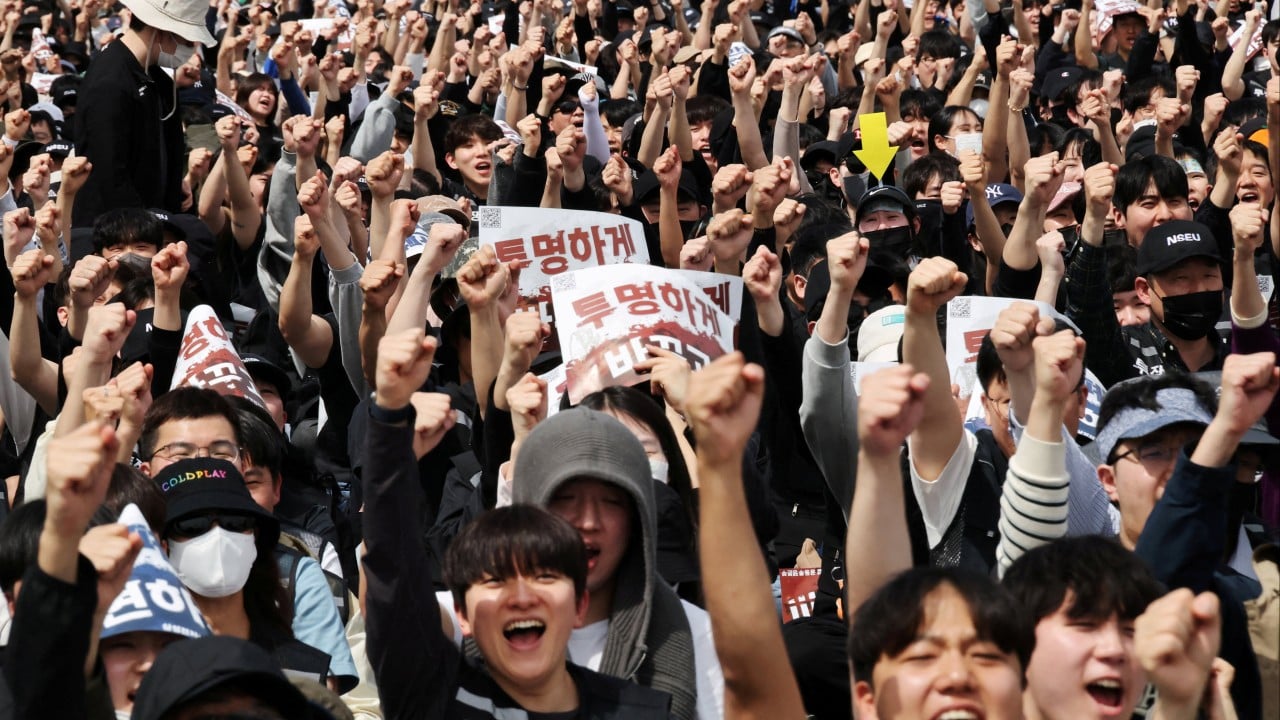
When the National Samsung Electronics Union declared an indefinite strike, it wasn't a sudden burst of greed. It was the snapping of a tightly wound spring. For decades, the South Korean economic engine has run on a fuel made of unyielding loyalty and brutal, late-night endurance. Now, the engineers who built the world’s digital infrastructure are demanding something that money can no longer buy.
They want the truth about how their lives are valued.
The Mirage of the 400,000 Dollar Bonus
To understand the fury bubbling beneath the surface of the tech giant, consider a hypothetical engineer. Let’s call him Min-woo.
Min-woo hasn't seen his children awake since Tuesday. He spends his days wrapped in an airtight, anti-static bunny suit, staring at machines that etch microscopic pathways onto silicon wafers. If one of those machines drifts by a nanometer, millions of dollars evaporate. The stress is a constant, ambient hum in his ears.
For years, Min-woo and his peers accepted the grueling hours because of a silent pact. The base salary at the company was decent, but the real reward came at the end of the year. The Performance Incentive was designed to share the spoils of global dominance. In the boom years, when memory chips floated the entire South Korean economy, that bonus could equal 50 percent of an employee's annual salary. It was the money that paid off mortgages, secured elite tutoring for the kids, and promised an early, comfortable retirement.
Then, the market shifted.
The global semiconductor industry hit a massive speed bump. Demand cooled, inventory piled up, and Samsung's semiconductor division posted historic losses. When bonus season arrived, the company’s complex, opaque financial formulas spat out a chilling number: zero.
Imagine working eighty hours a week under high-velocity stress, sacrificing your health and your family life, only to be told that due to a corporate equation you aren't allowed to see, your financial horizon has just been cut in half. Meanwhile, executives in other divisions, or those on the upper floors of the Seocho headquarters, still saw their bank accounts swell.
The strike isn't merely about the money. It is about the black box that decides who gets it. The union’s core demand is transparency. They want a bonus system that calculates rewards based on clear, operating profits, not an elusive metric that can be manipulated behind closed doors. They are tired of being treated like variable costs on a spreadsheet when times are bad, while being hailed as national heroes only when times are good.
The Fractured Foundation of a Republic
The crisis at Suwon sends ripples far beyond the corporate campus. In South Korea, Samsung is not just a company. It is a defining pillar of the nation's identity.
The term Chaebol refers to the massive, family-controlled conglomerates that dominate the domestic economy. Samsung is the crown jewel of them all, accounting for nearly a fifth of South Korea’s total exports. The relationship between the company and the state is deeply symbiotic, forged in the ashes of the Korean War when the government channeled resources into select enterprises to lift the country out of poverty.
Because of this history, a strike at the chip plant is viewed by the political establishment not just as a labor dispute, but as a threat to national security. The government’s reaction to the labor movement has historically been swift and chilling. For decades, unions were heavily suppressed, framed as disruptive forces that could derail the economic miracle.
But the workforce has changed. The younger generation of tech workers—the Millennials and Gen Z professionals currently occupying the cleanrooms—do not share the absolute, sacrificial patriotism of their parents. They don't believe that the glory of the Republic requires the destruction of their personal lives.
When the union walked out, the corporate leadership attempted to downplay the disruption, asserting that automated production lines would keep the chips flowing without a hitch. But automation is a fragile god. Silicon fabrication plants, or fabs, are some of the most complex environments ever engineered by humanity. They require constant tuning, predictive maintenance, and the intuition of experienced human minds. You can automate the repetitive mechanical tasks, but you cannot automate the instinct required to troubleshoot a chemical vapor deposition failure at three in the morning.
A Dangerous Vacuum in the Global Grid
The timing of this internal civil war could not be worse for the tech titan. The global tech sector is currently locked in a frantic, high-stakes arms race over artificial intelligence.
AI requires an immense amount of computational power, and that power relies on specialized memory chips called High Bandwidth Memory, or HBM. For the past year, Samsung’s fiercest domestic rival, SK Hynix, has been winning the race to supply these cutting-edge components to global AI powerhouses like Nvidia. Samsung, long accustomed to being the undisputed leader in memory tech, suddenly found itself playing catch-up.
To lose your competitive edge in the market while your workforce is walking out the door is a corporate nightmare. If the fabrication lines slow down even slightly, global supply chains tremble. The smartphone in your pocket, the server farming your cloud data, the guidance systems of modern vehicles—they all trace their lineage back to the silicon refined in East Asia.
Consider what happens next if the standoff prolongs. Global tech giants cannot afford to wait for a labor dispute to resolve itself. If they detect instability in Suwon, they will shift their orders elsewhere. They will look to Taiwan, to Japan, or to American fabs currently rising out of the Arizona desert. A market share lost in the semiconductor world is not easily reclaimed; it takes years and billions of dollars to build the trust required to switch suppliers.
The state knows this. The executives know this. And the workers know it too. That knowledge is precisely what gives the union its leverage, and what makes the government's urge to intervene so incredibly volatile.
The Breaking of the Silent Compact
Walk through the streets of Seoul during rush hour, and you will see an entire society moving at a breathless pace. There is a specific word for this in Korean: Ppalli-ppalli. Fast, fast. It is the cultural philosophy that transformed a war-torn peninsula into an industrial superpower in less than three generations.
But that speed came at a cost that cannot be calculated in quarterly earnings reports. South Korea currently faces the lowest birth rate in the developed world. It is a statistical freefall driven by an undeniable reality: young people feel they lack the time, the money, and the mental bandwidth to raise families in a hyper-competitive, exhaustive culture.
The strike in Suwon is a microcosm of this broader national exhaustion.
The engineers standing on the picket lines, wearing matching vests and chanting slogans through megaphones, are rewriting the social contract. They are rejecting the ancient corporate theology that demands an employee surrender their identity to the company logo in exchange for financial security.
The company has offered wage increases and minor concessions, trying to patch the leak with money. But the union is holding out for systemic change. They want structural reform in how bonuses are calculated. They want an environment where an employee's livelihood isn't held hostage by executive decisions they have no power to influence.
A high-ranking labor representative, speaking under a heavy coat of anonymity, summed up the existential dread that fueled the walkout: "They tell us we are the elite. They tell the public we make fortunes. But if you subtract the bonus, we are just highly educated laborers burning our lives away to make someone else's legacy look good on paper. We want a clean accounting of our sweat."
The standoff remains unresolved, a cold war played out under the glare of international scrutiny. Production lines continue to hum at a tense, brittle capacity, kept alive by managers and non-union staff working double shifts. But human endurance has a definitive limit, much like the silicon wafers they produce.
Late at night, when the protest chants fade and the shifts change, the workers leave the gates of the Digital City. They walk past the security turnstiles, peeling off their corporate identities, step out into the cool evening air, and look up at the glowing logo that dominates the horizon. It remains to be seen whether that light represents a promise of a prosperous future, or the embers of an old way of life that is slowly, inevitably, burning itself out.