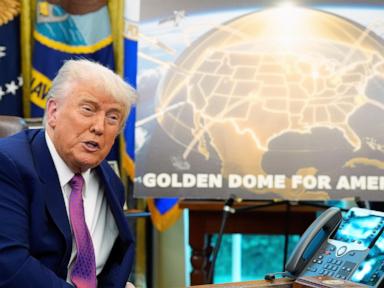
The $1.2 trillion figure is a ghost. It is a number conjured by analysts who treat national defense like a kitchen renovation. When the media screams about "cost overruns" for a theoretical missile defense shield, they are looking at the price of the steel and ignoring the value of the sovereignty. They want you to believe the "Golden Dome" is a fiscal black hole. In reality, the traditional bean-counting approach to continental defense is the actual disaster.
The Myth of the Static Price Tag
Mainstream reporting loves a big, scary number. They take the projected cost of a single Interceptor—say, a Ground-Based Midcourse Defense (GMD) element—and multiply it by the square footage of the United States. This is lazy math. It assumes we are building a literal physical roof over the country using 1990s procurement cycles.
If you have spent any time in the defense industrial complex, you know that cost curves in aerospace don't stay flat. They collapse. Look at the launch costs of SpaceX. From 1970 to 2000, the cost to launch a kilogram into space hovered around $18,500. Today, it is under $3,000 and dropping. A continental defense shield isn't just about interceptors; it is about the sensor layer. We are moving from a world of $500 million bespoke satellites to mass-produced Low Earth Orbit (LEO) constellations.
The critics are pricing a 2030 solution with 1980 budget logic. They are terrified of the $1.2 trillion "estimated cost" because they don't understand the difference between capital expenditure and a generational shift in industrial capacity.
Why $1.2 Trillion is Actually a Bargain
Let's do some uncomfortable math. The GDP of the United States is roughly $27 trillion. A single successful strike on a major financial hub like New York or a logistics vein like the Port of Los Angeles wouldn't just cost lives; it would erase decades of economic growth. We are talking about a $10 trillion to $15 trillion hit to the global economy in a single afternoon.
Spending $1.2 trillion over a decade to insure a $27 trillion-a-year engine isn't "extravagance." It is a basic insurance premium.
The Deterrence Dividend
Critics argue that a dome invites an arms race. This is the "lazy consensus" of the academic elite. They claim that if we build a shield, our adversaries will simply build more missiles.
They miss the point of economic exhaustion.
The United States can afford to build the shield. Our adversaries—whose economies are often the size of Texas or Florida—cannot afford to build enough decoys and hypersonic glide vehicles to overcome it. Defense is becoming cheaper than offense for the first time in the missile age. AI-driven target acquisition and directed energy (lasers) change the calculus. A laser shot costs the price of the electricity used to fire it. A missile costs millions.
We aren't just building a dome. We are forcing the opposition into a bankruptcy race they cannot win.
The Directed Energy Breakthrough Nobody is Factoring In
The $1.2 trillion estimate assumes we are using kinetic interceptors for every threat. That is like trying to put out a forest fire by throwing individual cups of water.
The "Golden Dome" concept only works if we pivot to directed energy. If you look at the current developments at companies like Lockheed Martin or Northrop Grumman, the focus is on high-energy lasers (HEL) and high-power microwaves (HPM).
- Infinite Magazine: As long as you have power, you have "ammo."
- Speed of Light Engagement: You don't need to lead a target if your "bullet" moves at $299,792,458$ meters per second.
- Cost per Shot: We are talking about dollars, not millions.
The critics won't mention this because it ruins the "trillion-dollar boondoggle" narrative. They want to keep the conversation focused on expensive, clunky hardware because that’s the only way their "math" stays scary.
The Economic Ghost in the Machine
I have seen the government blow billions on projects that go nowhere—look at the Littoral Combat Ship. I know the skepticism is earned. But the "Golden Dome" isn't a project; it is a catalyst for a new domestic manufacturing base.
When people cry about the cost, they act as if that $1.2 trillion is being burned in a giant pile. It isn't. It goes into:
- Silicon and Semiconductors: We are forced to repatriate high-end chip manufacturing.
- Advanced Materials: Developing the heat shielding for interceptors has immediate applications in commercial aerospace and energy.
- Labor: It creates a high-skilled workforce that doesn't just disappear when the project ends.
This is the "Apollo Effect." For every dollar spent on the moon landing, the US economy saw a return of roughly $7 to $40 in spin-off technology and economic activity. A continental defense shield is the 21st-century equivalent. It forces the technical frontier forward.
The "False Sense of Security" Argument is a Trap
"If we feel safe, we will become aggressive," the pundits say. This is an insult to strategic reality. Weakness is what invites aggression.
The current "Mutually Assured Destruction" (MAD) framework is aging poorly. It relies on the assumption that every actor on the world stage is a rational, stability-seeking entity. That is a dangerous bet to make in a multipolar world with non-state actors and rogue regimes.
A defense shield doesn't make us "bullies." It makes us "un-buyable." It removes the nuclear blackmail card from the table.
The Logistics of the Impossible
Is it hard? Yes. Is the $1.2 trillion figure potentially accurate in a worst-case, inefficient scenario? Sure. But focusing on the price tag is the ultimate distraction.
The real question isn't "Can we afford to build it?"
The question is "Can we afford to let the technology of defense fall behind the technology of destruction?"
We are currently in a period where offensive capabilities—hypersonics, drone swarms, and MIRVs (Multiple Independently Targetable Re-entry Vehicles)—are outstripping our legacy defense systems. The Golden Dome isn't a vanity project. It is a necessary rebalancing of the scales.
Dealing with the "Physics" Critics
Some physicists claim that "physics" makes a perfect dome impossible. They point to the difficulty of discriminating between a real warhead and a Mylar balloon in the vacuum of space.
They are right about the difficulty, but wrong about the solution. They assume we are using 20th-century sensors. Modern machine learning models can analyze the "wiggle" and thermal signature of a decoy versus a weighted warhead with a precision that was unthinkable ten years ago.
We aren't solving a physics problem anymore. We are solving a data problem. And the United States is still the king of data.
Stop Asking About the Cost
The obsession with the $1.2 trillion number is a symptom of a nation that has forgotten how to build for the long term. We spend more than that on administrative overhead and interest on the debt without blinking.
If we can find the money to bail out banks and fund endless cycles of reactive foreign policy, we can find the money to build a permanent, high-tech shield that ensures the American experiment continues regardless of who is having a bad day in a silo halfway across the world.
The Golden Dome is expensive. So is losing a city. Pick your price.
Stop listening to the people who know the price of everything and the value of nothing. The math isn't the problem. The lack of industrial ambition is.
Build the dome. Pay the bill. Own the sky.