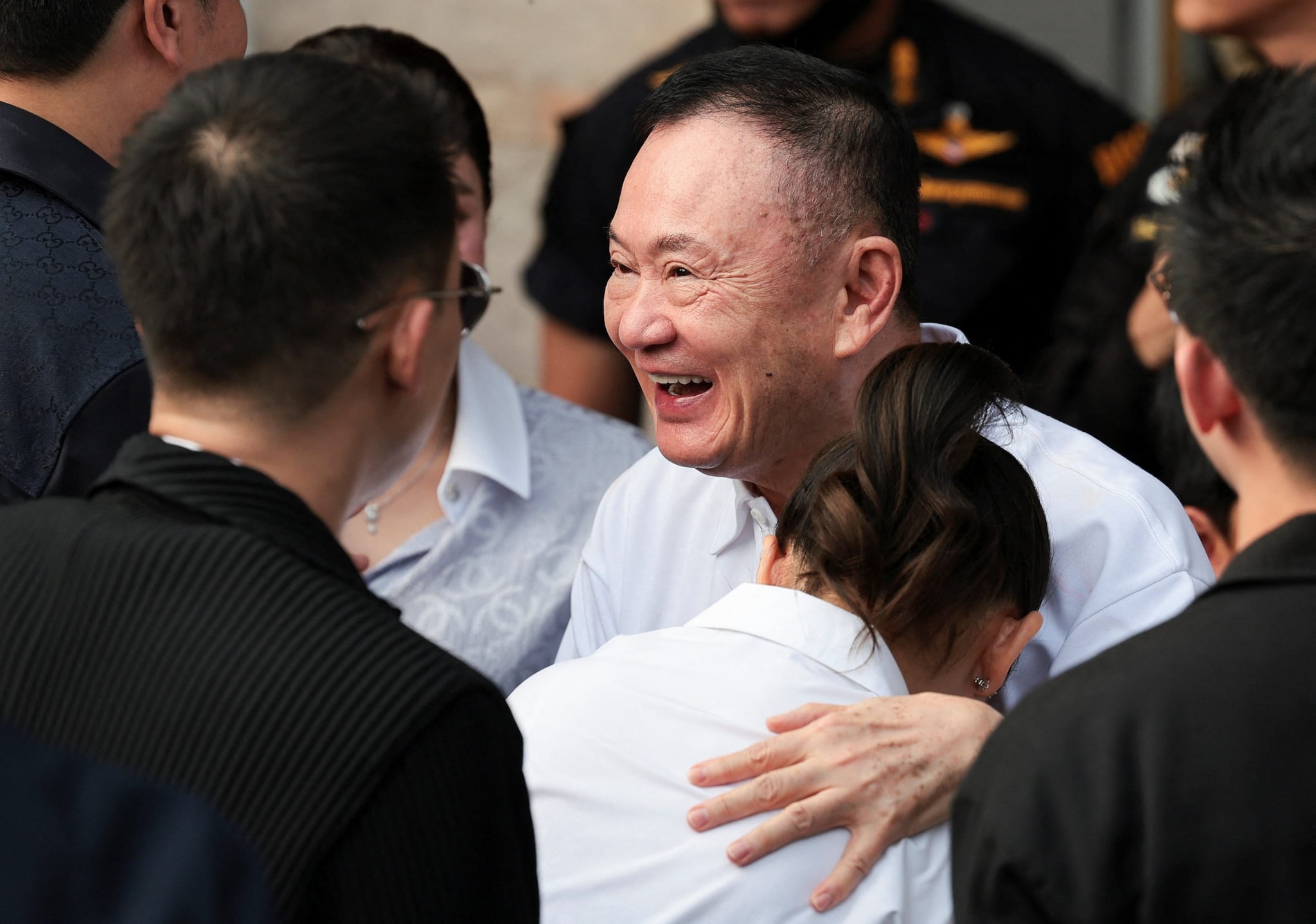
The black Mercedes-Benz glided through the gates of the police hospital in the pre-dawn hush of a Sunday morning. Behind the tinted glass sat a man who had been a ghost in his own country for fifteen years. Thaksin Shinawatra, the billionaire telecommunications mogul turned populist prime minister turned fugitive, was finally going home. He wore a neck brace and a green shirt, a visible reminder of the frailty that had kept him in a private hospital wing instead of a prison cell for the last six months. Outside, the Bangkok air was thick with the scent of humidity and the lingering electricity of a political storm that has refused to break for two decades.
He didn't speak to the press. He didn't have to. The image of the 74-year-old patriarch pulling into his "Manila-like" estate, Chan Song La, told the story of a kingdom in flux. For his supporters, the "Red Shirts" who once occupied the heart of the city in a sea of crimson, this was a homecoming for a hero. For his detractors, it was a cynical masterpiece of backroom deal-making.
To understand why a man being released on parole matters to a street vendor in Chiang Mai or a hedge fund manager in New York, you have to look past the legal jargon of "special parole" and "age-related illness." You have to look at the soul of a nation that has been locked in a circular argument with itself since 2006.
The Architect of a Divided Heart
Thaksin Shinawatra did something no Thai politician had done before: he made the rural poor feel seen. Before his rise, the villagers of the northern rice paddies were an afterthought in the glittering halls of Bangkok power. Thaksin gave them universal healthcare. He gave them micro-loans. He gave them a voice. In doing so, he created a loyalty so fierce it survived a military coup, a decade and a half of exile, and the dissolution of multiple political parties.
But power of that magnitude creates friction. To the established elite—the military, the judiciary, and the old-money bureaucracy—Thaksin was a populist wrecking ball. They saw a man who treated the country like a corporate subsidiary and the constitution like a suggestion. When the tanks rolled into Bangkok in 2006 while Thaksin was at the UN in New York, it wasn't just a change of government. It was the start of a cold war between two versions of Thailand.
One version looks back at tradition and hierarchy. The other looks forward to a disrupted, modernized future. Thaksin became the personification of that struggle. Even from his luxury villas in Dubai and London, his shadow loomed over every election. His sister, Yingluck, became prime minister and was eventually ousted. His daughter, Paetongtarn, now leads the party that carries his DNA. He was the "He-Who-Must-Not-Be-Named" of Thai politics, a specter that could win an election without ever stepping foot on the soil.
The Art of the Return
The timing of his return in August 2023 was a theatrical masterclass. He landed on a private jet just hours before the Thai parliament was set to vote for a new prime minister. After months of post-election deadlock, his Pheu Thai party did the unthinkable. They formed a coalition with the very pro-military parties that had spent the last twenty years trying to erase the Shinawatra name from history.
Critics called it a "Grand Bargain." The deal seemed simple: Thaksin returns and faces a reduced sentence, and in exchange, his populist machine helps the old guard keep the more radical, youth-led "Move Forward" party out of power.
Move Forward had won the popular vote by promising to reform the monarchy and the military—a bridge too far for the establishment. Suddenly, the man who was once the elite’s greatest enemy became their most useful shield. Politics, as the saying goes, makes for strange bedfellows. In Thailand, it makes for a complete rewrite of the script.
The Hospital Wing and the Rule of Law
Thaksin was originally sentenced to eight years for corruption and abuse of power—charges he always maintained were politically motivated. Within hours of his arrival, the eight years became one after a royal pardon. Within days, he was moved from a prison cell to a top-floor suite at the Police General Hospital, citing chest pains, high blood pressure, and a lack of sleep.
For six months, he lived in a strange limbo. He was a prisoner who never wore a uniform. He was a convict who never saw the inside of a communal ward. This sparked a different kind of outrage. On social media, the hashtag #DoubleStandard began to trend. Students and activists pointed out that while Thaksin was receiving specialized care in a private room, hundreds of young political prisoners were sitting in overcrowded cells for the crime of speaking their minds.
The tension is palpable. If the law is a rubber band, how far can you stretch it before it snaps? By releasing Thaksin on parole due to his age and health, the government followed the letter of the law. But the spirit of the law is a much more fragile thing. It relies on the belief that the rules apply to the billionaire and the beggar alike. When that belief wavers, the foundation of a society begins to crack.
A Patriarch in the Garden
Now, Thaksin is home. He sits behind the high walls of his residence, perhaps watching the monsoons roll in over the Chao Phraya River. He is technically a free man, though restricted by the conditions of his parole. But his influence doesn't need a hall pass.
His daughter is the head of the ruling party. His allies hold the levers of the economy. The "Thaksin Factor" is no longer a distant signal from Dubai; it is a live broadcast from the heart of Bangkok. The question that keeps political analysts awake at night is simple: What does he want now?
Some believe he is content to play the role of the elder statesman, a grandfather enjoying his twilight years after a lifetime of combat. Others see a chess player who has just moved his most important piece back onto the board. Thailand’s economy is sluggish. Its tourism industry is clawing back from the pandemic. The youth are restless and disillusioned with a political system that seems to trade favors in the dark.
Thaksin’s return was supposed to be a moment of national reconciliation—a closing of the circle. Instead, it feels like the start of a new, more complicated chapter. The old divide between "Red Shirts" and "Yellow Shirts" has been replaced by a more profound gap between the "Old World" and the "New."
The Invisible Stakes
We often talk about politics in terms of numbers—vote counts, GDP growth, seats in parliament. But the human element is what truly drives the gears. For the grandmother in a rural village, Thaksin’s release is a sign that the man who helped her family still has power. It is a win for "their side."
For the young protester who spent 2023 in the streets demanding a transparent democracy, it feels like a betrayal. It is a reminder that the elites will always find a way to protect their own, regardless of which side of the political fence they claim to be on.
The stakes are nothing less than the legitimacy of the Thai state. If the "Grand Bargain" brings stability, perhaps the public will forgive the perceived injustices. If the economy thrives and the streets remain quiet, the compromise might be seen as a necessary evil. But stability bought at the price of perceived fairness is a volatile currency.
As the sun rises over Bangkok, the city moves with its usual frantic energy. Tuk-tuks weave through traffic, and the street food stalls begin to sizzle. Life goes on. But the man in the Mercedes has changed the atmosphere. Thaksin Shinawatra is no longer a myth or a memory. He is a neighbor. He is a presence.
He is a reminder that in the theater of power, the final act is rarely what you expect. The curtain has risen on a Thailand where the ghosts of the past have been invited back into the living room, and everyone is waiting to see who will speak first. The rain stops, the heat rises, and the silence from the house behind the gates feels heavier than any roar of a crowd ever did.