The wind in the Bayuda Desert does not just blow; it scours. It carries a fine, golden grit that finds its way into the seams of your clothes, the corners of your eyes, and the very lungs of history. For six millennia, this wind has been the primary guardian of a secret so vast it redefines our understanding of where we come from.
We have long been taught that civilization is a neat, linear ladder. We start with small bands of hunters, move to modest farms, and eventually—after a long, slow climb—we build monuments. But the ground in modern-day Sudan is currently screaming a different story.
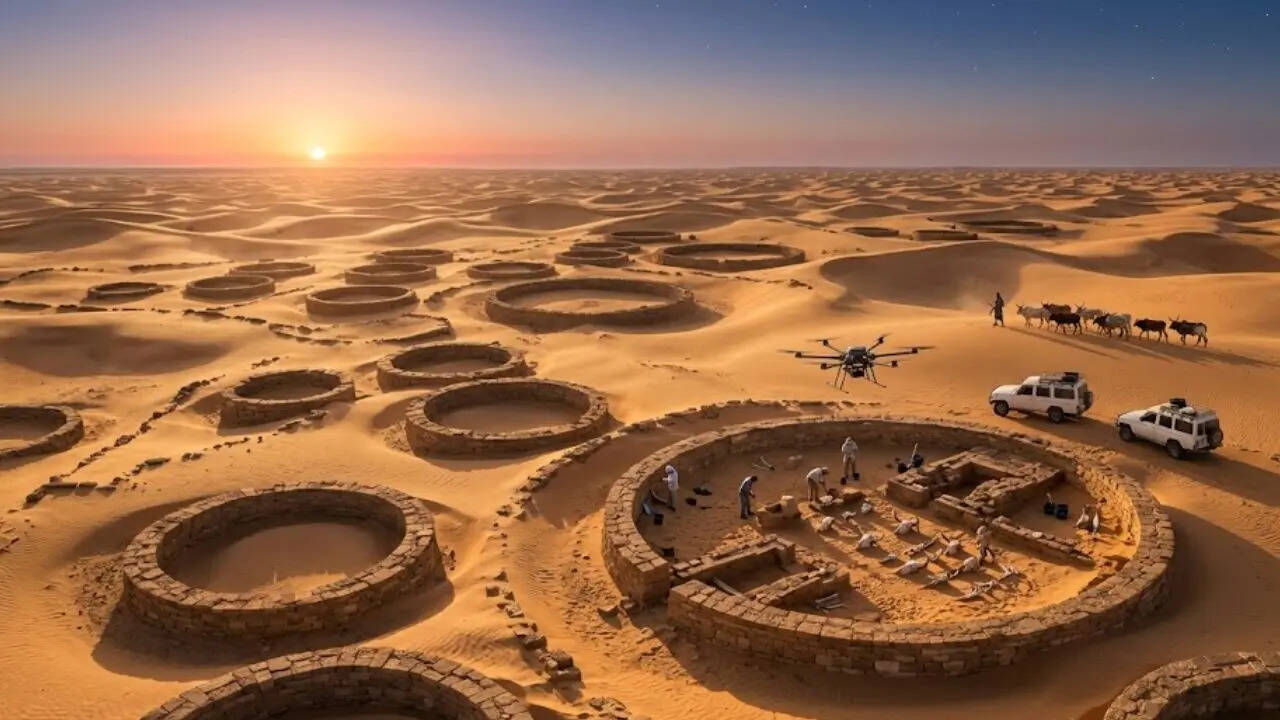
Archaeologists recently pulled back the veil on a series of massive, 6,000-year-old stone monuments. These are not just piles of rock. They are geometric signatures of a people we didn’t know existed, living in a time we thought was far too primitive for such ambition.
The Architect in the Dust
To understand the scale of this, we have to stop looking at satellite maps and start looking at the hands of a single, hypothetical builder. Let’s call him Elos.
Elos lived four thousand years before the first Roman set foot in Africa. He lived before the Great Pyramid of Giza was even a whisper of a dream. In the standard history books, Elos should be a simple nomad, obsessed only with the next meal and the nearest well.
Yet, here we find him and his kin moving stones that weigh as much as modern SUVs. They didn't do this for shelter. They didn't do it for defense. They did it to mark the earth.
When you stand where these monuments were found, the silence is heavy. These structures—vast, circular, and rectangular enclosures—suggest a level of social organization that shouldn't have been possible in 4000 BCE. It takes more than a family to move a mountain. It takes a society. It takes a shared belief. It takes a leader with a vision and a workforce that believes the future is worth carving into the crust of the planet.
The Sahara Was Not Always a Grave
It is a common mistake to view the Sudan of today—parched, golden, and unforgiving—as the world Elos knew.
Six thousand years ago, the "Green Sahara" was a reality. Imagine a savannah pulsing with life. Picture deep, permanent lakes where there are now only salt pans. There were giraffes, elephants, and lush grasslands that stretched toward the horizon. This wasn't a wasteland; it was an Eden.
But Edens are fragile.
As the earth’s tilt shifted and the rains began to fail, the people of the Bayuda Desert faced a slow-motion catastrophe. The lakes shrank. The grass turned to straw. The monuments they built weren't just decorative; they were likely anchors. In a world that was literally drying up and blowing away, these people planted stones to say, We were here. We mattered.
The sheer size of these monuments—some stretching over thirty meters in length—serves as a middle finger to the passage of time. The scientists who discovered them using satellite imagery and ground-penetrating radar weren't just finding rocks. They were finding the ghosts of a sophisticated cattle-herding culture that managed to thrive in a shifting environment.
The Problem With Our Timeline
Why does this matter to us, sitting in our climate-controlled rooms thousands of years later?
It matters because we are currently obsessed with our own "civilizational peak." We think we are the first to face environmental shifts. We think we are the first to organize on a massive scale.
The discovery in Sudan proves that the human spirit has been playing this game on "hard mode" since the very beginning. These 6,000-year-old structures predating the established Sudanese kingdoms like Kush or Meroë suggest that the foundations of African complexity are much deeper than we dared to guess.
Consider the logistical nightmare of such a project. There were no iron tools. No wheels. No beasts of burden capable of the heavy lifting. There was only the human back and the human will. To build these monuments, the "lost" people of Sudan had to solve problems of engineering and mathematics that we usually attribute to the Greeks or Egyptians much later in the timeline.
A Mirror in the Sand
There is a specific kind of vertigo that comes from looking into a trench and realizing you are staring at a floor laid by someone who died sixty centuries ago. It makes our modern squabbles feel thin.
The scientists working in Sudan are currently racing against more than just the sun. They are racing against political instability, looting, and the rapid expansion of gold mining in the region. Every time a bulldozer clears a path for a mine, a chapter of our collective biography is shredded.
We often treat archaeology as a hobby of the elite, a way to fill museums with shiny trinkets. But the monuments in Sudan aren't shiny. They are grit-blasted and rugged. They don't offer gold; they offer a mirror.
They show us a version of ourselves that was more capable, more organized, and more resilient than we give our ancestors credit for. They remind us that "progress" isn't a straight line. It’s a series of pulses. Cultures rise, they reach for the stars or the gods with heavy stones, and then the climate shifts, the water vanishes, and they fade into the dunes.
The Weight of What Is Missing
What else is down there?
If we missed monuments of this size for this long, what other cities, libraries, or temples are sleeping beneath the ripples of the Sahara? The discovery is a humbling reminder of our own myopia. We look at the desert and see emptiness. The desert looks back and sees a graveyard of giants.
The real tragedy isn't that these people are gone. The tragedy would be if we never bothered to learn their names. As the excavations continue, we are slowly piecing together a map of a forgotten empire of the mind.
The wind continues to scour the Bayuda. It will eventually cover these stones again if we let it. But for a brief moment, the veil has been lifted. We can see the shadows of the people who stood in the tall grass 6,000 years ago, looked at the horizon, and decided to build something that would outlast the very lakes that gave them life.
They succeeded. We are finally looking.
The stones are cold to the touch, but they still hum with the heat of the hands that placed them there, a defiant rhythm beating from the deep heart of the sand.