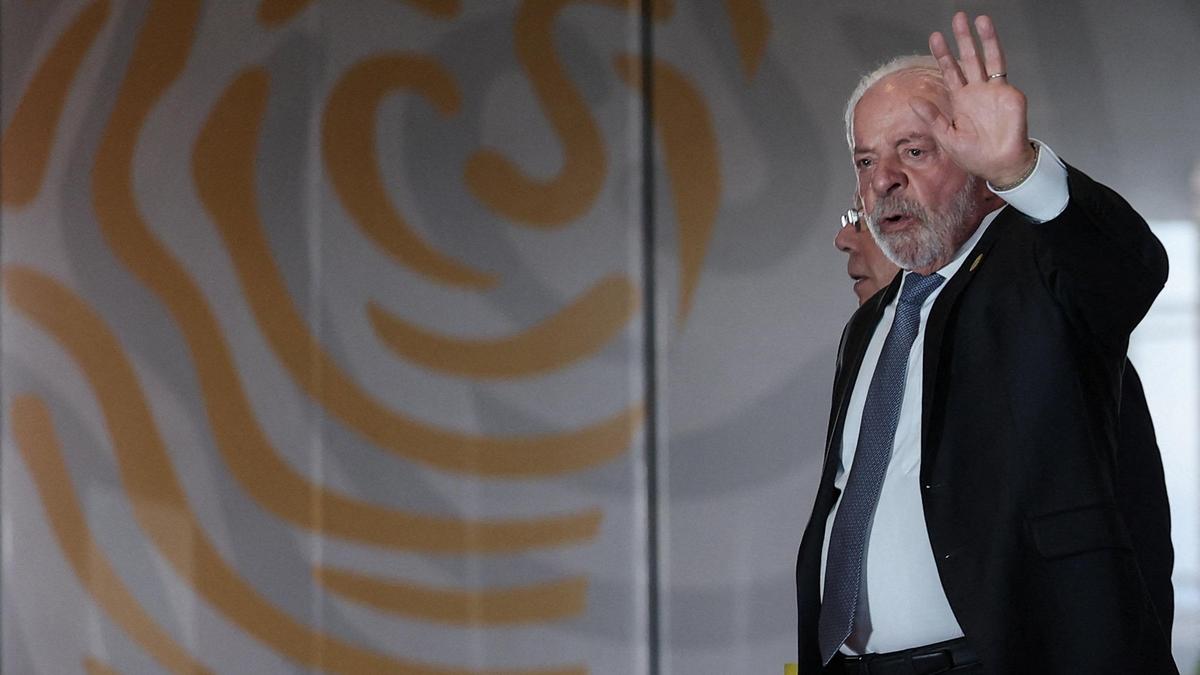
In the gilded, echo-prone halls of the UN’s International Fund for Agricultural Development, the air is usually thick with the sterile vocabulary of bureaucracy. You hear words like "allocation," "infrastructure," and "sustainability." But when Luiz Inácio Lula da Silva, the President of Brazil, stepped to the microphone, the temperature changed. He didn’t just give a speech. He reached back into a collective memory that spans centuries and continents.
Lula looked out at a room full of representatives from the Global South—nations that have spent the last few hundred years being told what to do by people across an ocean. He spoke about "interference." He spoke about the indignity of being treated like a junior partner in your own home.
The name Donald Trump never left his lips. He didn’t need to say it.
When a man of Lula’s history speaks about the "spirit of colonialism," he isn't just reciting a history textbook. He is talking about the scar tissue on the psyche of nations like Brazil, India, and South Africa. For these countries, sovereignty isn't an abstract legal term. It is the hard-won right to fail or succeed on their own terms.
The Invisible Architect of Chaos
Imagine a small farmer in the Brazilian interior. He doesn’t follow the daily fluctuations of the dollar or the latest polling from Iowa. Yet, his life is tethered to decisions made in boardrooms and capital cities he will never visit. When a major global power decides to impose its will—whether through trade sanctions, ideological pressure, or the simple threat of isolation—that farmer feels the tremor.
Lula’s critique was aimed at a specific brand of modern politics that views the world as a chessboard where only two or three players have hands. This brand of politics assumes that "previously colonized" countries are merely empty vessels waiting to be filled with Western influence or used as proxies in a new Cold War.
He was drawing a line in the sand.
The tension in that room was palpable because everyone knew the subtext. The world is watching the American political theater with a mixture of fascination and genuine dread. There is a sense that the rules of the game are being rewritten, and not everyone was invited to the meeting.
A History of Hands on the Wheel
To understand why Lula’s words carry such weight, you have to look at the anatomy of interference. It rarely starts with an invasion. It starts with a suggestion. Then it becomes a condition for a loan. Then it becomes a "recommendation" for how a nation should govern its own resources.
Lula’s own trajectory—from a shoe-shiner to a union leader to a president who saw the inside of a prison cell before returning to power—is a narrative of resistance. When he talks about the "interference" of the powerful in the affairs of the developing world, he is speaking from a place of lived defiance.
He highlighted a fundamental truth: the era where the North dictates the pace of the South is ending. Or, at least, it should be.
He pointed to the way international institutions are often weaponized. If a country chooses a path that doesn't align with the interests of a dominant global power, the screws begin to turn. The rhetoric shifts. Suddenly, that country is "unstable" or "drifting."
The Weight of a Shadow
There is a particular kind of ghost that haunts these international summits. It is the ghost of a populist, nationalist energy that seeks to pull the world back into silos. By refusing to name names, Lula actually made his point more universal. He wasn't just attacking a person; he was attacking a philosophy.
This philosophy suggests that "Might Makes Right" is the only true law of the jungle.
Lula countered this by invoking the collective strength of the Global South. He argued that the challenges we face—hunger, the climate crisis, the digital divide—cannot be solved if we are still operating under the old colonial script. You cannot fix a house if one person insists on holding all the hammers and telling everyone else where to stand.
The silence that followed his remarks was telling. It wasn't the silence of boredom. It was the silence of recognition.
Sovereignty as a Human Right
We often treat geopolitics like a game of Risk, but the stakes are measured in human dignity. When a nation’s policy is dictated by external "interference," the citizens of that nation lose their agency. They become spectators in their own democracy.
Consider the irony of a world that preaches democracy while simultaneously trying to micromanage the outcomes of elections in other hemispheres. Lula’s "slam" was a reminder that democracy is a messy, internal process. It requires a level of respect that has been sorely lacking in global diplomacy for decades.
He spoke to the "invisible stakes." It’s not just about trade deals or mineral rights. It’s about the right of a nation to define its own identity without looking over its shoulder to see if a superpower approves.
The New Map of Power
The world is no longer a bipolar or unipolar entity. It is a jagged, multi-dimensional space where Brazil, Indonesia, and Nigeria are no longer content to be the "emerging markets" of tomorrow. They are the power centers of today.
Lula’s refusal to name his target was perhaps the most "masterful" part of the performance. By leaving the space blank, he forced everyone in the room to fill it with their own fears and experiences of being pushed around. He turned a specific political grievance into a universal manifesto for independence.
The message was clear: The South is not a backyard. It is not a laboratory for failed ideologies. It is not a trophy to be won.
As the session ended and the delegates moved toward the exits, the air felt a little thinner, the stakes a little higher. The ghost was still in the room, but for a brief moment, it had been forced to stand in the light.
The struggle for sovereignty isn't a single event; it's a constant, rhythmic pulse of resistance against the gravity of the powerful. It is the sound of a door being locked from the inside, and the quiet, firm insistence that the people within are the only ones who hold the key.