The rain in Liverpool doesn’t just fall; it searches. It snakes through the cracks of the red-brick warehouses and pools in the uneven flagstones of the Cavern Quarter, reflecting the neon hum of a thousand late-night dreams. For a teenager clutching a cheap Squier Stratocaster in a drafty bedroom in Anfield or Toxteth, that rain feels like a barrier. Between the kid and the stage is a canyon of logistics, money, and the crushing weight of a legacy that sometimes feels more like a museum than a living, breathing pulse.
We talk about Liverpool as a "city of music" as if the notes are baked into the mortar. They are. But heritage can be a heavy crown. When the world looks at this city, they see four lads in mop-top haircuts. They see a black-and-white past. What they often miss is the kid standing on a street corner today, humming a melody that could change everything, yet having no idea where to plug in an amp.
The new Liverpool music trail isn't just a collection of plaques or a tidy walking route for tourists. It is a map for the dispossessed. It is a physical manifestation of the bridge that has been missing for decades—a way to turn "I wish I could" into "I am."
The Weight of the Bronze Statues
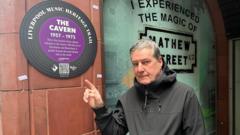
Walking down Matthew Street, you collide with history. John Lennon leans against a wall in bronze, forever cool, forever frozen. It is easy to look at that statue and feel small. For a local songwriter trying to find their voice, the greatness of the past can feel like an eviction notice for the present. The logic is silent but deadly: It’s all been done. The best songs are already written.
This is the "Museum Trap." When a city becomes famous for what it was, it risks suffocating what it could be. To combat this, the city’s new initiative focuses on "inspiration via proximity." By marking the trail not just with names of the dead, but with the stories of the struggle, the city is humanizing the icons.
Consider a hypothetical young girl named Mia. She lives in a high-rise, works a shift at a cafe, and spends her tips on guitar strings. To Mia, the "music industry" is a gleaming glass tower in London or a digital void on Spotify. It isn't real. But when she follows a trail that shows her exactly where a local band lugged their gear through the mud, or the specific basement where a world-changing riff was birthed out of sheer boredom, the distance shrinks.
The trail functions as a chronological argument. It says: They were just like you. They were broke, they were wet, and they were loud. Now, it's your turn.
The Infrastructure of a Dream
Music doesn't happen in a vacuum. It requires a specific kind of ecosystem—a messy, loud, often unprofitable network of small rooms and sticky floors. Over the last decade, these spaces have been vanishing across the UK, swallowed by luxury flats and noise complaints. Liverpool is fighting back by treating music trail locations as sacred geography.
This isn't just about nostalgia. It’s about "Cultural Density." Statistics from the UK music industry suggest that for every £1 invested in grassroots music venues, there is a manifold return in local economic activity. But the emotional return is harder to calculate. How do you measure the value of a sixteen-year-old seeing a stage and realizing for the first time that they are allowed to stand on it?
The trail incorporates QR codes and interactive installations that do more than tell tales. They connect. They point toward rehearsal spaces, grant applications, and mentorship programs. It is an "on-ramp" disguised as a tourist attraction.
The Sound of the Invisible Stakes
There is a specific kind of silence that happens when a creative person gives up. It doesn't make a sound, but it changes the atmosphere of a city. When the barriers to entry—the cost of equipment, the lack of transport, the mystery of how to get a gig—become too high, we lose the next "Eleanor Rigby." We lose the next "Relax." We lose the sound of the future.
The stakes are invisible because we don't know what we're missing until it never arrives.
By formalizing the music trail, Liverpool is essentially lowering the "activation energy" required to become an artist. It provides a sense of belonging to a lineage. If you can see the path, you are more likely to walk it. The initiative recognizes that talent is distributed evenly across the city’s postcodes, but opportunity is not.
Mapping the Unmappable
The trail isn't a straight line. It’s a web. It spans from the docks to the suburbs, highlighting the diverse genres that have called the Mersey home—from the synth-pop of the 80s to the vibrant hip-hop and electronic scenes of today. This inclusivity is the project’s secret weapon. It tells the soul singer and the DJ that they are just as much a part of the Liverpool story as the guitar band.
Imagine standing at the site of the old Eric’s Club. You aren't just looking at a doorway; you are looking at a portal where punk, post-punk, and New Wave collided. The trail uses these sites to explain "Creative Friction"— the idea that when you cram enough different types of artists into a small geographic area, something explosive happens.
The city is betting on the fact that if they can get people walking, talking, and thinking about these spaces again, the friction will return.
The First Note
The rain starts again. It’s that fine, misty drizzle that blurs the edges of the Liver Building. A group of students huddles under an awning near a trail marker. One of them is pointing at a phone, eyes wide, listening to a clip of a band that started in a garage three blocks from where they are standing.
They aren't looking at the past. They are looking at each other.
One of them reaches into a backpack and pulls out a notebook. The pen moves. A line of lyrics. A sketch of a melody. The trail has done its job. It has moved the conversation from "Look what they did" to "Look what I can do."
The bronze statues don't mind. They’ve been waiting a long time for some company.
The city isn't a museum. It’s a rehearsal.
Somewhere, a door slams. A drum kit is being set up. A cable is plugged into an amp with a satisfying, electric crackle. The air begins to vibrate.
The next song is starting. It’s loud. It’s messy. It’s perfect.