The rain in Seattle doesn’t just fall; it lingers. It clings to the pavement of Queen Anne Hill and mist-coats the glass of the Climate Pledge Arena, a gleaming, subterranean marvel built on the bones of a memory. For seventeen years, a specific kind of silence has occupied this city. It’s the silence of a stolen heartbeat.
In 2008, the SuperSonics didn’t just leave. They were surgically removed. They left behind a color palette of forest green and harvest gold that still adorns the hoodies of bar patrons in Ballard and the fading murals in South Seattle. When Gary Payton walks into a room here, the air changes. People don’t just see a Hall of Fame point guard; they see a living relic of a time when the city felt whole.
But the silence is about to break.
NBA Commissioner Adam Silver has spent years deflective and noncommittal, leaning on the standard corporate liturgy of "not yet" and "someday." However, the financial gravity of the modern sports era is pulling the league toward an inevitable conclusion. The league is currently finalizing a media rights deal whispered to be worth $76 billion over eleven years. That kind of capital doesn't just sustain a league; it demands expansion.
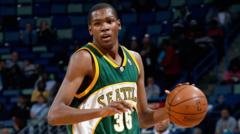
To understand the stakes, you have to look past the spreadsheets and into the eyes of a hypothetical fan we’ll call Marcus. Marcus was twelve when Kevin Durant played his lone, blistering season in Seattle. He remembers the squeak of sneakers in the old KeyArena and the way the vibration of a thunderous dunk felt in his teeth. Now, Marcus is nearly thirty. He has a daughter who wears a "Bring ‘Em Back" t-shirt, cheering for a team that exists only in YouTube highlights and her father's stories. For Marcus, expansion isn't a business "synergy." It is the return of a family member.
While Seattle is a story of resurrection, Las Vegas is a story of reinvention.
Six hundred miles south, the heat is a physical weight. On the Las Vegas Strip, the neon never blinks, and the concept of "too much" doesn't exist. For decades, the NBA viewed Vegas as a forbidden fruit—a city built on the very gambling that professional sports leagues once treated like a contagion.
That wall didn't just crumble; it vanished.
The success of the NHL’s Golden Knights and the NFL’s Raiders proved that Vegas isn't just a tourist trap. It is a sports town with a desperate, localized hunger. The NBA has already used the city as its laboratory, hosting the Summer League and the inaugural In-Season Tournament there. The crowds didn't just show up; they roared. LeBron James, a man who understands the intersection of legacy and ledger better than perhaps any athlete in history, hasn't been shy about his desire to own a franchise in the Mojave.
The numbers are staggering. A new expansion fee could cost upwards of $4 billion or $5 billion per team. That is a massive windfall for the existing thirty owners, a collective "thank you" for navigating the lean years of the pandemic. But for the people on the ground, the math is different.
In Vegas, the hypothetical character is Maya. She works three jobs in the service industry, the invisible engine that keeps the casinos humming. She doesn’t care about the $76 billion TV deal. She cares about the fact that her city, long dismissed as a playground for outsiders, is finally earning its own permanent identity. She wants to wear a jersey that says "Vegas" across the chest, not because she’s betting on the game, but because the game is finally betting on her home.
The logistical hurdles are real. The NBA’s Western Conference is already crowded. Adding two teams in the West would necessitate moving a franchise like Memphis, New Orleans, or Minnesota to the Eastern Conference. It’s a geographic reshuffle that changes rivalries, travel schedules, and the very texture of the postseason.
Yet, the momentum is undeniable.
The league is no longer asking if. They are calculating when. The collective bargaining agreement is settled. The TV money is coming. The only thing left is the formal announcement that will set off a gold rush.
In Seattle, the infrastructure is waiting. The arena is there, tucked under its historic roof, cooled by zero-carbon technology, waiting for a permanent tenant that isn't the NHL’s Kraken or the WNBA’s Storm. It’s waiting for the ghost of the Sonics to finally take a seat.
In Las Vegas, the blueprints are being drawn for a multi-billion dollar sports and entertainment district south of the Strip. Oak View Group has already committed to a project that would include a world-class arena. They aren't building it on a whim. They are building it because they know the desert is thirsty.
Critics might argue that expansion dilutes the talent pool. They say there aren't enough superstars to go around. Tell that to the kid in a suburban driveway in Henderson, Nevada, or the teenager at a park in Renton, Washington. The talent doesn't dilute; it finds a way to fill the space provided. The world is full of players waiting for thirty more roster spots to open up, thirty more chances to prove they belong under the bright lights.
The NBA is a business, yes. It is a machine designed to generate revenue and global brand awareness. But at its core, it is a narrative engine. It thrives on the stories we tell ourselves about loyalty, geography, and the thrill of the comeback.
One day soon, the lights will dim in a new arena in Nevada. A spotlight will hit center court. A crowd will erupt with a sound that has been building for twenty years.
Across the mountains, in the Pacific Northwest, a different light will turn on. The green and gold will be official again. The record books will be reopened. The gap in the city’s heart will finally be patched with hardwoods and rafters.
History is a circle. Sometimes it takes nearly two decades to close, but the arc is clear. The league is growing because the world demands it. Because a city in the rain and a city in the sun are both tired of waiting for the ball to drop.
The silence is almost over. You can hear the bounce of the ball if you listen closely enough. It’s getting louder. It’s coming home.