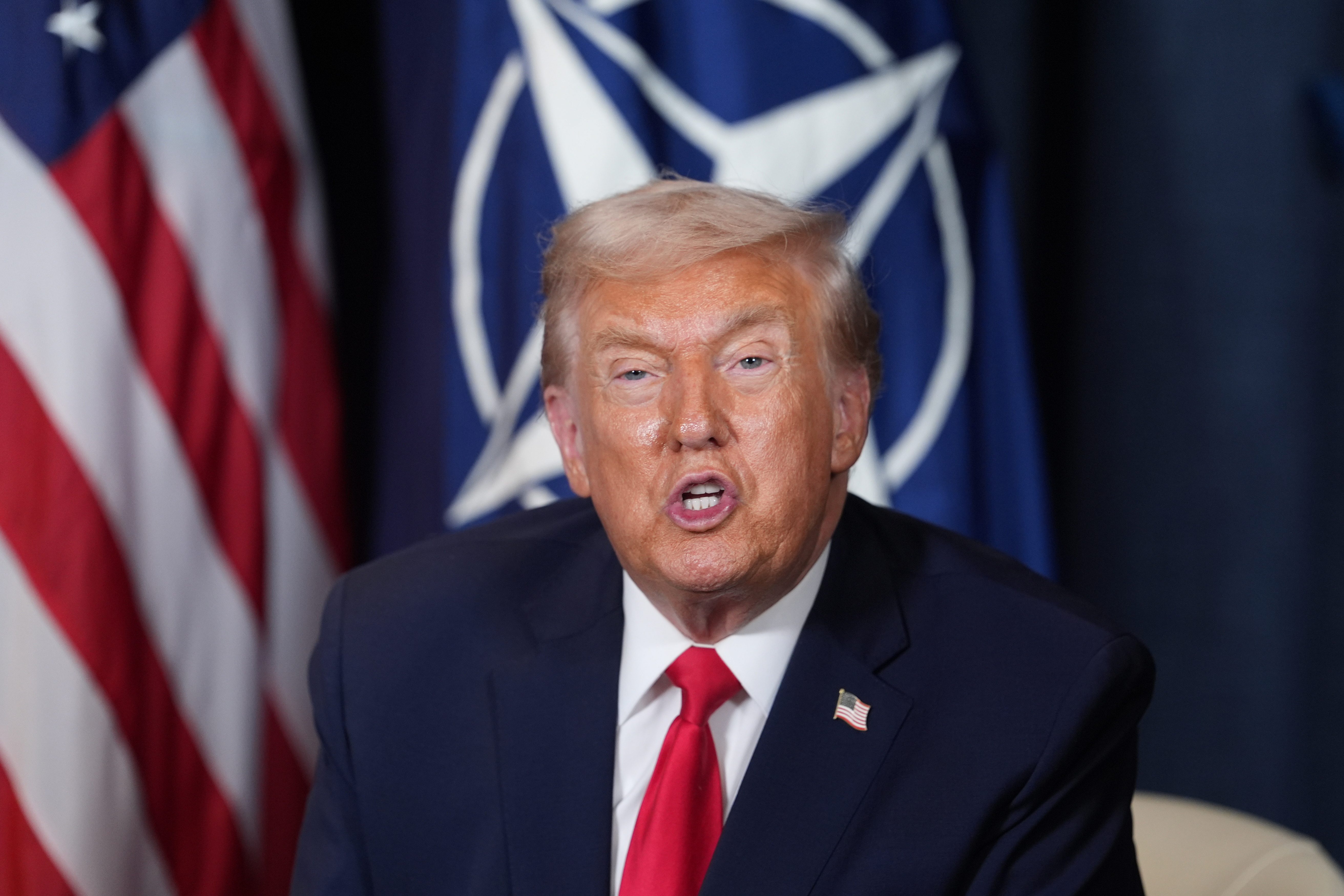
The current friction between the United States executive branch and the North Atlantic Treaty Organization (NATO) regarding the Strait of Hormuz is not merely a dispute over maritime patrols; it is a fundamental renegotiation of the Global Security Premium. The core tension lies in the mismatch between regional energy reliance and the cost of maintaining the security architecture that protects those flows. While the rhetoric focuses on a "very bad future," the underlying mechanism is an attempt to shift the financial and operational burden of global commons protection from a unipolar American model to a distributed, fee-for-service alliance structure.
The Strategic Value of the Hormuz Chokepoint
The Strait of Hormuz acts as the primary carotid artery of the global energy market. To understand the gravity of the "threat" issued to NATO, one must first quantify the exposure. Approximately 20% of the world’s liquid petroleum and nearly 25% of global liquefied natural gas (LNG) pass through this 21-mile-wide passage daily.
The economic vulnerability is structured by three variables:
- Volume Inelasticity: Because many Asian and European economies lack immediate alternative pipelines or domestic reserves, any disruption leads to an immediate price spike.
- Insurance Risk Premiums: Even without a physical blockage, a "hot" strait causes War Risk Surcharges to escalate, increasing the landed cost of every barrel.
- Globalized Downstream Effects: While the U.S. has achieved relative energy independence through shale production, the global oil price is a fungible commodity. A supply shock in Hormuz raises prices in Houston just as it does in Hamburg.
The Three Pillars of the NATO Realignment Strategy
The demand for NATO intervention in the Persian Gulf represents a departure from the alliance’s traditional Article 5 geographical scope. This push utilizes three specific leverage points to force a redistribution of responsibility.
1. The Transatlantic Burden-Sharing Pivot
For decades, the U.S. Fifth Fleet has functioned as the de facto guarantor of the Gulf. The argument currently being deployed is that NATO members—specifically those in Europe—are the primary beneficiaries of this stability but provide the least amount of "kinetic" support. By framing Hormuz as a NATO responsibility, the U.S. is attempting to expand the definition of "Collective Defense" to include the protection of the economic lifelines that sustain the alliance's members.
2. The Reciprocity Constraint
The "very bad future" alluded to suggests a scenario where the U.S. adopts a policy of Strategic Retrenchment. If NATO allies do not contribute to the security of the Strait, the U.S. could theoretically withdraw its umbrella, leaving European nations to negotiate their own security with regional powers. This creates a binary choice for NATO: integrate into a global maritime security role or face the volatility of a vacuum.
3. Weaponized Interdependence
The U.S. is leveraging its dominance in naval logistics and satellite intelligence as a bargaining chip. NATO cannot easily replicate the Command, Control, Communications, Computers, Intelligence, Surveillance, and Reconnaissance (C4ISR) capabilities that the U.S. provides in the Middle East. Therefore, the "security" being offered is not just ships in the water, but the underlying data architecture required to navigate a hostile maritime environment.
The Cost Function of Maritime Intervention
Quantifying what a "NATO-secured" Strait of Hormuz looks like requires an analysis of the operational requirements. The difficulty is not just the presence of ships, but the mitigation of Asymmetric Maritime Threats.
- Fast Attack Craft (FAC) Saturation: Regional actors utilize swarms of small, high-speed boats to overwhelm traditional destroyer-class vessels.
- Loitering Munitions and UAVs: The rise of low-cost, long-range drones requires advanced electronic warfare (EW) suites that many smaller NATO navies currently lack in sufficient quantities.
- Sea Mine Proliferation: Clearing the strait of modern "smart mines" is a slow, resource-intensive process that can paralyze shipping for weeks.
For NATO to effectively secure this area, it would need to commit permanent strike groups and mine countermeasure (MCM) assets, which are currently optimized for the North Sea and the Mediterranean. This shift creates a Security Deficit in Europe’s own backyard, forcing a hard choice between Baltic deterrence and Gulf energy security.
The Mechanism of the Economic Ultimatum
The threat of a "very bad future" functions as a psychological trigger in the energy markets. By signaling a potential withdrawal or a reduction in protection, the U.S. executive branch introduces Deliberate Uncertainty. This uncertainty is designed to achieve two outcomes:
- Internal Pressure within NATO: Business and industrial lobbies in Europe, fearing energy price volatility, will likely pressure their respective governments to comply with U.S. security demands to maintain market stability.
- Revaluation of the Alliance: It forces a debate on whether NATO is a static geographic treaty or a dynamic global security corporation.
Strategic Limitations and Failure Points
The strategy of forcing NATO into the Gulf is not without significant friction. The most prominent limitation is the Legal Mandate. NATO’s founding treaty is geographically bound. Expanding into the Persian Gulf requires a level of political consensus that is rarely found among the 32 member states.
Furthermore, a NATO presence in the Gulf could be perceived as an escalation by regional powers, potentially increasing the very risk the alliance seeks to mitigate. There is also the "Free Rider" dilemma: if the U.S. actually follows through on a withdrawal threat, it damages its own economy via global price contagion, making the threat a form of Mutual Assured Economic Destruction.
The Required Shift in Naval Architecture
If NATO does move toward the Gulf, we will see a transition from heavy carrier-centric deployments to Modular Distributed Maritime Operations.
- Member states like the UK and France would provide the core "high-end" capabilities.
- Smaller members would be expected to provide niche capabilities, such as coastal patrol vessels and cyber-defense units.
- The primary metric of success would shift from "Days on Station" to "Percentage of Successful Transits."
The Final Strategic Play
The ultimatum issued to NATO is a precursor to a new era of Transactional Geopolitics. The U.S. is effectively declaring that the era of the "Global Policeman" is being replaced by a "Security Co-op" model.
For NATO members, the move is clear: begin the immediate procurement of long-range maritime patrol assets and mine-sweeping technology. Waiting for the "very bad future" to materialize will result in a reactive, high-cost scramble. The alliance must either evolve into a global energy guardian or prepare for a fractured security environment where the U.S. provides protection only to those willing to co-fund the operational overhead. The next 24 months will likely see the formalization of a "Gulf-NATO Liaison" office, marking the first step in this inevitable geographic expansion.