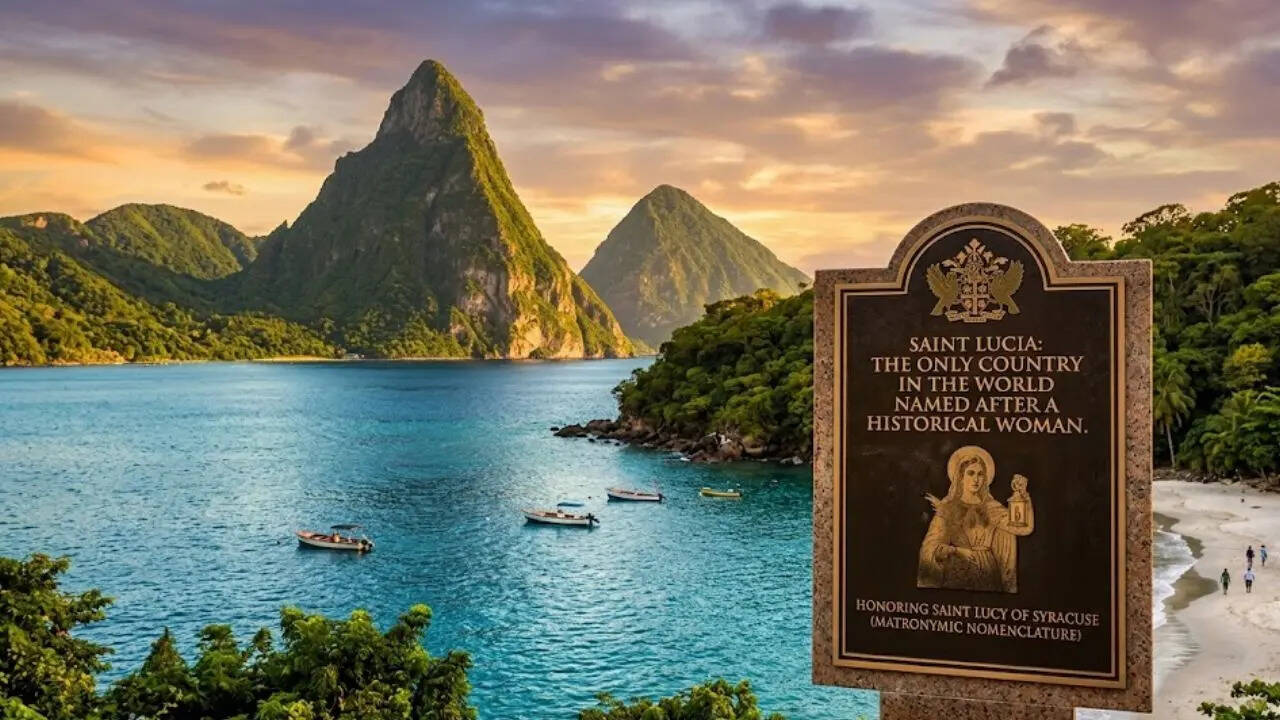
Saint Lucia represents a singular data point in the global distribution of national nomenclature. Of the 195 sovereign states recognized by the United Nations, it is the only nation named after a historical, non-mythological woman: Saint Lucy of Syracuse. This distinction is not merely a trivia point but a case study in the intersection of early modern maritime exploration, religious hegemony, and the erratic nature of European cartography. Understanding the mechanisms that allowed this name to persist requires an analysis of the "Discovery-Rename-Solidify" cycle that governed Caribbean colonization.
The Taxonomy of National Naming Conventions
To isolate the rarity of Saint Lucia, one must categorize the naming origins of current sovereign states. The global set of country names generally falls into four distinct buckets:
- Topographical or Positional: Australia (Southern Land), Ecuador (Equator), or Iceland.
- Ethnic or Tribal: France (Land of the Franks), Thailand (Land of the Thai), or Uzbekistan (Land of the Uzbeks).
- Hagiographic or Mythological (Masculine): San Marino, Saint Kitts and Nevis, or El Salvador (The Savior).
- Mythological (Feminine): Ireland (Eire, a goddess) or the various "Amazon" derivations that never reached sovereign status.
Saint Lucia breaks this pattern. Unlike the Virgin Islands (named after a collective legend of 11,000 virgins) or Ireland (named after a deity), Saint Lucia is tied to a specific historical figure: a 3rd-century Sicilian martyr.
The Mechanics of French and British Cartographic Volatility
The naming of Saint Lucia occurred during the height of the European "saints-calendar" exploration method. Spanish and French explorers frequently named landmasses after the saint whose feast day coincided with the date of landfall. This methodology created a high-stakes lottery for geographic branding.
The historical record suggests the French landed on the island on December 13, 1502, the feast day of Saint Lucy. However, the island's name did not transition from the indigenous "Hewanorra" (Land of the Iguanas) to "Sainte-Lucie" through a linear process. Instead, it survived a "tug-of-war" period where the island changed hands between the British and French 14 times.
The persistence of the name "Saint Lucia" despite British dominance is an anomaly. Usually, the British sought to anglicize or rename territories to honor their own monarchs (e.g., Georgia, Victoria, Queensland). The failure to rename the island "New [English City]" or "Prince [Name] Island" indicates that the French name had achieved a level of administrative inertia that the British found too costly or unnecessary to disrupt.
The Demographic and Cultural Feedback Loop
The name’s survival is linked to the socio-religious structures established during French occupation. Unlike other islands that saw a complete erasure of early colonial identities, Saint Lucia maintained a French patois and a deep Roman Catholic foundation. This created a cultural reinforcement mechanism:
- Linguistic Anchoring: Even when the British held official administrative power, the local population’s primary language and religious practice remained tethered to the French-Catholic tradition.
- Religiosity as Identity: The veneration of Saint Lucy became a central pillar of the island’s unique identity, distinct from the Anglican influences of neighboring islands like Barbados.
This cultural feedback loop meant that by the time of the 1814 Treaty of Paris, which permanently ceded the island to Britain, the name "Saint Lucia" was no longer a colonial label but a localized identity.
Quantifying the "Only Woman" Metric
Critics often point to countries like Ireland (Eire) or the Netherlands (Maria) as potential counter-examples. This is a failure of categorical definition.
- Eire is a goddess of sovereignty, not a person who lived and died.
- The Virgin Islands are a territory, not a sovereign state, and refer to a group, not a specific individual.
- Georgia is often attributed to Saint George, a man.
Saint Lucia stands alone because Saint Lucy of Syracuse was a documented human being. Her life, though shrouded in the hagiography of the Catholic Church, is treated as historical fact within the context of 4th-century Roman records.
Structural Resistance to Renaming
The "Cost of Rebranding" in the 18th and 19th centuries was significant. For the British Empire, maintaining the French name was a tactical concession. By allowing the inhabitants to keep their name, language, and religion, the British reduced the likelihood of local insurrection. This was a governance strategy focused on stability over symbolic totalism.
The name "Saint Lucia" survived because it functioned as a low-friction administrative tool. If the British had attempted to impose a name like "New London," they would have faced friction from a population whose entire geographic and spiritual orientation was built around the existing moniker.
Strategic Position and Maritime Influence
Saint Lucia's geography provided it with the "Gibraltar of the West Indies" status, specifically the deep-water harbor at Castries. This strategic value meant that the focus of occupying powers was almost entirely on fortification and naval dominance, rather than cultural re-engineering.
The focus on the Piton Mountains and the natural defenses of the island meant that cartographic resources were spent mapping inlets and batteries, not debating the merits of a name change. The rugged terrain acted as a physical barrier to the "homogenization" that occurred on flatter, easier-to-control islands like Antigua.
The Modern Implications of Sovereign Uniqueness
Today, Saint Lucia utilizes this unique etymological status as a differentiator in the hyper-competitive Caribbean tourism and investment market. In a region where many islands offer similar physical assets (beaches, climate, tax incentives), "The Only Country Named After a Woman" serves as a powerful narrative hook that signals a distinct cultural history.
This status is not just a marketing gimmick; it is a reflection of the island's historical resilience. The ability to retain a name through 14 changes of colonial hands suggests a deep-seated local identity that resisted the standard "blank slate" approach to colonial cartography.
The move toward total independence in 1979 solidified this. While other nations used independence as an opportunity to shed colonial names (e.g., Rhodesia to Zimbabwe, Dahomey to Benin), Saint Lucia retained its name. This indicates that the name had transitioned from a colonial imposition to a symbol of national sovereignty.
Analyzing the Survival Probability of the Hewanorra Identity
While "Saint Lucia" is the global brand, the indigenous name "Hewanorra" survives in the naming of the international airport. This dual-naming convention serves as a hedging strategy:
- Global Recognition: Saint Lucia remains the primary identifier for international diplomacy, aviation, and finance.
- Indigenous Reclamation: Hewanorra serves as a domestic signal of pre-colonial heritage, satisfying the modern requirement for post-colonial identity without sacrificing the established global brand equity.
The survival of the name Saint Lucia is the result of high administrative inertia, a tactical British decision to prioritize stability over symbolism, and a local population that successfully anchored its identity in a specific historical figure. To understand Saint Lucia is to understand how a Sicilian martyr’s feast day, observed by French sailors in 1502, became the permanent label for a sovereign Caribbean state through 500 years of geopolitical volatility.
Investors and analysts looking at the region must view Saint Lucia through the lens of this historical stubbornness. The island does not follow standard Caribbean trends; it maintains a hybrid French-British-African identity that is mathematically unique in the global system. Any strategy involving Saint Lucia—whether in diplomatic relations or infrastructure development—must account for this ingrained resistance to external homogenization. The name is the first indicator that Saint Lucia operates on its own cultural and historical logic.