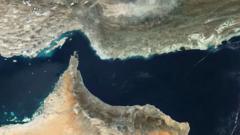
The glass of tea on Ahmed’s desk rattled. It wasn't an earthquake, but the heavy, rhythmic thrum of a diesel generator kicking in across the street in suburban Riyadh. For Ahmed, an energy analyst who spent his days staring at the jagged lines of global Brent crude prices, that rattle was the sound of a system under duress. When the Strait of Hormuz tightens like a constricted throat, the world doesn't just hold its breath. It starts looking for a way out.
We often talk about "energy shocks" as if they are abstract mathematical corrections. We see them in the red flickering numbers on a gas station sign or the sliding scales of a Bloomberg terminal. But for the person trying to keep the lights on in a hospital in Beirut, or the factory manager in Dusseldorf watching his overhead melt his margins, an Iran-led supply shock is a visceral, frightening thing. It is the sudden realization that our entire modern existence—the cold air in our rooms, the charge in our phones, the movement of our food—is tethered to a few specific, volatile miles of seawater.
Geopolitics is a cruel teacher. It reminds us that our dependence on a single, fragile artery of oil is a choice we made decades ago, and one we are now desperately trying to unmake.
The Two Paths in the Dark
When the drums of conflict beat in the Middle East, the global energy market reaches a fork in the road. It is a moment of profound, frantic improvisation. One path leads toward the blindingly fast adoption of renewables—the solar panels and wind turbines that don't care about blockades or sanctions. The other path, darker and more desperate, leads back to the belly of the earth. Back to coal.
Consider a hypothetical nation we will call Republic A. They are a developing economy, hungry for growth, with a middle class that has just discovered the joy of consistent refrigeration. When Middle Eastern oil prices spike because of a regional flare-up, Republic A cannot simply wait for a decade-long transition to green hydrogen. They have a crisis today. They have blackouts in their capital city. In that panic, the easiest, cheapest, and dirtiest solution is often sitting right there in their own backyard or available from a nearby neighbor: coal.
It is a tragic irony. A conflict intended to exert pressure or shift borders can inadvertently choke the lungs of the planet. While the headlines focus on the price per barrel, the real, invisible stake is the atmospheric carbon count that climbs every time a nation is forced to pivot back to the 19th century to survive the 21st.
The Physics of the Pivot
The shift to clean energy isn't just an ideological preference anymore; it has become a survival strategy. It’s about "energy sovereignty," a term that sounds like dry political science until you realize it actually means not having to ask permission from a foreign power to turn on your stove.
The math of a solar farm is fundamentally different from the math of an oil refinery. To understand why, we have to look at the Levelized Cost of Energy (LCOE).
$$LCOE = \frac{\sum_{t=1}^{n} \frac{I_t + M_t + F_t}{(1+r)^t}}{\sum_{t=1}^{n} \frac{E_t}{(1+r)^t}}$$
In this equation, $I_t$ represents the initial investment, while $F_t$ represents fuel costs. For a gas-fired plant, the fuel cost is a volatile ghost. It haunts the balance sheet for thirty years. For a solar array, $F_t$ is zero. The sun doesn't send an invoice. It doesn't care about regional hegemony or maritime law. This zero-marginal-cost reality is the ultimate "get out of jail free" card for nations tired of being held hostage by the geography of fossil fuels.
But here is the friction: you cannot build a gigawatt-scale solar array overnight. You can, however, shove more coal into an existing furnace by Tuesday.
The Human Toll of the "Quick Fix"
Walk through the industrial outskirts of a city that has just "pivoted" back to coal because of a price spike. You can smell it before you see it. It’s a thick, sulfurous weight in the air. This isn't just about global warming in the abstract; it’s about the rise in childhood asthma rates in the neighborhoods surrounding those plants. It’s about the gray film that settles on the laundry hanging from balconies.
We often treat energy policy like a game of Risk, moving little wooden blocks across a map. But every "block" represents millions of people whose health and economic stability are tied to these decisions. When a supply shock from Iran forces a shift to coal, we aren't just changing a fuel source. We are making a trade: we trade long-term respiratory health for short-term grid stability. It is a trade made in the heat of a crisis, and like most desperate trades, it is a bad deal.
Yet, there is a counter-narrative. In places like Northern Europe, these shocks act as an accelerant. They are the "Great Nudge." When the price of fossil-fuel-based heating tripled, families didn't just complain; they ripped out gas boilers and installed heat pumps. They invested in insulation. They bought electric vehicles.
History shows us that humans rarely change when things are comfortable. We change when the discomfort of staying the same becomes greater than the fear of the new. The rattling tea glass on Ahmed’s desk is that discomfort. It is the physical manifestation of an era ending.
The Invisible Infrastructure of Hope
To truly move away from the volatility of the Gulf, we need more than just panels and blades. We need a rethink of the "grid," that massive, aging machine we all rely on but never see.
The old grid was a one-way street: power moved from a big, central plant to your house. The new grid must be a conversation. It’s a complex, multi-directional web where your car battery talks to your neighbor's solar roof, and the regional utility manages the flow with the precision of a symphony conductor.
This is where the real business transformation happens. Companies are no longer just "power providers"; they are data managers. They are balancing the intermittency of wind—which might die down at 3:00 AM—with the surging demand of a heatwave. It is a monumental task of engineering and software. It is also an act of defiance. Every megawatt-hour generated by a local breeze is a megawatt-hour that doesn't have to pass through a vulnerable choke point in the ocean.
The Danger of the Middle Ground
The most dangerous place to be is in the transition. We are currently living in a "halfway house" of energy. We have enough renewables to threaten the old guard, but not enough storage to ignore them. We are caught between two worlds, and that is why the shocks from places like Iran feel so jarring. They expose our vulnerability.
If we move too slowly, we fall back on coal, undoing a decade of climate progress in a single winter of discontent. If we move too fast without building the necessary storage (like massive lithium-ion or flow batteries), we risk the kind of instability that topples governments.
I remember talking to a small business owner in a town that relied heavily on a local coal plant. He was terrified of the transition. To him, "clean energy" sounded like "unemployment." He didn't care about the Strait of Hormuz. He cared about his mortgage. To win the argument for a shift to clean energy, we have to address that man's fear. We have to show that the "shift" isn't just about saving the planet—it’s about building a local economy that isn't at the mercy of a geopolitical chess match five thousand miles away.
The Ghost in the Machine
We often forget that the "market" is just a collection of human expectations and fears. When news breaks of a tanker being seized or a drone strike on a refinery, the market "reacts." But what does that actually mean? It means thousands of traders, analysts, and CEOs are making a split-second calculation about risk.
They are asking: "Can I trust the old world to keep me safe?"
Increasingly, the answer is no. This realization is the most powerful engine for change we have ever seen. It’s more powerful than any treaty or protest. It is the cold, hard logic of the bottom line. The instability of the Middle East is the best salesperson the renewable energy industry ever had.
But the path is not a straight line. It is a jagged, painful journey. There will be seasons where we fail, where we see the smoke stacks of coal plants billowing once again because we didn't build the wind farms fast enough. There will be moments where the light flickers, and we wonder if we can truly make the leap.
The Final Chord
Ahmed eventually stopped noticing the rattle of the generator. He got used to it. That is perhaps the greatest danger of all—normalization. We get used to the instability. We get used to the high prices. We get used to the smog.
But then, one day, the rattle stops. Not because the crisis is over, but because the building finally installed a battery system tied to a series of solar canopies in the parking lot. The silence is profound. It is a different kind of power. It is the sound of a cord being cut.
The choice between a clean future and a coal-stained past isn't being made in high-level summits. It is being made in the quiet moments after a shock, when we decide whether to rebuild the old world or finally, stubbornly, invent a new one. The light is flickering. It’s up to us to decide what will keep it burning.
Would you like me to analyze the specific economic indicators that typically precede these energy pivots in developing nations?