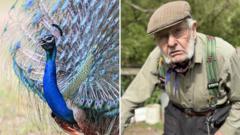
A 92-year-old farmer in the English countryside has spent seven decades mastering the rhythms of the land, yet his greatest threat is not the fluctuating market or the encroachment of modern developers. It is a single, feral peacock. This blue-necked interloper has turned a peaceful chicken run into a high-stakes conflict zone, exposing the growing tension between human agricultural heritage and the displacement of ornamental wildlife. The situation has shifted from a quirky local anecdote into a grim study of how a non-native species can dismantle the stability of a small-scale farm.
While the general public views the Pavo cristatus as a symbol of nobility and aesthetic grace, the reality on the ground is far more visceral. These birds are large, aggressive, and incredibly loud. For an elderly farmer maintaining a fragile ecosystem of laying hens, the peacock is not a decoration; it is a tactical nightmare. It consumes specialized feed meant for the livestock, physically intimidates the smaller birds, and creates a persistent state of stress that halts egg production.
The Biology of Dominance
Peacocks are not passive observers of their environment. They are territorial galliforms with a biological imperative to claim space. When a peacock "terrorizes" a coop, it is not acting out of malice, but out of a hardwired drive to establish a hierarchy. Because they are significantly larger and heavier than standard poultry, they command the physical environment with ease.
In this specific case, the farmer reported that the peacock had effectively sequestered the chickens inside their housing. This is a common behavioral outcome when a dominant bird stakes out the entrance to a coop. The chickens, sensing a predator-sized threat that shares their own ground-dwelling habits, refuse to forage. The result is a total collapse of the farm’s micro-economy. If the hens do not eat and move freely, the physiological stress triggers a drop in calcium levels and a cessation of the laying cycle.
The Regulatory Void of Ornamental Escapes
One of the most frustrating aspects of this conflict is the lack of legal recourse for smallholders. In many jurisdictions, peacocks occupy a strange gray area in animal management law. They are often classified as "feral" if they escape from a private estate, meaning no single neighbor is legally responsible for their damage. Unlike a dog that worries sheep, or a fox that can be legally culled as a pest, the peacock often enjoys a protected status in the minds of the public, if not strictly in the letter of the law.
Local councils are frequently ill-equipped to handle large-scale avian removals. This leaves a 92-year-old man, whose physical mobility is naturally limited, to defend his livelihood against a bird that can fly onto roofs and strike with powerful leg spurs. The power imbalance is stark. It highlights a systemic failure to protect traditional agriculture from the fallout of "hobby" exotic pet ownership that inevitably goes wrong when birds wander off-property.
Psychological Warfare on the Farm
The noise is the hidden weapon. A peacock’s call is a piercing, high-decibel shriek that can travel for over a mile. For a farmer living on-site, this is a form of acoustic bombardment that occurs at all hours, particularly during the breeding season. The psychological toll on an elderly individual trying to maintain a peaceful retirement through labor cannot be overstated.
Sleep deprivation and the constant anxiety of hearing his hens in distress create a volatile situation. This isn't just about a bird; it’s about the loss of agency over one's own land. When a farmer can no longer walk to his coop without being hissed at or charged by a five-foot-long avian, the nature of his home changes from a sanctuary to a cage.
The Limits of Non-Lethal Deterrence
Moving a resident peacock is notoriously difficult. They are highly intelligent and possess keen eyesight, making traditional trapping methods hit-or-miss. Most experts suggest a variety of deterrents, but these rarely work on a bird that has already found a reliable food source in a chicken run.
- Motion-Activated Sprinklers: These can work temporarily but often fail when the bird realizes the water is a nuisance rather than a threat.
- Physical Barriers: Netting a large chicken run is expensive and physically demanding to install, especially for a nonagenarian.
- Relocation: This requires a professional handler and a willing recipient, usually another large estate or a sanctuary that is likely already over-capacity with "nuisance" peacocks.
The farmer attempted basic shooing and noise-making, but the peacock simply waited for him to go back inside. The bird has learned the farmer’s routine. It knows exactly when the hens are fed and when the humans are most likely to be absent. This level of adaptation makes the animal a formidable opponent for someone who just wants to provide for himself and his community.
Wildlife Mismanagement and the Rural Divide
This incident is a microcosm of a larger issue within rural management. There is a widening gap between the romanticized view of "nature" held by urbanites and the gritty, often brutal reality of those who live and work in it. To a tourist, a peacock in a field is a photo opportunity. To a farmer, it is an invasive competitor that threatens the health of his flock and the safety of his daily movements.
The refusal of local authorities to intervene often stems from a fear of public backlash. No one wants to be the official who authorized the removal of a "beautiful" bird, even if that bird is causing genuine suffering to a vulnerable human and his livestock. This prioritization of aesthetics over agricultural utility is a recurring theme in modern land-use disputes.
Hard Lessons in Avian Territoriality
Biologists who study feral populations note that once a peacock identifies a "harem" of chickens, it may attempt to guard them as its own. This inter-species territoriality leads to the aggressive displays often reported by the farmer. The peacock isn't just looking for food; it is looking for a social structure to dominate.
The farmer’s hens, meanwhile, are caught in a crossfire of evolutionary biology. They do not have the defense mechanisms to deal with a bird of this size. Their only instinct is to hide, which leads to muscle atrophy and poor health outcomes over time. The situation requires more than a simple "shooing away"—it requires a total extraction of the invasive element to restore the ecological balance of the farm.
The Cost of Inaction
Every day the peacock remains on the property, the farmer loses money and health. The cost of chicken feed is not insignificant, and seeing it consumed by a thief while his own birds go hungry is a bitter pill. Furthermore, the risk of injury to a 92-year-old man from a sudden trip or a direct strike from the bird’s spurs is a serious medical concern.
Professional pest control services for large birds are costly, often ranging into hundreds of pounds for multiple visits. For a small-scale operation, these costs can wipe out months of profit. It is a reminder that the "quaint" rural life is often one unexpected event away from total disruption. The persistence of this specific peacock serves as a testament to the resilience of the species and the vulnerability of the traditional farmer.
The path forward is rarely simple. It involves navigating the messy intersection of animal welfare, property rights, and local government bureaucracy. Until the peacock is physically removed and relocated to a controlled environment, the farmer remains a prisoner of his own success in creating a habitable space for birds. The birds he wants are suffering because of the bird he didn't ask for.
Take the necessary steps to secure professional avian removal before the seasonal breeding aggression peaks. Waiting for the bird to leave on its own is a strategy that almost never pays off in the world of territorial wildlife management. Secure the perimeter, document the damage for local authorities, and reclaim the coop before the damage to the flock becomes irreversible.