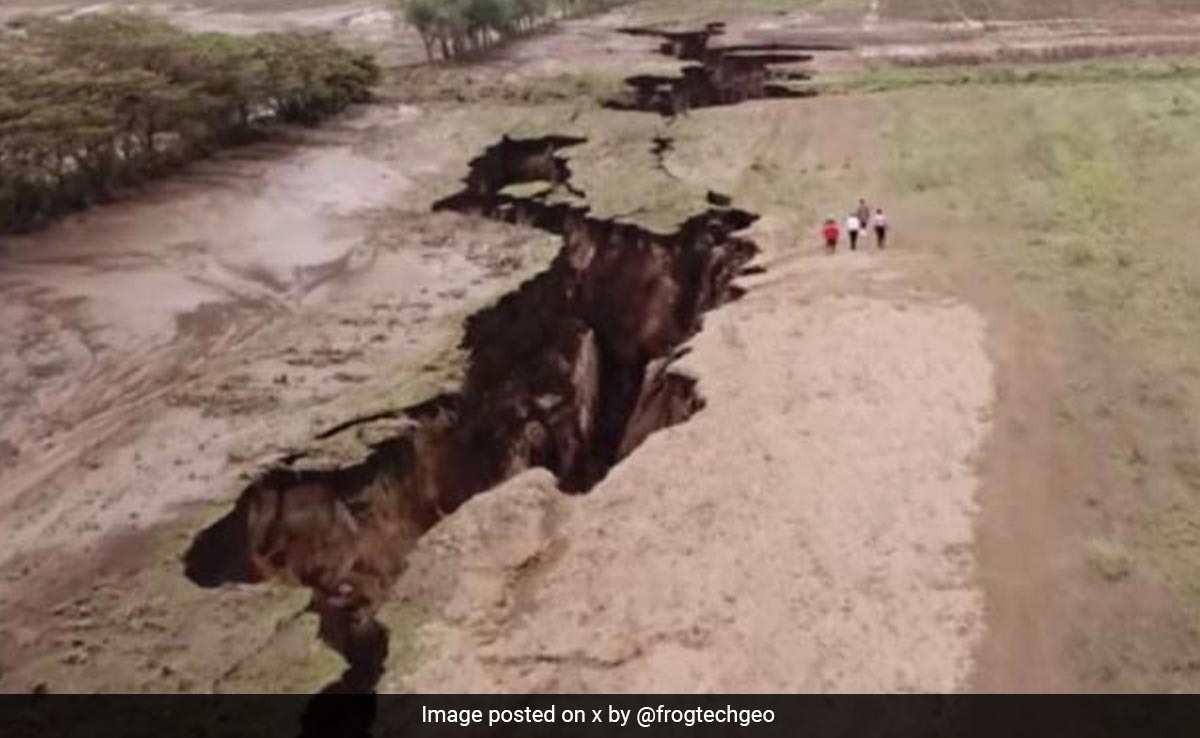
The asphalt didn't just crack; it vanished.
In the Suswa region of Kenya, a local farmer named Eliud Njoroge once stood over a fissure that had swallowed a portion of the Mai Mahiu-Narok highway. It wasn't the result of a sudden explosion or a localized landslide. It was a silent, jagged yawn from the earth itself. One day, the road was a solid ribbon of transit; the next, it was a severed artery, exposing a deep, dark throat of soil and rock that plummeted dozens of feet into the darkness.
This is the East African Rift. We often think of the planet as a finished product, a static stage upon which our fleeting lives play out. We are wrong. The ground is a living, moving, and occasionally violent thing. Beneath the acacia trees and the bustling markets of Nairobi, the African continent is literally tearing itself apart.
The Slowest Breakup in History
Geology usually operates on a clock so slow it feels irrelevant to the human experience. We measure our lives in decades; the Earth measures its shifts in eons. However, the rift in East Africa is different because it is visible. It is tangible. It is happening at a pace that, while still glacial by our standards, is sententious enough to redefine the maps our grandchildren will use.
The African plate is not one solid piece of rock. It is composed of two main pieces: the smaller Somali plate to the east and the larger Nubian plate to the west. They are moving away from each other at a rate of about 6 to 7 millimeters per year. That sounds like nothing. It is roughly the speed at which your fingernails grow. But when you apply that pressure to a landmass of millions of square miles, the math becomes catastrophic.
Consider the mechanics. Deep beneath the crust, a massive plume of superheated rock—a mantle plume—is rising. It acts like a blowtorch against a sheet of wax. As the heat weakens the lithosphere, the crust stretches and thins. Eventually, it snaps. When it snaps, the ground drops, creating the "valley" we see today.
The Human Toll of a Tectonic Shift
For the people living along the Suswa fault line, the science is secondary to the survival. Imagine waking up to find a hairline fracture running through your bedroom floor. You patch it with cement. A week later, the crack has widened. You can see the dirt beneath your home. By the end of the month, your house is no longer a shelter; it is a liability, leaning precariously into a growing void.
This isn't a hypothetical fear. Families in the Rift Valley have had to abandon ancestral lands because the earth simply decided it no longer wanted to hold them. When the heavy rains come, they wash into these fissures, eroding the soft volcanic ash from the inside out and widening the gaps overnight.
We often talk about "natural disasters" as singular events—a hurricane, an earthquake, a flood. But what do we call a disaster that lasts ten million years? The splitting of Africa is a permanent, unfolding crisis. It challenges our very notion of "land." We treat land as the ultimate asset, the one thing they aren't making any more of. In East Africa, the land is quite literally jumping ship.
A New Ocean in the Making
If we could fast-forward the clock by a few million years, the geography of our planet would be unrecognizable. The rift will eventually deepen enough that the Indian Ocean will come rushing in.
The Horn of Africa—including Ethiopia, Somalia, and parts of Kenya—will become a massive island, drifting away into the sea. The remaining bulk of the continent will have a brand-new coastline.
This process is most evident in the Afar region of Ethiopia. There, the landscape is a hellish, beautiful mosaic of salt flats, active volcanoes, and boiling geysers. In 2005, a 35-mile-long crack opened up in the desert in just a few days. It was a violent birth. Scientists rushed to the scene, realizing they were witnessing the embryonic stages of a new ocean basin.
The heat in the Afar Depression is so intense that the molten rock—the magma—is incredibly close to the surface. As the plates pull apart, this magma rises to fill the gap. When it cools, it creates a brand-new seafloor. This is the exact same process that created the Atlantic Ocean when the Americas broke away from Africa and Europe hundreds of millions of years ago. We aren't just reading about history; we are standing on the edge of its repetition.
The Invisible Stakes
Why should a businessman in London or a programmer in San Francisco care about a crack in the Kenyan dirt?
Because the Rift Valley is a laboratory for the future. The geological instability creates unique opportunities and terrifying risks. For instance, Kenya is currently a global leader in geothermal energy. By tapping into the intense heat just beneath the rift, they are powering millions of homes with clean, renewable steam. The very thing that threatens to swallow their roads is also providing the energy to build their future.
But the infrastructure risks are staggering. As we build massive trans-continental railways, fiber-optic networks, and pipelines, we are laying them across a surface that is fundamentally unstable. You cannot build "robust" structures on a foundation that is moving in two different directions.
Engineers are now forced to design bridges that can slide and roads that can flex. We are learning to build for a world that refuses to stay still. It is a humbling realization. Our greatest architectural achievements are mere playthings compared to the convective forces of the mantle.
The Ghost of Our Origins
There is a poetic irony to this fracture. The East African Rift is often cited as the "Cradle of Mankind." It is where our earliest ancestors evolved, shielded and shaped by the unique topography of the valley. The shifting landscape created a variety of ecosystems—forests, grasslands, and lakes—that forced early hominids to adapt, to walk upright, and to develop the intelligence that eventually led us to where we are today.
The earth broke, and in that break, humanity found its footing.
Now, we watch as that same cradle continues to move. It is a reminder that we are guests on a planet that is still under construction. We like to think we have "conquered" nature, but we have really only found a comfortable rhythm in a brief pause between geological beats.
The Fissure in the Mind
The most difficult part of understanding the African split is internalizing the scale. We see a crack in the road and think it's a repair job. We don't see it as the first breath of a new sea.
Science tells us that the "faster than expected" research indicates the lithosphere is thinner and more brittle than previous models suggested. The mantle plume is more aggressive. The separation is accelerating in specific "hot spots."
But the data doesn't capture the sound of the earth groaning. It doesn't capture the look on a farmer’s face when he realizes his field is now two fields, separated by a drop he cannot see the bottom of.
We are living through a continental divorce. It is messy, it is slow, and it is entirely indifferent to our presence. We can map the fault lines with satellites. We can measure the millimetric shifts with GPS. We can even predict where the new beaches will be in ten million years.
None of that changes the reality for the people currently standing on the edge. They are the first witnesses to the world's next great transformation. They are the ones who have to figure out how to live on a tectonic seam.
The road in Suswa has been repaired many times since that first great crack appeared. Each time, the workers pour more gravel, lay more tarmac, and paint fresh white lines. They do it with the grim determination of people who know they are fighting a losing battle. They know that the earth beneath the road isn't just settling. It’s leaving.
Every morning, the sun rises over the Rift, illuminating a valley that is slightly wider than it was the night before.
One day, the water will follow the sun.
The desert will become a seabed. The mountains will become islands. The maps will be burnt and redrawn. And we, if we are still here, will have to learn how to sail where we once used to walk.
The earth doesn't break all at once; it breaks one inch, one crack, and one morning at a time.


