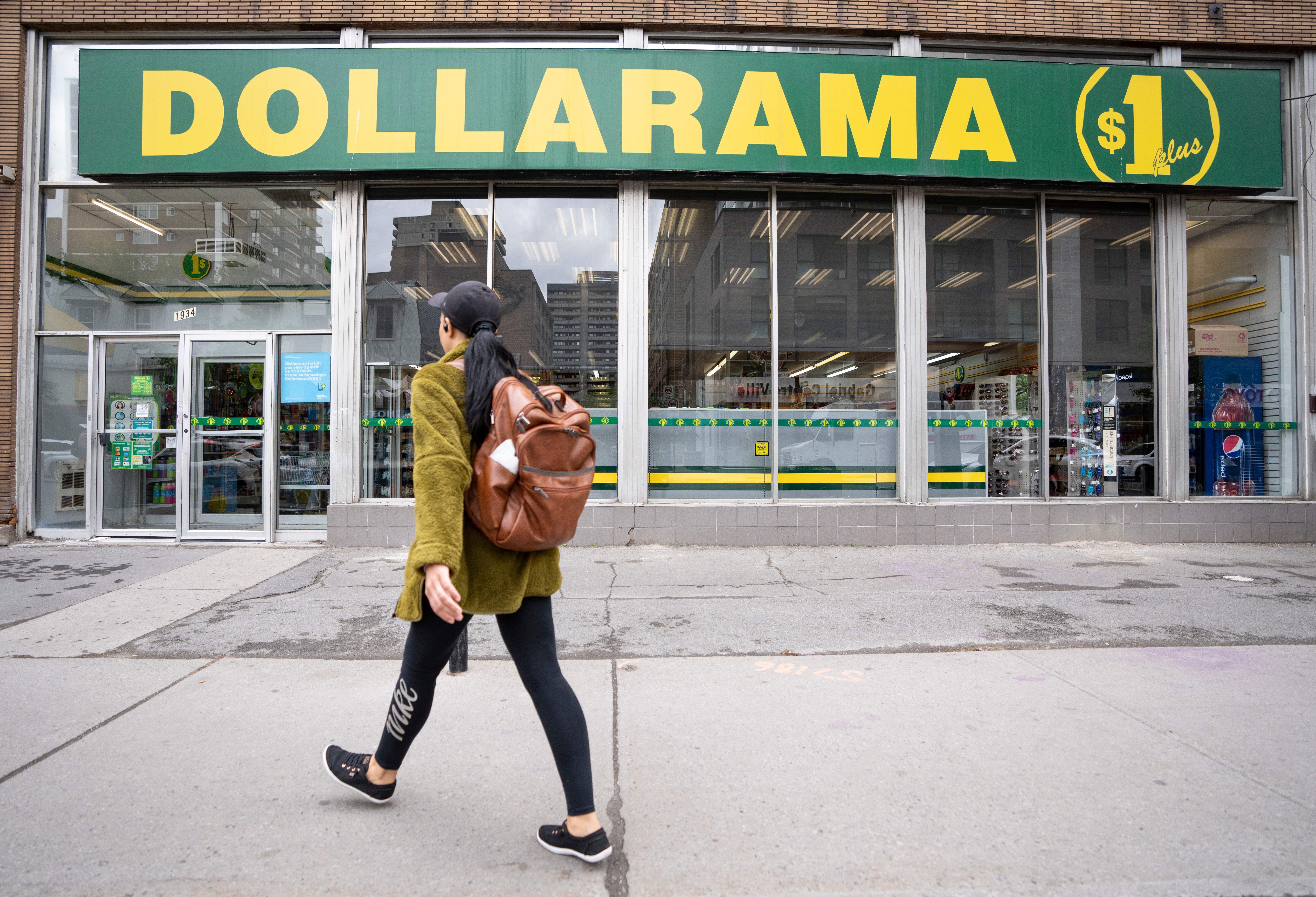
The Convergence of Saturation and Spend Compression
The prevailing narrative surrounding Dollarama’s shift toward a "cautious" outlook suggests a simple atmospheric cooling of the economy. This is an oversimplification. The real mechanism at play is the Value Extraction Ceiling, a point where a dominant discount retailer has fully harvested the "trade-down" traffic from higher-tier grocers and must now face the reality of diminishing marginal returns on basket size. As inflationary pressures transition from a driver of new customer acquisition to a destroyer of discretionary per-capita spending, Dollarama’s growth trajectory is moving from an expansionary phase into a defensive, optimization-focused phase.
The deceleration in sales growth is not merely a reflection of a "cautious" consumer; it is the result of three specific structural headwinds: the exhaustion of the price-gap advantage, the inventory-to-affordability mismatch, and the logistical floor of the $5 price point.
The Three Pillars of the Dollarama Growth Model
To understand why growth is slowing, one must first quantify the engines that drove its recent outperformance. Dollarama’s dominance relied on a specific trifecta of market conditions that are now reverting to the mean.
1. The Arbitrage of Absolute Price Points
Dollarama does not compete on unit price; it competes on absolute outlay. In a high-inflation environment, a consumer may pay more per gram for a product at Dollarama than at a warehouse club, but they choose the dollar store because the total cash required to exit the store is lower. This is "liquidity-constrained shopping." As wage growth continues to lag behind the cumulative 20% to 30% increase in the cost of living since 2021, the consumer's ability to even manage the absolute outlay is hitting a functional limit.
2. The Multi-Tier Trade-Down Effect
During 2023, Dollarama benefited from a tiered migration. Premium shoppers moved to mid-tier grocers, and mid-tier grocers' loyalists moved to Dollarama. This provided a constant influx of new, higher-income "treasure hunters." Data suggests this migration has plateaued. The "new" customers are now integrated into the base, meaning year-over-year comparisons (same-store sales) no longer benefit from the initial shock of the trade-down.
3. Yield Optimization through Private Label
Dollarama’s margin resilience has historically been protected by its high mix of private-label goods. By controlling the supply chain from sourcing to shelf, they bypassed the brand-tax associated with multinational CPGs (Consumer Packaged Goods). However, global shipping volatility and labor costs in manufacturing hubs have begun to compress the "spread" between private label and brand-name discount items.
The Cost Function of the $5 Threshold
Dollarama’s pivot to higher price points (up to $5) was a primary driver of revenue growth over the last 24 months. While this successfully moved the average unit retail (AUR) higher, it introduced a new psychological and competitive barrier.
When an item hits the $5 pivot point, it enters a different cognitive category for the consumer. At $1 or $2, the purchase is an impulse. At $5, the consumer performs a mental comparison with mass merchants like Walmart or Amazon. This creates a Competitive Overlap Zone where Dollarama’s convenience advantage is weighed against the bulk-buy efficiency of larger competitors.
The "cautious" forecast issued by management is a direct acknowledgment that the room for further price-point expansion is narrow. If they push to $6 or $7, they risk losing the "Dollar" identity that drives their high-frequency foot traffic. The business is currently trapped in a narrow corridor between rising COGS (Cost of Goods Sold) and a rigid price ceiling defined by brand perception.
Quantifying Global Economic Friction
The "global outlook" cited by leadership refers to specific, measurable frictions in the macro-environment that directly impact a fixed-price-point retailer.
- Currency Asymmetry: As a major importer of goods (primarily from East Asia), Dollarama is hyper-sensitive to the CAD/USD exchange rate. Since global commodities and shipping are priced in USD, any weakness in the Canadian dollar acts as an immediate, invisible tax on their margins that cannot always be passed to a consumer who is already "maxed out."
- The Red Sea and Freight Volatility: While spot rates for shipping containers fluctuate, the structural increase in transit times around the Cape of Good Hope adds "dead time" to inventory. For a retailer built on high inventory turnover, these delays increase the cost of working capital.
- Domestic Labor Compression: In Canada, provincial minimum wage increases create a rising floor for SG&A (Selling, General, and Administrative) expenses. Unlike a luxury retailer, a discount retailer cannot easily offset 5% labor inflation with a 5% price hike without seeing an immediate drop in units per transaction (UPT).
The Structural Shift in Consumer Discretionary Behavior
We are seeing a transition from "Inflationary Stockpiling" to "Defensive Austerity." In the early stages of the current cycle, consumers bought consumables at Dollarama to save money. Now, they are beginning to cut back on the consumables themselves.
The "cautious" outlook is a signal that the Basket Composition is shifting. High-margin seasonal items (party supplies, holiday decor, toys) are being deprioritized by shoppers in favor of low-margin essentials (bread, canned goods, cleaning supplies). This "Negative Mix Shift" means that even if foot traffic remains steady, the profitability of each visit declines.
Logical Framework: The Spend Elasticity Matrix
- Essentials (Low Elasticity): Bread, milk, hygiene. Demand remains high, but margins are razor-thin.
- Semi-Essentials (Moderate Elasticity): Stationary, basic kitchenware. Demand is slowing as consumers extend the lifecycle of what they already own.
- Discretionary (High Elasticity): Seasonal decor, impulse electronics. This is the "Margin Engine" of Dollarama, and it is the segment currently under the most significant pressure.
The Logistical Bottleneck of Same-Store Expansion
A critical limitation that the competitor's analysis failed to address is the Physical Square Footage Constraint. Dollarama’s urban footprint consists of smaller, high-density locations. Unlike big-box retailers, they cannot simply add more SKUs (Stock Keeping Units) to drive growth. Growth must come from either:
- Increasing the price of existing SKUs (The $5 Ceiling problem).
- Increasing the speed of the shelf-to-register cycle (Velocity).
The "slower growth" forecast indicates that velocity has hit a terminal rate. There is a physical limit to how many people can move through a 5,000-square-foot store with one or two active registers during peak hours. Without significant capital expenditure in self-checkout technology or store expansions—both of which depress short-term earnings—the organic growth of existing stores is capped.
Distinguishing Fact from Hypothesis in the Forecast
It is a fact that Dollarama’s same-store sales growth has decelerated from the double-digit highs of the post-pandemic rebound. It is also a fact that their inventory levels have been managed aggressively to avoid the "bullwhip effect" that crippled other retailers.
The hypothesis is that the Canadian consumer has reached a "breaking point." Management’s caution suggests they believe the surplus savings from the pandemic era have been fully exhausted, and the impact of mortgage renewals at higher rates is finally filtering down to the discount retail level. If 2024–2025 sees a wave of household deleveraging, even the most resilient value retailers will see a contraction in the "treasure hunt" portion of their revenue.
Strategic Play: The Shift to Operational Lean
The move for Dollarama is no longer about aggressive footprint expansion or price-climbing. The strategic imperative is now Internal Yield Management.
Expect a pivot toward:
- SKU Rationalization: Removing low-velocity items to maximize the "profit per square inch" of the shelf.
- Labor Automation: Accelerating the rollout of self-service kiosks to lower the SG&A floor.
- Supply Chain Localization: Attempting to source more "heavy" or "bulky" goods domestically to insulate the bottom line from ocean freight volatility.
The "cautious" forecast is not an admission of weakness; it is a clinical assessment of a market that has reached peak saturation. The next 12 to 18 months will be a test of whether Dollarama can maintain its industry-leading margins through operational efficiency rather than the raw tailwinds of a distressed economy. The era of easy growth via "price-tag inflation" is over; the era of "efficiency-driven survival" has begun.