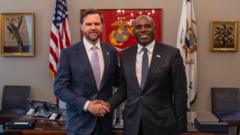
Foreign policy often moves with the stiff formality of a Victorian wedding, yet the most critical gears are frequently turned by the messiest human connections. Right now, the United Kingdom’s diplomatic strategy hinges on an alliance that looks, on paper, like a clerical error. David Lammy, a Labour stalwart from the progressive left, and JD Vance, the MAGA-intellectual heartbeat of the American Right, have spent months building a bridge across an ideological canyon. This is not just a story of two men finding common ground over shared working-class roots. It is a calculated, high-stakes insurance policy designed to protect British interests if the political winds in Washington shift toward a second Trump term.
The British government is betting that personal rapport can bypass institutional gridlock. While the media fixates on Lammy’s past criticisms of Donald Trump, the Foreign Secretary has quietly spent the last year courting the Republican vanguard. He isn't doing this out of a sudden conversion to populist conservatism. He is doing it because, in a world where the United States is increasingly skeptical of traditional alliances, a direct line to the Vice Presidential nominee is more valuable than a dozen formal summits in Brussels.
The Strategy of the Unlikely Messenger
Diplomacy is rarely about agreeing on everything. It is about knowing who to call when everything goes wrong. Lammy’s outreach to Vance represents a shift in how the UK treats the "Special Relationship." For decades, Downing Street relied on the State Department and established think tanks to handle Washington. That old map is useless now. The new map is drawn by individuals who can speak the language of "America First" without sounding like they are lecturing.
Vance and Lammy share a specific biographical resonance. Both rose from backgrounds defined by economic hardship and family struggle. This "Hillbilly Elegy" meets Tottenham narrative provides a social lubricant that softens the friction of their policy differences. When they sit down, they aren't just discussing NATO spending or trade tariffs; they are validating each other’s political journeys. For Lammy, this is a pragmatic necessity. If the Republicans win, the UK cannot afford to be an outsider looking in. By befriending Vance, Lammy secures a seat at the table before the dinner even begins.
Security Guarantees in an Uncertain Era
The biggest sticking point between these two camps is Ukraine. Vance has been one of the most vocal critics of continued, open-ended American funding for the war in Kyiv. The UK, conversely, remains one of Ukraine’s most aggressive backers. On the surface, this should be a deal-breaker. However, the depth of the Lammy-Vance connection allows for a more nuanced conversation behind closed doors.
British officials are attempting to frame European security in terms that resonate with the Vance wing of the GOP. They are moving away from the language of "moral obligations" and toward the language of "burden sharing." By showing that the UK is willing to lead on defense spending and regional stability, they hope to convince a potential Trump-Vance administration that Britain is an asset, not a dependent.
The Mechanics of the Outreach
The groundwork for this relationship wasn't laid in televised debates. It happened in quiet meetings, small dinners, and private exchanges. Lammy has made multiple trips to the U.S., specifically targeting the "New Right" intellectuals who provide the policy framework for the MAGA movement.
- Shared Economic Anxiety: Both men focus on the "left behind" communities in their respective countries.
- Skepticism of Globalism: While Lammy is a remainer, he understands the political force of national identity, a concept Vance lives and breathes.
- Direct Communication: They have established a rapport that bypasses the usual diplomatic filters, allowing for "plain speaking" that the Trump camp values.
The Risk of Proximity
This strategy carries significant domestic risks for Lammy. The Labour base is instinctively hostile to the brand of politics Vance represents. Every photo op and every friendly quote is a potential weapon for Lammy’s critics on the left. They see this not as diplomacy, but as a betrayal of progressive values.
Yet, the Foreign Office views this as sentimental nonsense. The primary duty of the Foreign Secretary is the security and prosperity of the United Kingdom, not the ideological purity of the Labour party. If the choice is between being ideologically consistent or having influence in a Republican White House, the pragmatists will choose influence every time.
Realigning the Special Relationship
The United States is currently undergoing a fundamental reassessment of its role in the world. The era of the "global policeman" is fading, replaced by a more transactional, inward-looking posture. In this environment, the "Special Relationship" cannot survive on nostalgia alone. It needs a new foundation.
Vance represents the future of the Republican party—a future that is younger, more populist, and less committed to the post-WWII international order. Lammy’s gamble is that by engaging with this future now, the UK can help shape it. He isn't trying to change Vance’s mind on isolationism; he is trying to ensure that when Vance looks at a map of the world, Britain is seen as a partner worth keeping.
The Trump Factor
We cannot ignore the shadow of Donald Trump in this equation. Vance is the bridge, but Trump is the destination. The British government remembers the volatility of the first Trump term. They remember the tweets, the sudden policy shifts, and the disregard for traditional diplomatic channels.
The Lammy-Vance friendship is an attempt to build a "shock absorber" into the relationship. If Trump returns to the Oval Office, the UK will have a senior figure in the administration who understands their perspective and has a personal relationship with the Foreign Secretary. It is a hedge against chaos.
Historical Precedents for Odd Couples
History is full of leaders who loathed each other's politics but worked together out of necessity.
- Thatcher and Gorbachev: The Iron Lady famously said of the communist leader, "I like Mr. Gorbachev. We can do business together."
- Nixon and Mao: A staunch anti-communist opening the door to China changed the Cold War.
- Reagan and O’Neill: Despite fierce political battles, they found a way to govern through personal respect.
Lammy and Vance are operating in this tradition. They are the latest iteration of the "Odd Couple" school of geopolitics.
Economic Realities and Trade Hopes
Beyond security, there is the matter of the economy. Britain is still desperate for a comprehensive trade deal with the U.S., a goal that has remained elusive since Brexit. A Trump-Vance administration would likely be more protectionist, not less.
Lammy is using his connection with Vance to argue that a strong UK economy is in America’s interest. He is trying to position Britain as the preferred partner for "friend-shoring"—the practice of moving supply chains to allied nations. If the U.S. is going to decouple from China, the UK wants to be the first place those manufacturing and technology contracts land.
The Institutional Skepticism
While Lammy and Vance talk, the institutions behind them remain wary. The British civil service is naturally cautious about the "New Right," and the MAGA movement remains deeply suspicious of "globalist" London. This personal bond is a thin thread holding together two very different worldviews.
If this thread snaps, the fallout will be public and messy. If it holds, it could be the most significant diplomatic achievement of the decade. The stakes aren't just about a few trade tariffs or a single war; they are about whether the UK can remain relevant in an era of American retrenchment.
The Intellectual Architecture of the New Right
To understand why Vance is the target, one must understand what he represents. He is not a traditional country-club Republican. He is part of a movement that views the last thirty years of American foreign and economic policy as a disaster for the working class.
Lammy has spent time reading the same books and talking to the same theorists that Vance admires. He is doing his homework. He knows that to influence Vance, you have to engage with the intellectual core of his movement. This isn't about being "nice"; it's about being informed.
The Shadow of the Next Election
Everything in this relationship is framed by the upcoming U.S. election. If the Democrats retain the White House, the Lammy-Vance connection becomes a curious footnote—a "what if" of diplomatic history. But if the GOP wins, this relationship becomes the most important axis in British foreign policy.
The British government is effectively running a dual-track foreign policy. They are working closely with the current Biden administration on immediate concerns while simultaneously building a "government in waiting" relationship with the Trump-Vance camp. It is a exhausting, high-wire act of political balancing.
The Language of Power
In the end, power recognizes power. Vance is a rising star in a movement that may soon control the world’s only superpower. Lammy is the diplomatic voice of a nation trying to find its feet in a post-EU world. Both men are ambitious, and both are survivors.
They are using each other to bolster their own positions. Vance gets a "statesman" gloss by engaging with a senior foreign official, and Lammy gets the "inside track" on the most important political movement in America. It is a partnership built on mutual utility.
Diplomatic success is often measured by what doesn't happen—the wars that are avoided, the trade disputes that are settled quietly, and the alliances that don't crumble under pressure. By the time the world realizes how important the Lammy-Vance connection is, the work will already have been done. The British government has realized that in the modern world, the most effective way to handle a superpower is to stop treating it like a country and start treating it like a person. Stop looking at the flags and start looking at the men holding them.