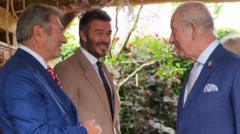
King Charles III and David Beckham sharing a laugh over a jar of homemade honey isn't just standard tabloid fodder. It's a calculated masterclass in modern royal PR.
When the duo met at the RHS Chelsea Flower Show, the media naturally went into a frenzy over the smiles and the firm handshakes. But if you look past the flashing cameras, you see a deliberate alignment of two major British brands. They are pooling their cultural capital to push a very specific, very green agenda.
The public wants authenticity from the royal family. They don't want stuffy, distant figures anymore. By bringing the world's most famous footballer into the royal orbit over a shared passion for beekeeping, the King managed to make environmentalism look genuinely cool.
The Royal Beekeeper Meets the Inter Miami Boss
The Chelsea Flower Show has always been a cornerstone of the royal calendar. Queen Elizabeth II famously attended almost every year during her reign. King Charles is carrying that torch, but he's changing the flavor of these appearances. He isn't just nodding politely at prized orchids. He is using the platform to highlight his lifetime commitment to sustainability.
Enter David Beckham.
Beckham isn't just a retired athlete. He's a global icon who recently turned his hand to amateur beekeeping at his Cotswolds estate. His Netflix documentary showed him proudly harvesting honey, a hobby that perfectly mirrors the King’s long-standing passion for organic farming at Highgrove House.
When they met at the show's handwashing exhibit, the connection was instant. Beckham reportedly offered the King a jar of his own homemade honey. Charles, ever the enthusiast, joked about exchanging tips.
It was a brilliant moment. It humanized a monarch undergoing cancer treatment. It also elevated a hobby that is vital to British biodiversity.
Why the Chelsea Flower Show Matters for Royal Survival
The Royal Horticultural Society (RHS) Chelsea Flower Show isn't just about wealthy people looking at pretty gardens. It's an economic powerhouse and a massive cultural touchpoint in the UK. For the King, it serves a much deeper institutional purpose.
- Bridging the generational divide: Charles knows the monarchy faces skepticism from younger demographics. Aligning with Beckham, who bridges the gap between old-school sports stardom and modern social media influence, is a smart way to stay relevant.
- Amplifying the climate message: The King has championed environmental causes for five decades, often being ridiculed for it in the past. Today, those views are mainstream. The Chelsea Flower Show allows him to showcase practical, beautiful solutions to climate issues without giving a dry, political speech.
- The power of soft diplomacy: A casual chat about bees does more to project a warm, stable image of the British crown than a dozen formal state banquets ever could.
The interaction also highlights a quiet shift in how the royal family operates. They are leaning heavily into figures who command massive, independent global audiences. Beckham has over 80 million followers on Instagram alone. When he posts about meeting the King to talk about nature, that message reaches corners of the internet that royal press releases never touch.
The Real Story Behind the Honey Exchange
Let’s talk about the bees. It sounds like a quirky detail, but it’s actually the core of the whole interaction.
The UK has lost roughly 97% of its wildflower meadows since the 1930s. This loss has devastated native pollinator populations. Both Charles and Beckham are using their properties to reverse this trend. Highgrove has become a sanctuary for rare breeds and wild bees. Beckham's Cotswolds garden is managed with similar biodiversity goals in mind.
This shared interest isn't just a coincidence. It represents a broader trend among influential figures who are moving away from loud, performative environmentalism. Instead, they are embracing hands-on, local conservation. When a monarch and a global sports star normalize these practices, it influences landowners and amateur gardeners across the country to change how they manage their own green spaces.
How to Apply Royal Sustainability Tactics to Your Own Backyard
You don't need a sprawling estate in Gloucestershire or a mansion in the Cotswolds to make a difference in local ecology. The principles highlighted by the King and Beckham at Chelsea are completely scalable.
First, stop obsessing over a perfectly manicured, chemical-heavy lawn. Leave a section of your garden wild to allow native weeds like dandelions and clover to grow. These are crucial early-season food sources for bees.
Second, plant for continuous color. Choose a mix of flowers that bloom at different times of the year, from early spring bulbs to late autumn asters. This ensures pollinators have a reliable food supply for as long as they are active.
Finally, ditch the pesticides. Bug sprays don't differentiate between pests and beneficial insects. Embrace natural predators like ladybirds and frogs instead.
If you want to support your local ecosystem, start by visiting a local nursery this weekend. Ask for native British plants. Put up a solitary bee brick on a south-facing wall. It’s a small, cheap step that directly mirrors the high-profile conservation work happening at the highest levels of British society.