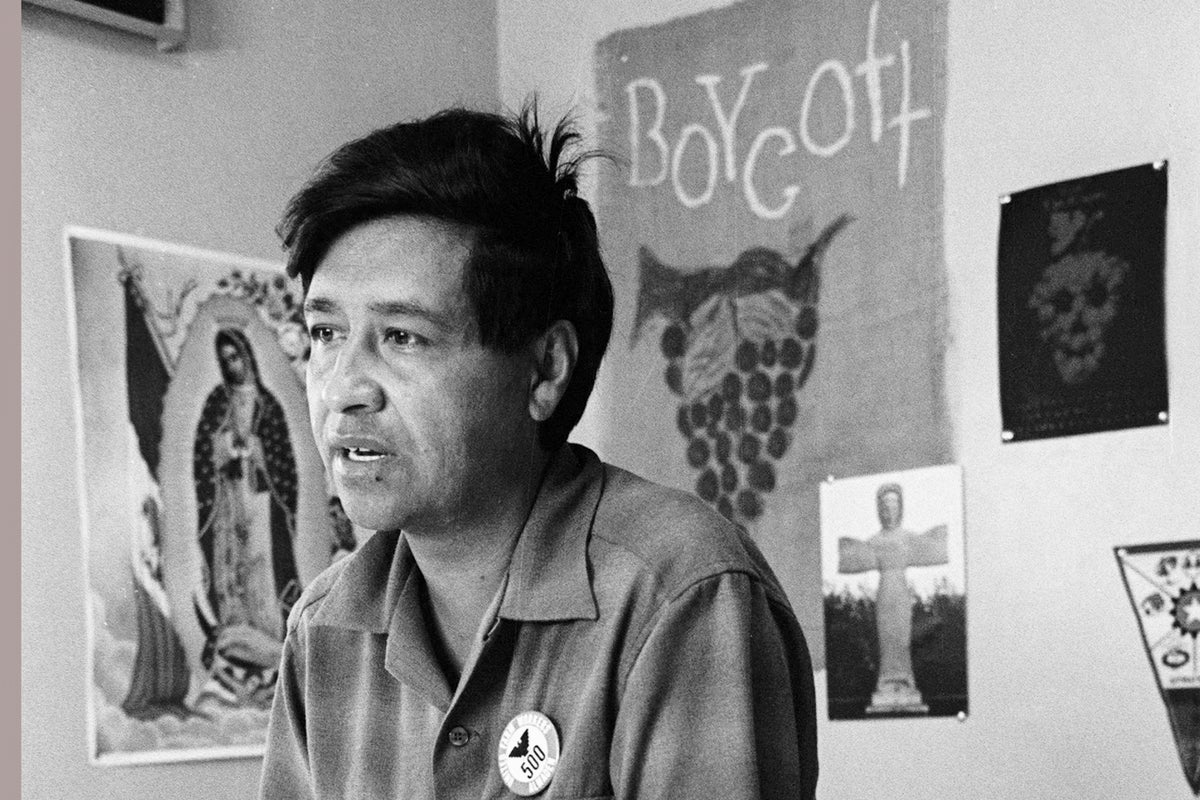
The mural on the corner of 24th Street in San Francisco has always felt like a prayer. It depicts a man with weathered skin, eyes that seem to hold the collective exhaustion of a thousand grape pickers, and a simple black eagle soaring behind him. For decades, that face—Cesar Chavez—was more than a portrait. It was a moral compass.
When you grow up in a community where his name is whispered with the same reverence as a saint, you don’t just learn history. You inherit a debt. You are told that this man took the weight of the sun-scorched fields and turned it into dignity.
But icons are made of stone, and stone eventually cracks.
In the early spring of 2024, the air didn’t carry the usual scent of celebration. Typically, this is the season when banners go up and school children practice speeches about non-violence and the power of the huelga. Instead, a heavy, suffocating silence took hold. From Los Angeles to the Central Valley, the calendars began to clear. Events were scrubbed. Keynote speakers stepped back into the shadows.
The reason wasn't a lack of funding or a shift in political interest. It was a ghost. Or rather, the voices of people who were no longer willing to let a ghost rest on a lie.
The Weight of the Unspoken
The allegations didn't emerge as a single, explosive roar. They arrived as a series of tremors. Women, some whose families had been the backbone of the United Farm Workers (UFW) for generations, began to speak of a different Cesar Chavez. They spoke of a man who used the staggering power of his reputation to shield behavior that was anything but saintly.
Sexual abuse is a phrase that carries a clinical coldness, but in the context of a labor movement, it feels like treason.
Think of a young organizer in the 1970s. She is working eighteen-hour days, fueled by nothing but coffee and the belief that she is part of a secular miracle. She looks up to the leader of the movement not just as a boss, but as the architect of her people’s future. If that man crosses a line, where does she go? If she speaks, she isn't just accusing a man; she is "betraying" the cause. She is risking the progress of millions for her own "private" pain.
That is the invisible cage. It is a structure built out of loyalty, and it is the most effective silence-maker in human history.
The recent decision by various organizations to cancel Chavez Day celebrations wasn't a move dictated by "cancel culture" in the way pundits often describe it. It was an act of communal grief. It was an acknowledgment that we cannot shout for justice in the streets while whispering excuses for it in the hallway.
When the Hero Becomes the Hurdle
We have a desperate, almost primal need for flawless heroes. We want to believe that the person who can stare down a multibillion-dollar agriculture industry must be inherently good in every facet of their life. We want the greatness of the work to be a reflection of the greatness of the soul.
History, however, is rarely that tidy.
The facts now surfacing involve specific, credible accounts of sexual assault and harassment that were allegedly suppressed for decades. These aren't just rumors whispered in the back of a union hall. They are formal claims that have forced the hands of those who manage the Chavez legacy.
When the Cesar Chavez Foundation or city councils pull the plug on a parade, they are grappling with a terrifying question: Can you celebrate the win if the winner was a predator?
Consider the paradox of the movement itself. The UFW was built on the idea that the "least among us" deserved protection. It was built on the sanctity of the human worker. To find out that the man at the top may have treated women as disposable assets isn't just a disappointment. It is a systemic failure. It suggests that the very power gathered to fight one type of oppression was used to facilitate another.
The Architecture of the Pedestal
Why did it take fifty years?
To understand the delay, you have to understand the stakes of the era. In the 60s and 70s, the farmworkers' movement was fragile. It was under attack from the police, the growers, and the government. In that environment, "unity" becomes a weapon. Anything that threatened that unity was viewed as an existential threat to the survival of the Mexican-American working class.
If a woman complained about Chavez, she wasn't just a victim; she was a liability.
The tragedy is that by protecting the "symbol" of the movement, the movement actually abandoned its most vulnerable members. We see this pattern repeat across history—in religious institutions, in film studios, and in political revolutions. We decide that the "Mission" is more important than the "Individual."
But a mission that requires the sacrifice of a person's bodily autonomy is a mission that has already lost its way.
The New Shape of Justice
The cancellations we are seeing now are a form of architectural demolition. We are taking down the pedestal to see what was actually underneath it.
Some argue that this is an attempt to erase history. They say that Chavez’s work for labor rights stands alone, regardless of his personal failings. They point to the contracts signed, the pesticide bans, and the lunch breaks—real, tangible wins that saved lives. They ask if we should burn the house down just because the builder was a flawed man.
But that argument misses the point of why these events are being canceled.
Celebrating a person is different than studying them. A holiday is a crown. By removing the crown, we aren't saying the work didn't happen. We are saying that the price of that work—the silence of abused women—is a price we are no longer willing to ignore.
The "invisible stakes" here involve the daughters and granddaughters of those original farmworkers. They are looking at their leaders and asking: Who do you see? Do you see the man who marched, or do you see the woman who was cornered in his office?
A Future Built on Truth
There is a particular kind of mourning that happens when a hero falls. It feels like a loss of gravity. If the man who gave us "Si Se Puede" was capable of this, who can we actually trust?
The answer is uncomfortable but necessary: Trust the movement, not the man.
The victories of the UFW didn't belong to Cesar Chavez alone. They belonged to the thousands of people who walked until their boots fell apart. They belonged to the mothers who cooked for the strikers and the lawyers who worked for free. Chavez was the face, but the power was always in the hands of the people.
By stepping away from the cult of personality, we actually reclaim the movement for everyone else.
We are moving into a period of deep, painful recalibration. It means rewriting textbooks. It means changing the names of parks. It means having hard conversations over dinner with grandfathers who still have a framed photo of Cesar next to the Virgin Mary.
It isn’t about being "woke." It is about being honest.
The cancellation of a few banquets and festivals is a small thing in the grand scheme of history. But as a signal, it is massive. It tells survivors that their pain is finally worth more than a legend’s reputation. It tells the world that justice is not a trade-off. You don't get to buy your way out of accountability with a few good deeds, no matter how historic those deeds may be.
The mural on 24th Street isn't going anywhere. It will stay there, sun-faded and iconic. But the way we look at it has changed forever. We no longer see a god. We see a man. And in the space between the myth and the reality, we find the truth of our own responsibility.
We realize that the most important work isn't following a leader. It's building a world where no leader is powerful enough to be above the law of human decency.
The eagle is still soaring, but the wind has changed. It’s colder now. It’s sharper. It’s honest.