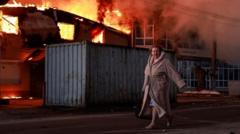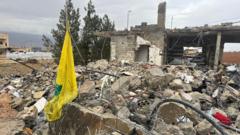
The air in south Lebanon doesn't smell of Mediterranean salt anymore. It smells of pulverized limestone, charred rubber, and the metallic tang of old blood. When a house collapses under the weight of a missile, it doesn't fall like the movies suggest. There is no graceful descent. It is a violent, instantaneous compression of a lifetime’s worth of memories into a single, jagged pile of gray silt.
A teapot sits miraculously unbroken on a slab of kitchen floor that now hangs ten feet in the air. A child’s notebook, its edges singed, flutters in the breeze, resting atop a crater where a living room used to be. These are the leftovers of a Tuesday afternoon strike. The Israeli Defense Forces (IDF) state they are targeting Hezbollah infrastructure, neutralizing "terrorist assets" hidden within civilian neighborhoods. But to the people standing in the dust, those assets had names. They had favorite chairs. They had a way of laughing that their neighbors could recognize through the walls.
War is often described in the sterile language of geometry and logistics. We hear about "buffer zones," "surgical strikes," and "lateral escalations." These words are bandages for the soul, designed to make the unbearable seem manageable. If we talk about a "target," we don't have to talk about the seventy-year-old grandfather who was sitting on his porch when the world turned into fire.
The Weight of the Morning
Consider a family in a village like Aadoussiyeh or the outskirts of Tyre. For months, the sky has been a source of constant, low-frequency anxiety. The hum of drones—the "MK" as locals call them—is the soundtrack of their lives. It is a mechanical hornet that never sleeps, a reminder that someone, somewhere, is watching your backyard through a thermal lens.
When the strike comes, it is faster than sound. The physics of it are brutal. A high-explosive warhead strikes a multi-story building, and the kinetic energy alone is enough to liquify the glass in the windows. Then comes the heat.
The IDF maintains that Hezbollah uses these homes as human shields, storing cruise missiles and rocket launchers in basements and garages. This is the strategic reality of a border war where the frontline is a kitchen table. The military logic is cold and consistent: if a weapon is in a house, the house is no longer a home; it is a legitimate military objective.
But what does "legitimate" mean to a man digging through the rubble with his bare fingernails?
He is not looking for a rocket. He is looking for a yellow sweater. He saw his daughter wearing it three minutes ago. The gap between the geopolitical necessity of a "security zone" and the scream of a father is a chasm that no press release can ever bridge.
The Architecture of Displacement
The road north is a ribbon of desperation. Cars are packed until their axles groan, mattresses strapped to roofs with frayed rope, suitcases bursting at the seams. It is a migration of the dispossessed. This isn't just a move; it's an erasure.
When you leave your home under fire, you don't take your "essentials." You take what you can grab in the sixty seconds after the neighbor’s house vanishes. You take a bag of bread. A folder of property deeds. A cell phone charger. You leave behind the heavy things—the photo albums, the cast-iron pans, the height marks penciled onto the doorframe.
These people are moving toward Beirut or Sidon, cities already buckling under a decade of economic collapse and the lingering trauma of the 2020 port explosion. They are moving from one uncertainty to another. The "invisible stakes" here aren't just the lives lost in the strikes; it's the slow, grinding death of a social fabric. When a village is emptied, a history is paused. The olive groves go untended. The schools remain dark. The local dialect, unique to those specific hills, begins to fade in the anonymity of a crowded refugee shelter.
The Logic of the Sky
Israel’s perspective is anchored in the scars of October 7th and the relentless rain of Hezbollah rockets that followed. From their side of the Blue Line, the northern Galilee has become a ghost town. Tens of thousands of Israelis have been displaced from their own homes, living in hotels for nearly a year, their lives suspended by the threat of anti-tank missiles.
For the IDF, the strikes in Lebanon are an attempt to restore a "deterrence" that felt shattered. They see a landscape where every garage could be a launchpad. In their view, the tragedy of civilian death is a byproduct of Hezbollah’s decision to embed itself within the population. It is a war of proximity.
The math is grim. To stop a rocket from hitting Haifa, a house in South Lebanon is leveled. To ensure a child in Kiryat Shmona can go to school, a child in Nabatieh loses theirs. It is a zero-sum game played with human hearts.
The Silence After the Blast
There is a specific kind of silence that follows a modern airstrike. It isn't the absence of noise—there is the crackle of fires, the distant sirens, the shouting of rescuers. No, this silence is the sudden, violent vacuum of a life that was just there.
A woman stands by a pile of stones that used to be her sister’s house. She isn't crying yet. She is staring at a pair of shoes. They are neatly placed, as if someone just stepped out of them to take a nap. The shoes are perfectly intact, covered in a fine layer of white powder.
This is the "human element" that gets lost in the headlines about "increased tensions." We talk about the Middle East as if it were a chessboard, a series of moves and countermoves by powerful men in air-conditioned rooms. We analyze the range of the missiles and the sophistication of the iron dome.
We rarely analyze the grief.
Grief is not a strategic factor. It doesn't show up on a satellite map. It doesn't have a range of 40 kilometers. But it is the most potent fuel in the world. Every strike that kills a family in Lebanon, regardless of the military justification, plants a seed of resentment that will take decades to harvest. It is a cycle of "security" that creates the very insecurity it seeks to destroy.
The Invisible Borders
The world watches this through a screen, scrolling through images of smoke plumes over green hills. It feels distant. It feels like a "conflict" that has been happening forever and will happen forever. We become numb to the numbers. Five dead. Ten dead. Twenty.
But consider the reality of being "targeted."
It means the grocery store is a gamble. It means the sound of a motorcycle makes your heart jump into your throat because it sounds, just for a split second, like a diving jet. It means the "frontline" is your bedroom window.
The IDF claims they give warnings—leaflets, "roof-knocking," phone calls. Sometimes they do. Sometimes the warning is the explosion itself. In the chaos of south Lebanon, a warning is only useful if you have somewhere to go and a way to get there. For the elderly, the poor, or the disabled, a "warning" is just a countdown to an inevitable end.
The Ghost of the Future
What happens when the smoke clears? The "aftermath" isn't just the day after. It's the decade after.
South Lebanon is a land of beautiful, rugged terrain, of ancient trees and resilient people. But it is being transformed into a graveyard of concrete. The rubble isn't just stone; it's the material evidence of a failed world. A world where we have perfected the technology of destruction but haven't yet mastered the basic human empathy required to stop using it.
As the sun sets over the Mediterranean, the light hits the smoke columns, turning them a bruised purple. The drones continue their vigil. The people in the shelters huddle together, sharing stories of the homes they might never see again.
They don't talk about Hezbollah’s geopolitical standing or Israel’s security doctrine. They talk about the smell of the jasmine in their gardens. They talk about the way the light hit the hills at noon. They talk about the people who were there one second and gone the next, leaving nothing behind but a pair of shoes and a silence so heavy it feels like it might never be broken.
The war moves on. The maps are redrawn. The "targets" are hit. And in the center of it all, a small child picks up a singed notebook from the dust, looking for a page that hasn't been burned.