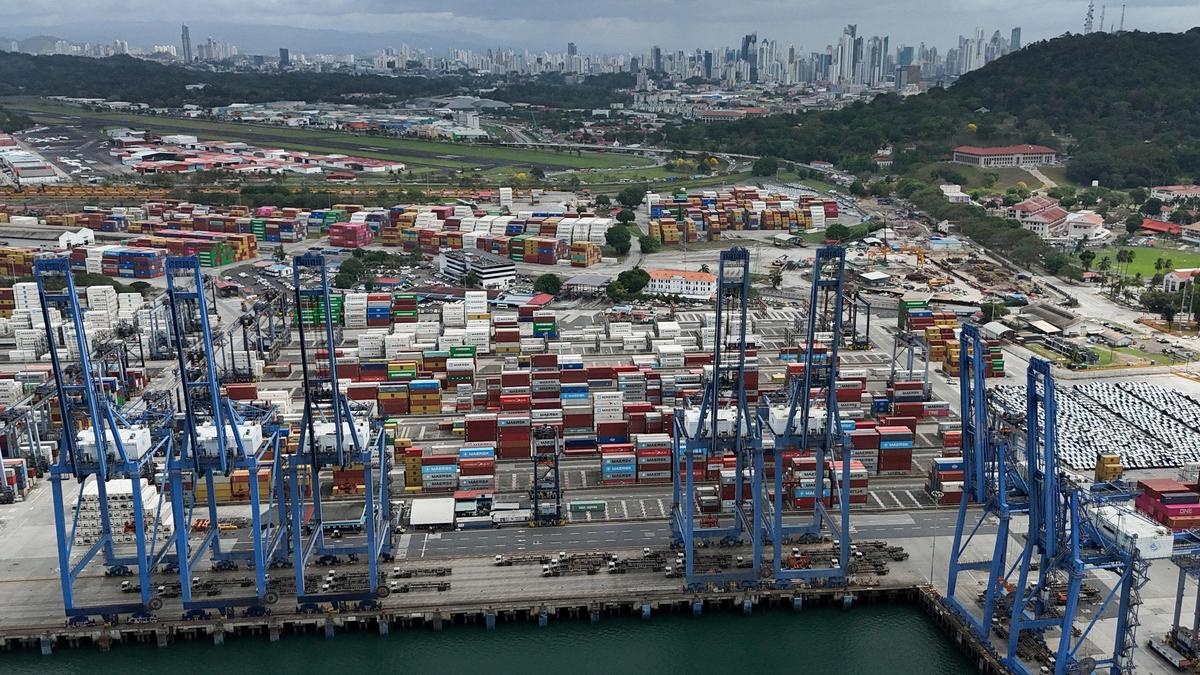
The humidity in Panama City doesn't just sit on your skin; it claims you. It is a thick, salt-heavy weight that carries the scent of diesel and the distant, metallic groan of the world’s commerce passing through a narrow strip of earth. At the Pacific and Atlantic mouths of the Panama Canal, two ports—Balboa and Cristóbal—stand as the massive gatekeepers of this passage. For decades, they were the crown jewels of a global shipping empire. Now, they are the center of a $2.1 billion legal storm that threatens to redefine how nations and corporations shake hands.
Imagine a dockworker named Mateo. He is a hypothetical composite of the thousands who have spent their lives in the shadow of these massive gantry cranes. Mateo remembers when the logo of Hutchison Port Holdings, a subsidiary of the Hong Kong-based CK Hutchison Holdings, represented stability. To him, the "concession" wasn't a dry legal term found in a 1997 contract. It was his mortgage. It was the school uniforms for his children. It was the unspoken agreement that if a company pours billions into the soil of a nation, that nation lets them keep digging.
That agreement shattered. In a move that sent tremors through the international boardrooms of Hong Kong and the marble halls of Panama’s capital, the Panamanian government effectively moved to take back control of these vital hubs. The fallout is not just a line item on a balance sheet. It is a $2.1 billion demand for compensation, filed at the International Centre for Settlement of Investment Disputes (ICSID).
The Handshake That Soured
To understand why a company would sue a sovereign nation for the equivalent of a small country’s GDP, you have to look at the geometry of the Canal. It is a shortcut that saves ships a 5,000-mile journey around the tip of South America. If you control the ports at either end, you control the pulse of global trade.
Hutchison entered Panama in the late nineties, right as the United States was preparing to hand over the Canal. It was a time of immense optimism. The deal was simple: Hutchison would modernize the ports, invest in infrastructure, and operate them for decades. In exchange, Panama would receive a steady stream of revenue and the prestige of hosting a world-class logistics hub.
But trust is a fragile resource. Over the years, the political climate in Panama shifted. Governments changed. National sentiment began to sour on the idea of foreign entities reaping the lion's share of the Canal's bounty. The "takeover" wasn't a sudden military occupation; it was a slow tightening of the regulatory and legal noose. The Panamanian Maritime Authority began questioning the terms of the extension of the contract. They looked at the billions flowing out and the pennies—in their view—staying in.
The Invisible Stakes of Sovereignty
When a government decides to reclaim an asset, it calls it "national interest." When a corporation loses that same asset, it calls it "expropriation."
This is where the human element becomes most poignant. Beyond the lawyers in $3,000 suits, there is the reality of the "sovereign risk." Every time a story like this hits the wires, an invisible wall goes up. Investors who were planning to build bridges, solar farms, or hospitals in developing nations pause. They look at Panama and ask: Is my contract worth the paper it’s printed on?
Consider the sheer scale of $2.1 billion. It is a number so large it becomes abstract. To ground it, consider that this amount could fund Panama’s entire public education budget for a year. Or, from the perspective of the Hong Kong firm, it represents decades of projected earnings, technical expertise, and the literal concrete they poured into the Panamanian mud.
The legal battle hinges on the Fair and Equitable Treatment (FET) standard. This is the bedrock of international investment law. It suggests that a government cannot lure a company in with promises and then change the rules of the game once the money is spent. Panama argues they are simply correcting a lopsided deal that favored a multinational giant over its own citizens.
The Ghost in the Machine
Walking through the Balboa port today, the machinery looks the same. The cranes still lift twenty-ton boxes with the grace of a ballet dancer. The ships still queue up in the Bay of Panama, their lights twinkling like a fallen constellation at night. But the soul of the operation has changed.
There is a palpable tension among the staff. When the boss is a local government authority rather than a global corporation, the priorities shift. Efficiency often takes a backseat to politics. Maintenance schedules that were once rigorous might slip. For the men and women on the ground, the "takeover" feels like a change in the weather—unpredictable and potentially violent.
The dispute is a symptom of a larger, global fever. From mining projects in South America to tech hubs in Southeast Asia, the era of the "uncontested multinational" is ending. Nations are reasserting their boundaries. They are clawing back the rights to their geography.
But geography is a static thing. Trade is fluid. If the ports of Panama become too bogged down in legal warfare, the world will find another way. The "Ghost of the Canal" isn't a spirit; it's the haunting possibility that the most important shortcut on Earth could become a bottleneck of litigation.
The Price of a Broken Promise
Why should a person living in London, New York, or Tokyo care about a port dispute in the tropics? Because the price of your coffee, the availability of your next smartphone, and the cost of the fuel in your car are all tethered to the stability of these nodes.
When a major player like Hutchison is pushed out, it creates a vacuum. Who fills it? Often, it is a state-backed entity from another superpower, or a local firm with more political connections than technical capability. The "human-centric" cost is a world that becomes slightly more expensive, slightly less efficient, and significantly more volatile.
The $2.1 billion figure is a warning shot. It is the sound of a giant hitting the ground. It tells every other country in the region that breaking a contract isn't free. But it also tells every corporation that their footprint is only as deep as the local government allows.
A Horizon Made of Steel and Paper
The sun sets over the Pacific entrance of the Canal, painting the sky in bruises of purple and gold. Mateo finishes his shift. He looks at the rows of containers, stacked high like a child’s building blocks. He knows that somewhere in a climate-controlled room in Washington D.C. or Geneva, people who have never smelled the diesel of Balboa are deciding the fate of his workplace.
They will argue about "bilateral investment treaties" and "discounted cash flow models." They will trade barbs over "regulatory creep" and "public purpose."
But the truth is much simpler. It is about a handshake that didn't hold. It is about the realization that in the high-stakes world of global logistics, the only thing more powerful than a billion-dollar crane is a single signature on a piece of government stationery.
The cranes continue to turn. The ships continue to pass. But the silence between the two sides of the Atlantic and Pacific is growing louder. It is the silence of a partnership that died, leaving behind nothing but a mountain of paperwork and a $2 billion bill that someone, eventually, will have to pay.
The water in the locks rises and falls, indifferent to the names on the contracts. It is the only thing that remains certain in a landscape where even the ground beneath the ports is shifting. The world watches, not for the verdict, but for the precedent. Because if the gates of the Canal are no longer a safe place for a handshake, no harbor in the world truly is.