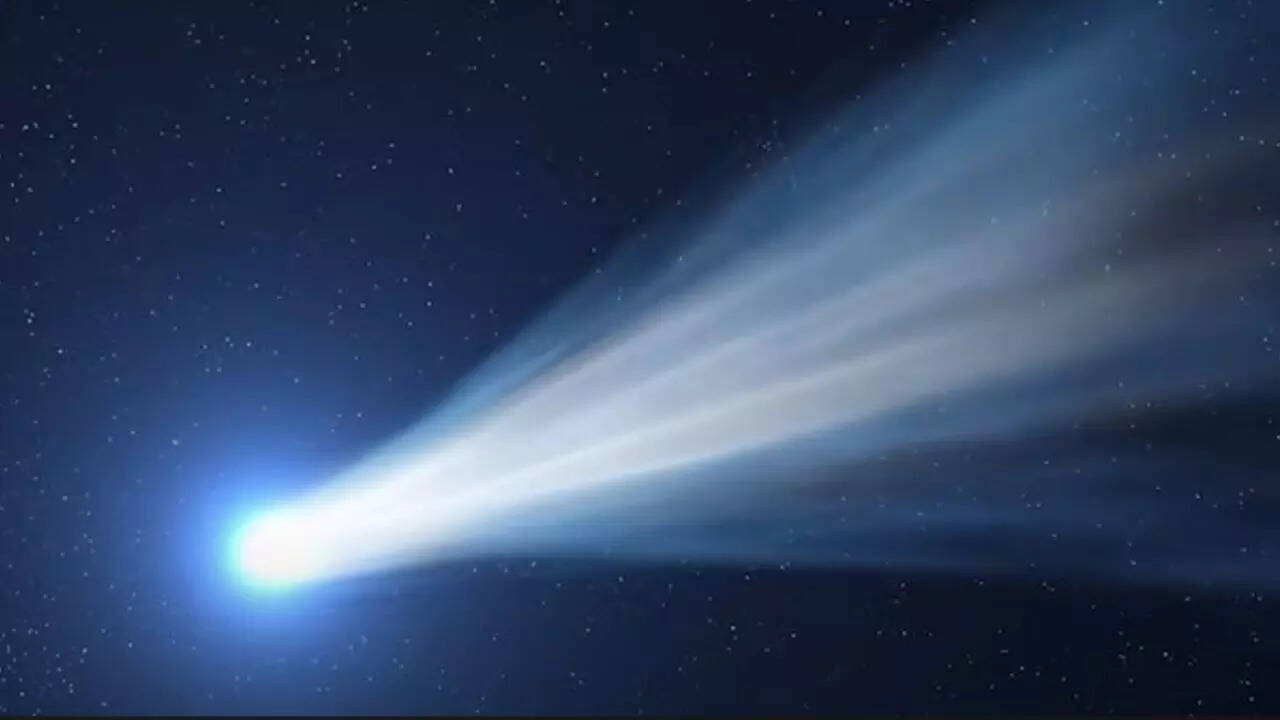
Stop mourning the "death" of Comet C/2025 K1.
The standard media cycle is already in full panic mode, lamenting the loss of a "once-in-a-generation" light show. They want you to feel cheated because a ball of ice and dust didn't survive its solar flyby to become a bright smear in your evening sky. They call it a failure. NASA’s Hubble captures the "explosion," and the public treats it like a failed movie premiere.
They are dead wrong.
From a purely scientific and data-driven perspective, C/2025 K1 breaking apart is significantly more valuable than if it had remained a boring, frozen lump of primordial leftovers. We don't learn anything new from a comet that stays intact. We’ve seen those. We’ve mapped those. But a comet that undergoes spontaneous fragmentation? That is a laboratory experiment conducted by the universe, and we just got front-row seats.
The Myth of the Pristine Comet
The "lazy consensus" in astronomy reporting is that an intact comet is a "success" and a fragmented one is a "disappointment." This stems from a fundamental misunderstanding of what these objects actually are.
Comets are not solid rocks. They aren't even "dirty snowballs," a term Fred Whipple coined in 1950 that has been lazily repeated for decades despite our evolving understanding. They are "icy dirtballs"—loosely bound aggregates of dust, frozen gases, and organic molecules held together by the weakest gravitational forces imaginable.
When a comet like C/2025 K1 approaches the Sun, the thermal stress is immense. If it stays whole, we only see the "skin"—the crust that has been processed by billions of years of cosmic radiation. We learn nothing about the interior. When it fragments, the comet essentially performs a self-autopsy. It exposes 4.5-billion-year-old materials that have been locked in a deep-freeze since the solar system was a swirling disk of gas.
Why Hubble’s "Explosion" Photos Are Better Than a Light Show
The headlines use words like "explosion" to bait clicks, but what Hubble actually captured is a structural failure. It’s a messy, chaotic, and beautiful data dump.
1. Internal Composition Reveal
By analyzing the light reflected from the newly exposed fragments, astronomers can use spectroscopy to identify the exact ratio of volatile ices like carbon monoxide ($CO$) and methane ($CH_4$) versus water ice ($H_2O$). You cannot do this with an intact comet because the surface is often covered in a dark, carbonaceous mantle. Fragmentation is the only way to verify if our models of the early solar nebula are actually correct.
2. Rotational Dynamics
Why did it break? Usually, it's not just heat; it's spin. As the comet outgasses, it acts like a sprinkler head. The "jet" of gas can increase the comet's rotation until the centrifugal force overcomes its negligible gravity. Observing the trajectory of the fragments allows us to calculate the internal strength of the nucleus.
3. Surface-to-Volume Ratios
The sudden increase in surface area means a massive spike in sublimated gas. This creates a temporary, localized atmosphere that is dense enough for us to detect rare isotopes. If C/2025 K1 had stayed in one piece, that data would have remained buried under meters of dust.
The Boredom of the Great Comets
Think back to Comet ISON in 2013 or Comet Kohoutek in the 70s. The public was promised a spectacle, the comet fizzled or broke, and the collective groan could be heard across the hemisphere. But for the teams at the Jet Propulsion Laboratory (JPL) and the European Space Agency (ESA), these "fizzles" provided the most intense data points of the decade.
We are currently obsessed with the visual. If we can't take a selfie with it, we think it’s broken. But in the realm of high-stakes astrophysics, the visual is the least interesting part. We have enough pictures of bright streaks in the sky. What we lack is a clear understanding of the "glue" that holds these objects together.
If we ever need to divert a comet or asteroid that is actually on a collision course with Earth—a "Planetary Defense" scenario—knowing the internal tensile strength of these objects is the difference between a successful deflection and a catastrophic mistake. C/2025 K1 is giving us a free lesson in how to take a punch.
People Also Ask: "Did NASA fail to predict the breakup?"
This is a common, flawed question. Predictive models for cometary brightness and structural integrity are notoriously difficult because we are dealing with objects that have the density of a cork. NASA didn't "fail." The comet behaved exactly as a fragile, non-homogeneous body should when subjected to 1000°C temperature swings.
The real question should be: "Why are we still surprised when a giant ice cube melts next to a campfire?"
The Cost of the "Spectacle" Mindset
When we prioritize the "light show" over the science, we dry up funding for the missions that actually matter. We focus on the "Great Comets" and ignore the "Main Belt Comets" or the Centaurs that are arguably more important for understanding the origin of Earth’s water.
I’ve seen mission proposals get buried because they didn't have enough "public engagement potential." That’s a polite way of saying the comet wasn't going to be bright enough for a suburban dad to see with his $100 binoculars.
C/2025 K1 breaking up is the best thing that could have happened for the researchers actually doing the work. It filtered out the casual observers and left the serious scientists with a mountain of fresh, raw data.
A New Framework for Observation
Stop looking for the "Great Comet." Start looking for the "Informative Comet."
If you want to see a bright light, go look at Venus. If you want to see the literal building blocks of your own atoms being ripped apart by a star, look at the Hubble feed of C/2025 K1.
The destruction of the comet isn't the end of the story. It’s the opening of the vault. Every fragment flying off into the void is a time capsule that just got cracked open. You aren't watching a tragedy; you’re watching the most expensive and revealing demolition derby in the history of the solar system.
Stop complaining that the show was canceled. The real show just started, but you have to be smart enough to read the script.