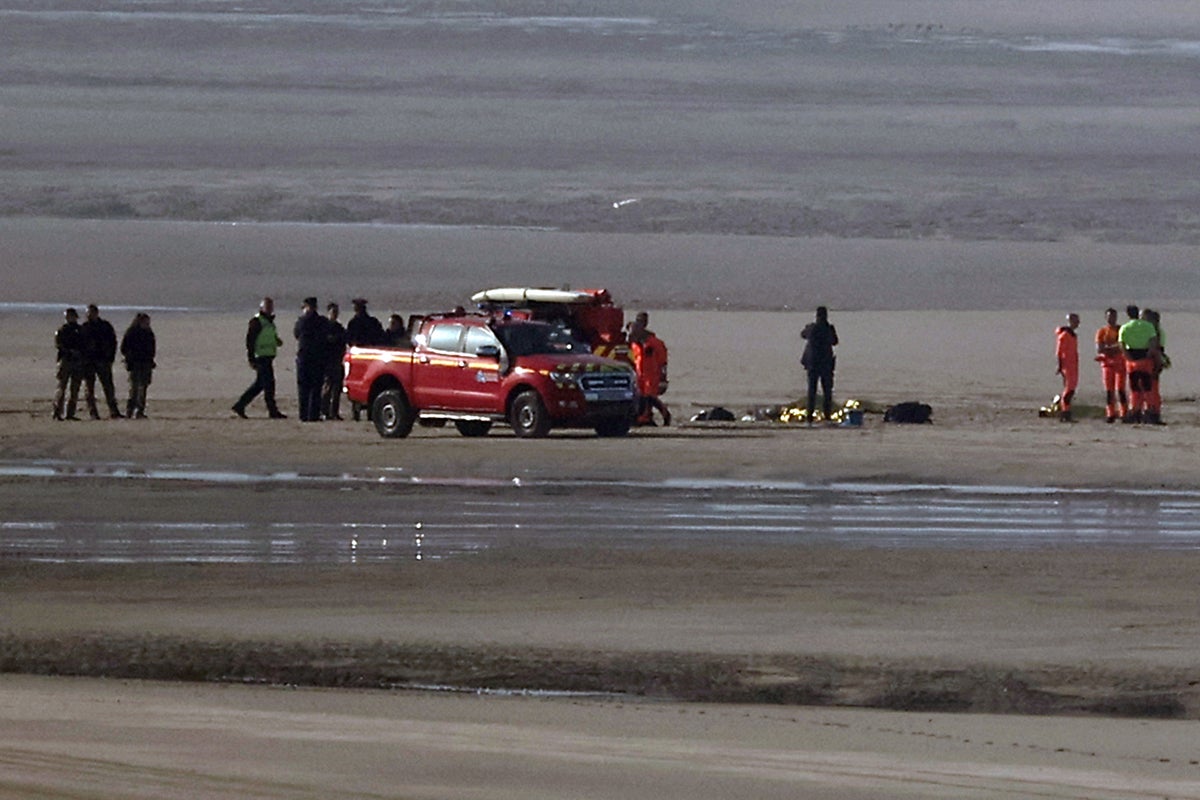
The English Channel is the busiest shipping lane on earth. It is a 20-mile stretch of water that has become a theater of the absurd where national sovereignty goes to die. Four more souls lost. The standard media script is already running on a loop: politicians trading barbs, NGOs crying for "safe routes," and the public caught in a cycle of performative outrage.
Everyone is arguing about who should have intercepted the boat. They are asking the wrong question. The real question is why we have built a system where the boat is the only logical choice for the migrant and the only political lever for the state. In similar updates, take a look at: Why Performance Politics Fails British Jews and Fuels the Very Fire It Claims to Quench.
Stop looking at these deaths as a failure of cooperation between London and Paris. They are the inevitable outcome of a border logic that values the optics of "deterrence" over the mechanics of reality. If you want to understand why people keep dying, you have to stop listening to the slogans and start looking at the incentives.
The Myth of the Interception Gap
The "row" between the UK and France over who should pull people out of the water is a convenient distraction. It allows both governments to pretend that the problem is operational. If only the French used more drones. If only the UK Border Force had better thermal imaging. TIME has analyzed this fascinating topic in great detail.
This is nonsense.
The French won't intercept boats unless they are in active distress because doing so effectively turns the French Navy into a free ferry service to British waters. Under maritime law, once you rescue someone, you take them to the nearest "safe port." The French argue that if the boat is still moving toward England, the migrants don't want to go back to France. Forcing them back creates a violent flashpoint on the high seas that no gendarme wants to manage.
On the flip side, the UK wants the French to stop them on the beaches. But France has thousands of miles of coastline. You cannot police every sand dune without turning northern France into a militarized zone, which the locals—and the French budget—will not tolerate.
What we are witnessing is not a "lack of coordination." It is a cold, calculated stalemate. Both sides are using the physical danger of the Channel as a component of their immigration policy. The danger is the point. If the crossing were safe, the political cost would be infinite. By keeping it deadly, the state maintains a veneer of "toughness" while the actual numbers continue to rise.
The Safe Routes Delusion
The battle cry from the humanitarian left is always the same: "Provide safe and legal routes."
It sounds compassionate. In practice, it is a mathematical impossibility that none of its proponents will honestly address. There is no such thing as a "safe route" that doesn't involve an uncapped visa scheme.
If the UK opens a processing center in northern France, how many people will show up? Thousands? Tens of thousands? Hundreds of thousands? And when 80% are inevitably rejected because they don't meet the specific criteria of the Refugee Convention, what do you think they will do? They won't go home. They will buy a seat on a dinghy.
The "safe route" doesn't replace the "small boat." It merely creates a two-tier system where the most vulnerable wait in a line that never moves, while the most desperate (or the most resourceful) still pay the smugglers to jump the queue. You cannot "out-legalize" a demand for entry that exceeds your political capacity to accept.
The Smuggler is a Service Provider
We love to demonize the smugglers. We call them "evil" and "bloodthirsty." They are. But they are also rational economic actors. They are filling a market gap created entirely by state policy.
When you make it impossible to fly to the UK without a visa, and you make it impossible to get a visa without being in the UK, you create a monopoly for the black market. The smugglers aren't "tricking" people into these boats. The people on those boats know exactly how dangerous it is. They have smartphones. They see the news. They see the reports of the four dead this week.
They get on the boat because the "illegal" path is the only path with a non-zero chance of success.
Governments claim they want to "smash the gangs." You cannot smash a gang that provides a service for which there is infinite demand and zero legal competition. You can arrest every kingpin in Dunkirk today; by tomorrow morning, three more will have risen to take their place because the price of a seat just went up. Risk equals profit. Every time the UK adds a new "deterrent," the smugglers just hike their fees.
The Sovereignty Theater
The UK government talks about "taking back control" of our borders. This is a profound misunderstanding of what a border is in the 21st century.
A border is not a wall. It is a data point.
The obsession with the physical act of crossing the water is a relic of 19th-century thinking. We spend billions on buoys, drones, and "pushback" tactics that are legally dubious and practically useless. Meanwhile, the real border—the one that actually determines who stays and who goes—is the asylum processing system.
And that system is broken beyond recognition.
The backlog is the real pull factor. If you make it to British soil, you are effectively in the UK for the next three to five years while your claim winds its way through a sclerotic bureaucracy. During that time, you disappear into the informal economy or you build a life that becomes a human rights argument against your removal.
The tragedy in the Channel is the "front-end" noise of a "back-end" collapse. Politicians focus on the boats because it’s easy to film a boat. It’s hard to film a dysfunctional Home Office department or a lack of judicial resources. The boat is the perfect scapegoat. It allows the government to blame the French, the smugglers, and the "activist lawyers" all in one breath.
The Cost of the Moral High Ground
We have to admit something uncomfortable: the current "halfway house" policy is the worst of all worlds.
We don't have the stomach to be truly "tough"—which would involve the immediate, forceful return of every boat to the French coast, regardless of the diplomatic or humanitarian fallout. And we don't have the capacity to be truly "open"—which would involve accepting anyone who wants to come.
Instead, we have chosen a path of managed lethality.
We allow the boats to come, we rescue most of them, and we let a few sink every month to maintain the "deterrent" narrative. It is a gruesome compromise that satisfies no one and kills the most desperate.
If we were serious about stopping the deaths, we would stop obsessing over the water. We would move the border. Not to the middle of the Channel, but to the point of origin. This would mean massive, uncomfortable investment in regional processing centers in North Africa and the Middle East, coupled with a genuine, enforced agreement with the EU that says: "We take X thousand people legally, and in return, any boat found in the Channel is returned to its point of departure immediately."
But that requires political capital that doesn't exist. It requires admitting that "Stop the Boats" is a slogan, not a strategy. It requires acknowledging that France is not our enemy, but a partner in a tragedy we both helped author.
The Reality of the "Unskilled" Argument
We often hear that those on the boats are "illegal economic migrants" posing as refugees. This distinction is increasingly meaningless. In a world of climate instability and collapsing states, the line between "fleeing for your life" and "seeking a life worth living" has evaporated.
The UK economy is addicted to cheap labor. We have a massive labor shortage in social care, agriculture, and hospitality. Yet, we spend billions to keep out the very people who are desperate enough to work those jobs. We treat migration as a threat to be managed rather than a market to be regulated.
Imagine a scenario where we issued "Channel Visas"—temporary work permits for those willing to brave the crossing, contingent on a security check and a job offer. The smuggling industry would vanish overnight. The deaths would stop. The "uncontrolled" border would suddenly be under the most effective control possible: the tax man.
But we won't do that. Because the spectacle of the "illegal" migrant is too valuable to the political class. It is the perfect evergreen crisis. It provides a constant stream of "them" to protect "us" from.
The four people who died this week didn't die because of a "row" between nations. They died because they were the collateral damage of a political system that prefers a deadly status quo to an uncomfortable truth.
The boats will keep coming. The water will keep taking its toll. And the politicians will keep arguing about who should have picked up the pieces, because picking up the pieces is much easier than admitting the vessel was designed to sink.