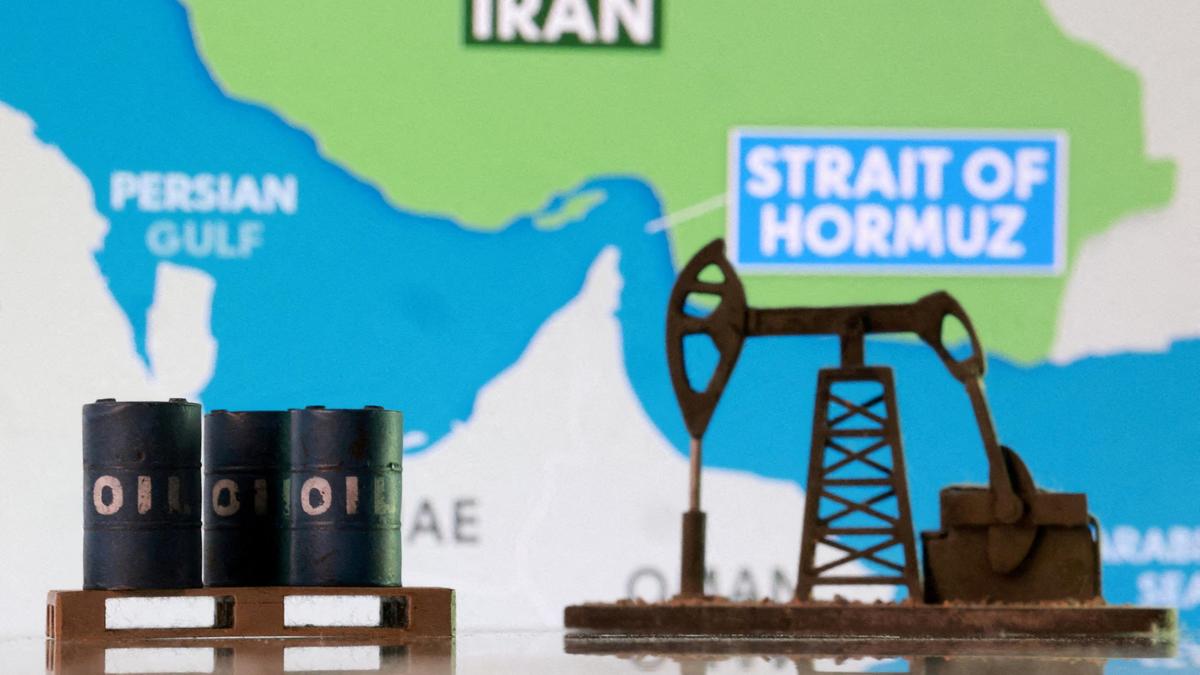
Energy markets are currently trapped in a cycle of violent, reactive pricing driven by a singular fear. That fear is the total disruption of the Strait of Hormuz. As the conflict between Israel, its neighbors, and Iran shifts from a shadow war into a direct, kinetic confrontation, oil prices have begun to bake in a "war premium" that assumes the worst-case scenario is inevitable. However, the raw data suggests that the surge in crude isn't just about the physical flow of oil. It is about the systemic collapse of the world’s spare capacity buffer and a desperate hedge against a geopolitical miscalculation that neither side actually wants to trigger.
The math of the global oil trade is unforgiving. Roughly 21 million barrels of oil pass through the Strait of Hormuz every single day. That represents about 21% of global petroleum liquid consumption. In a world where the margin between "well-supplied" and "crisis" is often less than two million barrels, the math of a regional blowup suggests a price floor that hasn't been seen in decades. Yet, for all the headlines about missiles and drones, the physical supply of oil has not actually dropped. We are seeing a price rally built entirely on the anticipation of a catastrophe, a phenomenon that veteran floor traders call "buying the bullet."
The Fragile Geometry of the Middle East Escalation
The current spike in oil prices is not a fluke of seasonal demand. It is the direct result of a fundamental shift in how Israel and Iran engage with one another. For years, the two nations traded blows through proxies or in the "gray zone" of cyber warfare and maritime harassment. That era is over. When long-range ballistic missiles begin flying between sovereign territories, the risk profile for every oil terminal from Ras Tanura to Kharg Island changes overnight.
Investors are no longer looking at the conflict as a localized border skirmish. They are looking at the vulnerability of the "Energy Triangle." If Israel targets Iranian refining infrastructure, Iran has a limited set of retaliatory options. The most potent of those is the disruption of the flow of energy from its neighbors—Saudi Arabia, the UAE, and Kuwait. This creates a bizarre paradox where the oil markets are rooting for a stalemate. Any decisive move by either side threatens to break the logistical chain that keeps the global economy functioning.
The Myth of the Strategic Petroleum Reserve
One of the most dangerous misconceptions currently circulating in Western capitals is that the Strategic Petroleum Reserve (SPR) can act as a permanent shield against a Middle Eastern supply shock. It cannot. The SPR was designed as a bridge, a temporary fix to allow the market to find new equilibrium during a short-term outage.
After significant drawdowns over the last two years, the buffer is thinner than it has been since the early 1980s. If the Strait of Hormuz were to be restricted for more than thirty days, no amount of SPR release could offset the loss of 20 million barrels per day. We are looking at a scenario where the "safety net" is already frayed, leaving the global economy exposed to the whims of tactical commanders in the Persian Gulf.
Why the US Shale Patch Isn't Coming to the Rescue
A common argument from domestic energy bulls is that higher prices will simply trigger a massive wave of new drilling in the Permian Basin. This ignores the reality of modern corporate finance. The era of "drill at any cost" ended in 2020. Today, shale producers are beholden to shareholders who demand dividends and debt repayment over aggressive production growth.
Even if every rig in Texas started turning tomorrow, it takes months to bring that production online. There is no "instant on" switch for global energy. Furthermore, the specialized labor and equipment required to scale up production are currently squeezed by inflation and supply chain bottlenecks. The cavalry is not coming, at least not in time to prevent a price shock if the Iranian conflict goes vertical.
The China Factor and the Demand Floor
While the world watches the missiles, the real pressure on oil prices might be coming from the East. China has been quietly stockpiling crude for months, taking advantage of lower price windows to fill its own strategic reserves. This creates a massive demand floor. Even as the global economy slows, the world’s largest importer is essentially telling the market that it will buy any dip.
When you combine a firm demand floor from Asia with a rising geopolitical risk ceiling in the Middle East, you get a market that is primed for a breakout. The volatility we see today is just the beginning. Traders are now pricing in the possibility that Iran could use its "oil weapon" not by choice, but by necessity. If the Iranian regime feels its survival is at stake, the economic cost to the West becomes a secondary concern.
The Intelligence Gap in Oil Forecasting
Most analysts focus on the "known unknowns"—the number of barrels, the range of missiles, and the public statements of politicians. The "unknown unknowns" are far more terrifying. We do not know the true state of the internal power struggle in Tehran, nor do we fully understand the limits of Israel’s patience regarding Iranian nuclear progress.
What we do know is that the insurance industry is already moving. Shipping rates for tankers entering the Gulf are skyrocketing. Insurance premiums for "war risk" are being rewritten daily. This is a hidden tax on every barrel of oil that comes out of the region, and it is passed directly to the consumer at the pump. Even if a single shot is never fired at a tanker, the cost of moving that oil has already risen, creating a structural increase in price that won't easily dissipate.
The Specter of 1973
History doesn't repeat, but it certainly rhymes. The 1973 oil embargo changed the geopolitical map forever. Today, the players are different, but the dependency is the same. The West has spent decades talking about "energy independence" while remaining tethered to the most volatile geography on earth.
The current conflict is a stark reminder that the global economy is a giant machine with a single, massive point of failure. If the U.S.-Israeli conflict with Iran continues to expand, we aren't just looking at $100 oil. We are looking at a fundamental reordering of how energy is priced, insured, and defended. The "supply risk" isn't a line item on a spreadsheet anymore; it is the central reality of the 21st-century economy.
The Logistics of a Blockade
If Iran moves to close the Strait, it won't be with a traditional naval blockade. They don't have the fleet for it. Instead, they will use asymmetric means: sea mines, "suicide" drone swarms, and shore-based anti-ship missiles. This makes the threat incredibly difficult to neutralize. The U.S. Navy's Fifth Fleet is the most powerful maritime force in the region, but clearing a field of thousands of sophisticated sea mines while under fire from the coast is a task that takes weeks, if not months.
During that window, the world loses a fifth of its oil supply. The panic that would ensue in the paper markets—where oil is traded as a financial instrument—would likely dwarf the actual physical shortage. We saw this during the initial stages of the Ukraine war; the fear of the loss is often more powerful than the loss itself.
The Role of Spare Capacity
The only entity capable of truly stabilizing the market is Saudi Arabia. They hold the world's only significant "spare capacity"—barrels that can be brought to market within 30 days. However, the Saudis have their own strategic objectives. They are currently leading the OPEC+ effort to keep prices high enough to fund their massive domestic diversification projects. Relying on Riyadh to "save" the West from high prices is a gamble that ignores the Kingdom's shift toward a more independent, "Saudi First" foreign policy.
Assessing the Financial Fallout
The impact of a sustained $120+ oil price would be catastrophic for global inflation targets. Central banks have been struggling to bring inflation back to the 2% mark. A massive energy shock would undo years of interest rate hikes in a matter of weeks. It would force a "stagflation" scenario—stagnant growth combined with high inflation—that most modern portfolios are not equipped to handle.
This is why the current tension is more than just a regional conflict. It is a systemic risk to the global financial order. The bond markets are already showing signs of stress, and the dollar’s strength is being tested by the shift in commodity flows. If you aren't watching the crude charts, you aren't watching the real heartbeat of the crisis.
The escalation between Israel and Iran has moved past the point of "saber-rattling." We are now in a phase of strategic positioning where every move is calculated to inflict maximum economic pain on the opponent's supporters. For the oil market, this means the "war premium" is no longer a temporary spike; it is the new baseline. Traders who are waiting for a return to the "normal" price levels of the last decade are ignoring the fact that the geopolitical foundation of that era has crumbled.
Check the freight forwarding rates for VLCCs (Very Large Crude Carriers) in the Persian Gulf this afternoon.